
Leopard Gecko Heating & Thermostat Guide
Master leopard gecko heating with the right temps, UTH setup, and thermostat. Your gecko's health depends on it — get the full setup guide here.

✓Recommended Gear
In this guide, we cover everything you need to know and recommend 6 essential products. Check prices and availability below.
TL;DR: Leopard geckos require a belly-heat source (under-tank heater or heat mat) covering one-third of the enclosure floor, maintaining a warm-side surface temperature of 88–92°F (31–33°C) and a cool-side ambient of 75°F (24°C). Always connect heat mats to a thermostat — unregulated mats regularly overheat to 105°F+ and cause thermal burns. A digital infrared thermometer gun is essential for accurately measuring surface temperatures, as stick-on dial thermometers are notoriously inaccurate.
Your leopard gecko is barely moving, refusing food, and spending all day buried in the cool hide. Sound familiar? Nine times out of ten, the culprit is wrong temperature — and the fix is simpler than you think.
Leopard geckos are ectotherms. They cannot generate their own body heat. Every feeding, digestion, immune response, and behavior is governed by the temperature of their environment. Get heating right, and you have a thriving, active gecko. Get it wrong, and you have a sick one.
This guide covers everything: target temperatures, heating equipment, thermostat selection, and the common mistakes that quietly harm geckos every day.
Temperature Targets for Leopard Geckos
Leopard geckos come from the rocky highlands of Afghanistan and Pakistan, where daytime ground surface temperatures regularly hit 90°F or higher and nights drop dramatically. Your enclosure needs to replicate this gradient.
| Zone | Target Range | Notes |
|---|---|---|
| Warm Side (UTH zone) | 88–93°F (sweet spot: 90°F) | Belly heat for digestion |
| Basking Spot (overhead heat) | 90–95°F | Surface temp, not air |
| Cool Side | 75–85°F | Retreat and thermoregulation |
| Nighttime (all zones) | 60–72°F | Natural drop; never below 60°F |
The gradient is not optional. Without a cooler zone, your gecko cannot self-regulate its body temperature. It will overheat or chronically stress — both are dangerous.
Pro Tip: Measure the floor surface inside the warm hide, not the ambient air. That is where your gecko's belly sits, and that is the temperature that matters most.
Leopard Gecko Temperature Zones
Target ranges for each enclosure zone
Warm Side (UTH)
88–93°F
Sweet spot: 90°F
Basking Spot
90–95°F
Surface temp, not air
Cool Side
75–85°F
Retreat zone
Nighttime
60–72°F
Never below 60°F
Why Belly Heat Matters
Most reptiles bask under overhead light. Leopard geckos are different — they are crepuscular ground dwellers that absorb heat through their bellies from sun-warmed rocks and soil.
They primarily absorb infrared C (IR-C) radiation through their ventral surface. This belly heat directly drives digestive enzyme activity. A warm gut means food gets processed efficiently. A cold gut means food sits, ferments, and causes impaction or regurgitation.
This is why an under-tank heater (UTH) is the foundation of leopard gecko heating — not a basking bulb, not a heat rock, not a light. The UTH mimics the warm ground of their natural habitat and delivers exactly the IR-C wavelength their belly absorbs. Everything else is supplemental.
Heating Methods Compared
Not all heat sources are equal. The type of infrared radiation emitted determines how useful a heater actually is for a leopard gecko.
| Heater | IR Type | Belly Heat? | Best Use | Risk |
|---|---|---|---|---|
| Under Tank Heater (UTH) | IR-C | Yes — primary | Warm side belly heat | Needs thermostat; can exceed 120°F without one |
| Deep Heat Projector (DHP) | IR-A + IR-B | Partial (penetrating) | Premium ambient + belly supplement | Needs dimmer thermostat |
| Halogen Heat Lamp | IR-A + IR-B | No (overhead) | Best basking supplement | Needs dimmer thermostat |
| CHE (Ceramic Heat Emitter) | IR-C | No (air heat) | Ambient air warming | Never produces basking heat alone |
| Heat Rocks | Uncontrolled | Technically yes | NEVER USE | Burns, fires, death |
| Uncontrolled Heat Tape | IR-C | Yes | NEVER USE without thermostat | Fire hazard |
UTH — The Essential Foundation
The Zoo Med ReptiTherm Under Tank Heater is the industry standard starting point. It adheres to the outside bottom of the enclosure and warms the glass floor, which then warms your gecko's belly when it rests in the warm hide above it.
Always connect a UTH to a thermostat. An uncontrolled UTH can drive glass surface temperatures to 120°F+ — hot enough to cause thermal burns through a gecko's thin ventral scales.
Deep Heat Projector — The Premium Upgrade
The Arcadia Deep Heat Projector 50W is the most significant heating innovation in the hobby in the past decade. A 50W DHP outperforms a 100W CHE because it emits IR-A and IR-B radiation that penetrates tissue rather than just warming the surface air.
Paired with a UTH, this combination gives your gecko the most naturalistic thermal environment possible.
Halogen Bulb — Best Overhead Option
If you want an overhead basking component, halogen is the correct choice. The Arcadia Halogen Heat Lamp 75W emits IR-A and IR-B like natural sunlight. For a full breakdown on halogen lighting for leopard geckos, see our halogen light guide.
DANGER: Heat Rocks Kill Geckos
Remove any heat rock from your enclosure immediately. This is not a preference — it is a safety emergency.
Heat rocks have resistive heating elements that develop hot spots reaching 150°F+ in localized areas. The gecko cannot detect this danger through temperature-sensing nerve endings on its belly quickly enough. It will rest on the rock, sustain full-thickness thermal burns to its ventral surface, and often die from infection or organ damage before the owner realizes what happened.
No thermostat reliably controls a heat rock's internal hot spots. No brand is safe. There is no acceptable use case for a heat rock in a gecko enclosure.
Pro Tip: If you received a heat rock with a starter kit, throw it away. Replace it with a UTH on a thermostat.
Arcadia Deep Heat Projector 50W
Emits IR-A and IR-B penetrating radiation for naturalistic deep tissue warmth. A 50W DHP outperforms a 100W CHE for genuine thermal benefit.
Check Price on Amazon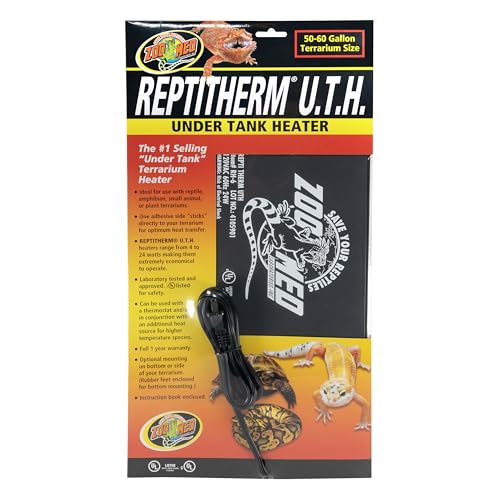
Zoo Med ReptiTherm Under Tank Heater
Industry standard UTH for essential belly heat. Adheres to enclosure bottom and delivers IR-C through the glass floor directly to your gecko's ventral surface.
Check Price on AmazonArcadia Halogen Heat Lamp 75W
Emits IR-A and IR-B like natural sunlight — the correct choice for an overhead basking component that pairs with a UTH or DHP.
Check Price on AmazonUTH vs. Deep Heat Projector
Side-by-side comparison
| Feature | UTH (Under Tank Heater) | Deep Heat Projector |
|---|---|---|
| IR Type | IR-C (surface heat) | IR-A + IR-B (penetrating) |
| Belly Heat | Yes — primary source | Partial — supplement |
| Heat Quality | Surface warming only | Deep tissue penetration |
| Thermostat | On/off or pulse (budget) | Dimmer required |
| Cost | $15–25 | $40–60 |
| Best For | Every setup — foundation | Premium upgrade |
Our Take: Start with a UTH on a thermostat for essential belly heat. Add a DHP later as the premium naturalistic upgrade.
Choosing the Right Thermostat
A thermostat is not optional — it is the difference between a safe enclosure and a death trap. But choosing the wrong thermostat type for your heater wastes money and can damage equipment.
| Thermostat Type | How It Works | Best For | Avoid With |
|---|---|---|---|
| On/Off | Full power on, full off at setpoint | UTH only (acceptable) | Basking bulbs, DHP — shortens filament by 50%+ |
| Pulse Proportional | Rapid on/off pulses; smoother control | UTH, CHE — recommended default | Light-emitting bulbs (visible flicker) |
| Dimmer (PWM) | Reduces voltage proportionally | Halogen bulbs, DHP | CHE, UTH — less effective |
Budget Pick: Inkbird ITC-308
The Inkbird ITC-308 Digital Temperature Controller delivers ±1°F accuracy for around $40. The WiFi version lets you monitor remotely. It is an on/off controller — perfectly suitable for UTH use, and the best value option in the hobby.
Premium Pick: Herpstat 1
The Herpstat 1 Proportional Thermostat is what serious keepers use. Proportional control means near-zero temperature fluctuation, extended heater life, and precise setpoints. Herpstat units run $80–$440 depending on model — worth every dollar if you are running multiple enclosures or a DHP.
Pro Tip: Match thermostat type to heater type. Dimmer for light-emitting heaters (halogen, DHP). Pulse or on/off for non-light heaters (UTH, CHE). Mismatching causes flickering, shortened heater life, or inaccurate temperature control.

Inkbird ITC-308 Digital Temperature Controller
±1°F accuracy at around $40 makes this the best value thermostat in the hobby. WiFi version available for remote monitoring.
Check Price on AmazonHerpstat 1 Proportional Thermostat
Proportional control delivers near-zero temperature fluctuation and extends heater life significantly. The professional standard for serious keepers.
Check Price on AmazonMeasuring Temperatures Correctly
A thermostat probe tells you one spot. An infrared thermometer tells you the whole picture. You need both.
The Zoo Med ReptiTemp Digital Infrared Thermometer is the standard tool for weekly spot checks. Point it at the floor inside the warm hide, the cool side floor, the basking spot, and the thermostat probe location.
Place your thermostat probe on the floor of the warm hide — exactly where your gecko's belly will rest. This is the control point. If the probe is clipped to the enclosure wall or sitting in open air, your readings are meaningless.
Pro Tip: Do a full temperature map when you first set up the enclosure and after any equipment change. Measure five spots: warm hide floor, warm side open floor, center, cool side floor, and cool hide floor.
Night Heating and Winter Care
Leopard geckos experience natural temperature drops in the wild — from 90°F+ daytime to 50s°F at night. This drop is metabolically beneficial. It is not a problem to replicate it in captivity.
Turn off overhead heat at night. If your ambient room temperature stays above 65°F, your UTH alone will maintain adequate nighttime warmth.
If your room drops below 65°F, you need supplemental nighttime heat. A CHE on a separate thermostat set to 68°F works well — it raises ambient air without disrupting the dark cycle. Do not use colored "night" bulbs. Red and blue light disturb sleep and do not provide meaningful heat.
Never let your enclosure drop below 60°F. Below this threshold, leopard geckos enter a dangerous torpor, stop digesting, and can develop respiratory infections.
Brumation Basics
Brumation is a winter slow-down behavior. Pet leopard geckos do not require brumation. It is only necessary if you plan to breed your geckos.
If breeding: cool the enclosure gradually to 50–60°F over 2–4 weeks, maintain that temperature for 6–12 weeks, then warm back up. Never let temperatures drop below 50°F during brumation — this risks fatal respiratory complications.
For non-breeding pets, maintain stable temperatures year-round. Your gecko will be healthier, feed more consistently, and live longer without an artificial brumation cycle.
Common Heating Mistakes
- Using a heat rock. See above. Remove it now.
- Running a UTH without a thermostat. Glass surface will exceed 120°F. Thermal burns are silent and slow.
- Using an on/off thermostat with a basking bulb. Shortens filament life by 50%+. Use a dimmer thermostat instead.
- No temperature gradient. If the enclosure is one uniform temperature, your gecko cannot thermoregulate.
- Keeping nighttime temps above 75°F. Misses the natural metabolic benefit of a temperature drop.
- Thermostat probe in the wrong location. Probe on the wall or in air = false readings. Always probe the floor of the warm hide.
- Assuming the thermostat is correct without verifying. Thermostats fail. Always cross-check with an IR gun weekly.
For more on enclosure selection, see our best leopard gecko terrariums guide and substrate guide.
Key Takeaways
What you need to know
Never use a heat rock — hot spots reach 150°F+ and cause fatal thermal burns
Always connect a UTH to a thermostat — uncontrolled UTH exceeds 120°F on glass
Match thermostat type to heater: dimmer for halogen/DHP, pulse/on-off for UTH/CHE
Place thermostat probe on the warm hide floor — wall or air readings are meaningless
Verify thermostat accuracy weekly with an IR thermometer — they fail silently
Maintain a temperature gradient — uniform heat prevents thermoregulation
Recommended Gear
Arcadia Deep Heat Projector 50W
Emits IR-A and IR-B penetrating radiation for naturalistic deep tissue warmth. A 50W DHP outperforms a 100W CHE for genuine thermal benefit.
Check Price on AmazonZoo Med ReptiTherm Under Tank Heater
Industry standard UTH for essential belly heat. Adheres to enclosure bottom and delivers IR-C through the glass floor directly to your gecko's ventral surface.
Check Price on AmazonInkbird ITC-308 Digital Temperature Controller
±1°F accuracy at around $40 makes this the best value thermostat in the hobby. WiFi version available for remote monitoring.
Check Price on AmazonHerpstat 1 Proportional Thermostat
Proportional control delivers near-zero temperature fluctuation and extends heater life significantly. The professional standard for serious keepers.
Check Price on AmazonArcadia Halogen Heat Lamp 75W
Emits IR-A and IR-B like natural sunlight — the correct choice for an overhead basking component that pairs with a UTH or DHP.
Check Price on Amazon
Zoo Med ReptiTemp Digital Infrared Thermometer
Essential for weekly temperature mapping across all enclosure zones. Point-and-shoot accuracy lets you verify every surface your gecko contacts.
Check Price on AmazonFrequently Asked Questions
No. A UTH is their primary heat source. Leopard geckos are crepuscular ground dwellers that absorb belly heat from warm surfaces, not overhead light. A halogen basking spot is a beneficial supplement but not a requirement. Never replace a UTH with a basking bulb alone.
References & Sources
Related Articles

Leopard Gecko Tank Setup: Enclosure, Heating & Hides for a Ground-Dweller
Leopard geckos need belly heat, not overhead—and a 20-gallon tank is too small for an adult. This setup guide covers floor temps, hide placement, and substrate.

Veiled Chameleon Heating and Lighting Guide: The Three-Light Setup Explained
Veiled chameleons need three separate light sources and a nightly drop to 65°F. Learn how to set up the full lighting stack for your screen cage today.

Blue Tongue Skink Heating Guide: Temperatures, Subspecies & Real Setup Advice
Blue tongue skink heating guide: Indonesian vs Northern BTS temperature differences, Deep Heat Projectors vs halogen bulbs, and 4x2x2 setup walkthrough.