
Green Tree Python Care: The Complete Guide
This guide contains affiliate links. Complete green tree python care covering locality differences, the juvenile color change, perch design, and advanced feeding techniques.

✓Recommended Gear
In this guide, we cover everything you need to know and recommend 7 essential products. Check prices and availability below.
TL;DR: Green tree pythons (Morelia viridis) are advanced-level snakes requiring precise care: a humid enclosure (70–80%) with temperatures of 82–88°F (28–31°C) during the day and no lower than 72°F (22°C) at night, plus horizontal perches at multiple heights. Hatchlings are yellow or red and only transition to green between 6–12 months of age. They are display animals — frequent handling causes chronic stress and feeding refusals, especially in wild-caught individuals.
The green tree python (Morelia viridis) is arguably the most visually stunning python in captivity: a vivid emerald-green adult coiled motionless over a horizontal branch, dorsal white spots gleaming, a snake that looks sculpted from glass. What most new keepers don't know is that the stunning green adult you see in photos started life as a bright yellow or brick-red juvenile — and watching that transformation unfold over 12-18 months is one of the hobby's great experiences.
GTPs are advanced-level snakes. They demand precise humidity, horizontal perching architecture, locality-specific care adjustments, and a keeper willing to accept a snake that will almost certainly bite and should not be handled recreationally. But for the prepared keeper, they are a 20-year relationship with a genuinely spectacular animal.
This guide goes deeper than a standard care sheet — covering locality differences, the science of the color change, and why the diameter of your perch dowels matters more than enclosure square footage.
Quick Facts: Green Tree Python
| Feature | Detail |
|---|---|
| Scientific name | Morelia viridis |
| Adult size | 4–6 ft females; 3–5 ft males |
| Lifespan | 15–20+ years in captivity |
| Activity | Nocturnal; ambush predator |
| Temperament | Defensive; strikes readily; display animal |
| Beginner-friendly? | No — experienced keepers only |
| Origin | New Guinea, Cape York Peninsula (Australia) |
| CITES status | Appendix II (export regulated) |
Quick Facts: Green Tree Python
Scientific name
Morelia viridis
Adult size
4–6 ft females; 3–5 ft males
Lifespan
15–20+ years in captivity
Activity
Nocturnal; ambush predator
Temperament
Defensive; strikes readily; display animal
Beginner-friendly
No — experienced keepers only
Origin
New Guinea, Cape York Peninsula (Australia)
CITES status
Appendix II (export regulated)
Localities: Biak, Aru, and Jayapura
This is the section most care sheets skip — and it matters. GTPs are not a single uniform animal. Wild populations from different island localities have distinct adult colors, adult sizes, and temperament tendencies. Captive-bred specimens are often sold by locality, and knowing the differences helps you choose the right animal.
| Locality | Adult Color | Adult Size | Temperament Notes |
|---|---|---|---|
| Biak | Vivid turquoise-blue-green; often blotched | Largest locality — females up to 6 ft | Most defensive; frequent biters |
| Aru | Deep emerald green; clean white spots | Medium — females 4.5–5.5 ft | Considered most handleable locality |
| Jayapura | Blue-green to teal; variable white markings | Medium-large | Variable; mid-range defensiveness |
| Sorong | Bright green; often yellow-green tones | Medium | Moderate defensiveness |
| Manokwari | Vivid green; high white spot density | Medium | Variable |
Pro Tip: Biak GTPs are the most commonly available and are visually spectacular — but if handleability matters to you at all, seek out Aru locality captive-bred animals. The temperament difference between localities is real and documented among experienced keepers.
CBB (captive-bred and born) is the only ethical choice. Wild-caught GTPs carry heavy parasite loads, almost never adapt to captivity feeding, and their capture depletes wild populations. Never buy wild-caught regardless of price.
Biak vs Aru: Which Locality to Choose?
Side-by-side comparison
| Feature | Biak | Aru |
|---|---|---|
| Adult Color | ★Vivid turquoise-blue-green; often blotched | Deep emerald green; clean white spots |
| Adult Size | Largest locality — females up to 6 ft | Medium — females 4.5–5.5 ft |
| Temperament & Handleability | Most defensive; frequent biters | ★Considered most handleable locality |
| Availability | ★Most commonly available in captive trade | Less common; requires targeted sourcing |
Our Take: Biak for visual spectacle and easy sourcing; Aru if temperament and handleability matter to you.
The Juvenile Color Change
One of the most fascinating biological phenomena in the python world: GTP hatchlings are not green. Depending on locality and genetics, they hatch in one of three colors:
- Yellow (most common — the majority of localities)
- Brick red / orange-red (common in some Biak and Sorong lines)
- White/cream (rare; specific breeding lines)
This ontogenetic (age-related) color change occurs through gradual replacement of yellow pigment (xanthophores) with blue structural coloration (iridophores), which the eye perceives as green. The transition typically:
- Begins: 6–12 months (some juveniles shift earlier)
- Peak transition: 12–18 months — the animal may look blotchy, partial-green, or even temporarily dull during this phase
- Completes: 18–24 months — most reach adult coloration
During the juvenile phase, your care approach changes:
- Juvenile enclosure temperature: 82–85°F ambient (slightly cooler than adult)
- Feeding: Juveniles often require movement to trigger strikes — dangle prey on feeding tongs rather than placing it
- Perch size: Use thinner perches (3/8 to 1/2 inch diameter) — juveniles cannot grip large-diameter adult perches effectively
- Feeding refusal: Yellow-phase juveniles are notoriously fussy. Scenting prey with lizard shed skin or offering anole-sized live prey to trigger the feeding response is an accepted practice among GTP keepers
Pro Tip: Document the color change with weekly photos. The intermediate blotchy phase is often the most photographically interesting — you'll want a visual record. Many keepers sell this photo series as part of their animal's lineage documentation.
Juvenile Color Change Timeline
Color change begins
6–12 monthsHatchlings are bright yellow, brick-red, or white/cream depending on locality and genetics. Gradual replacement of yellow pigment (xanthophores) with blue structural coloration (iridophores) begins.
Tip: Juveniles are notoriously fussy eaters; scent prey with lizard shed skin or offer anole-sized live prey to trigger feeding
Peak transition phase
12–18 monthsAnimal transitions from juvenile color to adult green. May appear blotchy, partial-green, or temporarily dull during this phase. Use thinner perches (3/8 to 1/2 inch) and feed using movement to trigger strikes.
Tip: Document with weekly photos—the blotchy intermediate phase is often the most photogenic. Many keepers sell photo series as lineage documentation
Color change completes
18–24 monthsMost animals reach full adult coloration. Scale up to adult perch diameter (1–2 inches) as the snake's girth increases.
Enclosure Setup
GTPs spend virtually their entire lives on horizontal perches. In the wild, they descend to the ground only to lay eggs or cross between trees. Your enclosure design must reflect this: perches are not an accessory — they are the enclosure.
Sizing
| Age/Size | Minimum Enclosure | Notes |
|---|---|---|
| Hatchlings (under 18 in) | 18" × 18" × 24" H | Smaller space makes prey finding easier |
| Juveniles (18–36 in) | 24" × 18" × 36" H | Add perch heights |
| Adults | 24" × 24" × 48" H or larger | Height > footprint for this species |
For GTPs, vertical space matters more than floor space. A 4 ft tall enclosure with multiple perch levels is far more valuable than a 4 ft long but short enclosure.
Front-opening doors are non-negotiable. Top-opening forces you to reach from above — a threat posture that will trigger defensive strikes every single time. Front access allows lateral, non-threatening approach.
Perch Design — The Detail That Actually Matters
Perch diameter is the most underrated variable in GTP husbandry. In the wild, GTPs choose branches that match their body diameter — this allows the classic "saddle" perch posture where the body loops evenly over the branch with head hanging in the center.
- Juvenile perch diameter: 1/2–3/4 inch (12–19 mm) — matches juvenile body width
- Adult perch diameter: 1–2 inches (25–50 mm) — scale to your animal's girth
- Spacing: Multiple perches at different heights, with 6–8 inch horizontal spacing
- Material: Smooth hardwood dowels, PVC pipe wrapped in cork tape, or natural cork bark rounds
- Stability: Perches must be firmly anchored — a shifting perch causes chronic stress and feeding refusal
Smooth wooden perch dowels or [PVC perch systems designed for GTPs](https://www.amazon.com/dp/B09X6MVN7X?tag=krawlo-20 both work well. Avoid bark-heavy perches with sharp edges — these cause scale damage during shedding.
Pro Tip: Position one perch approximately two-thirds up the enclosure at the warm end. This becomes your snake's primary thermoregulation perch — it will spend most time here. A secondary cool-side perch lower in the enclosure provides an escape from heat.
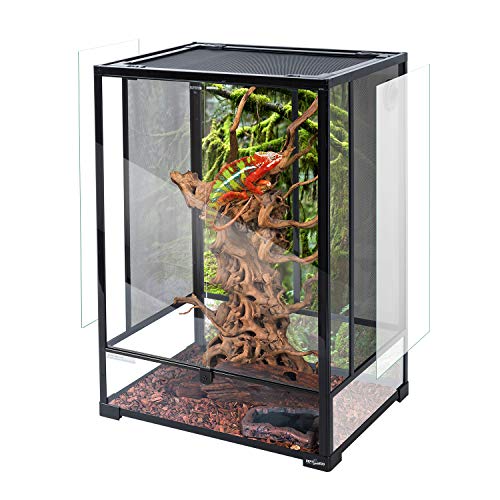
Exo Terra Rainforest Habitat Kit 18x18x36
Tall front-opening glass terrarium sized correctly for a juvenile to subadult GTP — the raised front door and full-height ventilation cover both critical requirements.

Wooden Dowel Rod Perch Set (1 inch hardwood)
Smooth hardwood at 1-inch diameter matches adult GTP body girth for the correct saddle posture — the single most important furniture item in the enclosure.
Temperature Requirements
GTPs are tropical rainforest snakes from sea-level to mid-altitude New Guinea forest. Their thermal requirements reflect this: warm, humid, and stable.
| Zone | Temperature |
|---|---|
| Warm-side perch (primary) | 85–88°F (29–31°C) |
| Ambient mid-enclosure | 80–84°F (27–29°C) |
| Cool-side perch | 76–80°F (24–27°C) |
| Nighttime drop | 72–76°F (22–24°C) |
Critical: Heat must come from above, not below. GTPs never use floor-based heat. Mount a [low-wattage ceramic heat emitter](https://www.amazon.com/dp/B096JWWQMC?tag=krawlo-20 above the warm perch, controlled by a thermostat set to hold the warm perch zone at 86°F.
Use a temperature gun to verify perch surface temperature — digital probe thermometers measure air, not the surface your snake is resting on. A snake resting on a 90°F perch surface all night will develop thermal stress.
Lighting
GTPs are nocturnal and do not require UVB lighting — unlike bearded dragons or uromastyx. Maintain a 12-hour day/night photoperiod with standard LED room lighting or a low-wattage LED terrarium light. UVB is unnecessary and adds heat management complexity.

Ceramic Heat Emitter 100W with Thermostat
Provides ambient overhead heat without visible light — essential for a nocturnal species that needs 24-hour warmth without disrupting day/night cycles.
Inkbird ITC-306A Reptile Thermostat
Accurate on/off thermostat that prevents the warm perch zone from exceeding the 85-88°F target — temperature stability is non-negotiable for GTP health.
Humidity Requirements
Target 70–80% ambient, with 90–95% during misting cycles. GTPs are from tropical rainforest and need consistently high humidity — but also need drying periods between misting. Chronically wet enclosures cause scale rot and respiratory infections.
Humidity Management
- **[Automatic misting system](https://www.amazon.com/dp/B09KX9YFWW?tag=krawlo-20 Timed for early morning and late afternoon — mimic tropical rain patterns. 30-60 seconds per cycle, 2x daily
- Digital hygrometer: Place at mid-enclosure height, not at floor level
- Ventilation: Screen or mesh top with side ventilation panels — stagnant high-humidity air causes respiratory infection even when temperatures are correct
- Drying period: Allow 3–4 hours of humidity drop between misting cycles (ambient may drop to 50–60%) — this prevents constant wetness on perch surfaces
Substrate: The enclosure floor should hold moisture for passive humidity. Use **[coconut fiber substrate](https://www.amazon.com/dp/B001F9COL8?tag=krawlo-20 (coco coir, 2–3 inch depth) or a bioactive tropical soil mix. GTPs rarely contact the substrate, but it acts as a humidity reservoir.
Pro Tip: The perches and enclosure walls — not just the substrate — should be damp after misting but not dripping wet. Perches that stay wet between misting cycles are a scale rot risk. If perches feel perpetually damp, reduce misting duration or increase ventilation.
Exo Terra Monsoon Solo II Misting System
Programmable dual-cycle misting replicates tropical rain patterns — morning and evening cycles maintain 70-80% ambient humidity without keeper intervention.

Zoo Med Coconut Fiber Substrate (Eco Earth)
Coconut coir holds moisture for passive humidity, rarely grows mold, and provides the rainforest floor aesthetic appropriate for GTP bioactive setups.
Feeding
GTPs are obligate carnivores that eat appropriately sized rodents in captivity. In the wild, juveniles take lizards and small birds; adults eat larger prey including small possums. In captivity, frozen-thawed rodents are the standard and are strongly preferred over live prey.
Feeding Schedule
| Life Stage | Prey Size | Frequency |
|---|---|---|
| Hatchling (under 100g) | Pinky / fuzzy mouse | Every 7–10 days |
| Juvenile (100–300g) | Small mouse | Every 10 days |
| Subadult (300–600g) | Medium rat / large mouse | Every 10–14 days |
| Adult (600g+) | Medium rat | Every 14–21 days |
Prey should be no wider than the widest point of the snake's body. GTPs have long, slender builds — many keepers accidentally overfeed by sizing prey to ball python standards.
Feeding Technique
GTPs are aerial ambush predators. They coil on a perch, hang their head down into the strike zone, and wait for prey to pass below. This posture drives feeding behavior — exploit it:
- Offer prey on [feeding tongs](https://www.amazon.com/dp/B0F1JS95WQ?tag=krawlo-20 dangling below perch height
- Warm thawed prey to 100–102°F (body temperature of a live animal) using a heat gun or warm water bath — GTPs have heat-sensitive pit organs and respond strongly to warm prey
- Never place dead prey on the perch floor — GTPs trained to strike downward may become permanently reluctant feeders if prey presentation shifts to floor-level
- Feed at night when the snake is naturally active
- Leave the snake alone for 48 hours post-feeding — disturbing a GTP in the process of digesting causes regurgitation, which is damaging and can trigger extended feeding refusal
Pro Tip: If your GTP is in feeding refusal, check in order: (1) Is it in shed? — refuse food during pre-shed is normal. (2) Is prey temp correct? — use a thermometer gun on the prey, not your hand. (3) Is prey being presented correctly — from above (wrong) or dangled below perch (right)? Most GTP feeding refusals resolve with prey temperature correction and proper tong presentation.
Juvenile Feeding — Special Considerations
Yellow-phase juveniles are notorious problem feeders. If your juvenile is refusing:
- Scenting: Rub prey with a shed gecko or anole skin — the lizard scent triggers the juvenile feeding instinct that pre-dates their adult rodent diet
- Braining: Gently pierce the skull of the frozen-thawed prey to release scent
- Humidity boost: Feed in a separate humid container (deli cup) to focus the snake and reduce stress from enclosure opening
- Paper bag trick: Place the snake and warm prey in a paper bag, close loosely, and leave for 30 minutes — darkness and confined space often trigger feeding in reluctant juveniles
Never go more than 3–4 weeks without a successful feed on a juvenile GTP without consulting a reptile vet — juveniles dehydrate and decline rapidly.
Handling
GTPs are display animals, not handling pets. This is not a limitation of bad breeding — it's the species. The GTP's long, curved teeth evolved to grip birds and lizards; a defensive bite causes deep puncture wounds. Many experienced keepers go entire years without handling their animals except for veterinary needs.
If you want to handle your GTP:
- Never reach from above — this triggers an instinctive predator-avoidance strike. Always approach laterally with an open hand from the side
- Use a snake hook to reposition the animal on a perch before attempting contact
- 15 minutes maximum — GTPs stress quickly outside their enclosure
- Never handle within 48 hours of feeding
- Respect defensive postures: An S-coiled GTP on a perch is preparing to strike. Do not proceed.
For comparison on more handleable snake options, see our ball python care guide or corn snake care guide.
Health and Common Problems
Respiratory Infection (RI)
Cause: Cool ambient temperatures + high humidity = perfect bacterial/viral RI environment. The most common cause of GTP death. Signs: Wheezing, clicking sounds when breathing, mucus at mouth/nostrils, open-mouth breathing, refusing to stay on perch (dropping to floor). Prevention: Maintain 80–84°F ambient; ensure ventilation between misting cycles; never allow overnight temps below 72°F. Action: Vet visit required — RIs require antibiotic treatment; a "wait and see" approach leads to rapid decline.
Scale Rot
Cause: Perches or substrate remaining wet for extended periods. GTPs rest on perches 20+ hours daily — any moisture on a perch surface contacts the ventral scales continuously. Signs: Discolored scales (brown, yellow, or black patches on ventral surface), soft or raised scales. Prevention: Allow drying cycles between misting; inspect perch surfaces daily. Action: Mild cases respond to diluted chlorhexidine cleaning and husbandry correction; severe cases need veterinary intervention.
Feeding Refusal
Already covered above. The most common non-pathological complaint with GTPs. Work through the feeding technique checklist before assuming illness.
Dysecdysis (Retained Shed)
Cause: Low humidity, lack of appropriate rubbing surfaces, or underlying illness. Signs: Dull, gray shed that doesn't come off cleanly; retained eyecaps (spectacles); skin remaining on tail tip. Prevention: Maintain 70–80% humidity; ensure perches have variable textures the snake can rub against; provide a moist hide or elevated humidity period (sustained 90%+ for 24 hours) during shed cycle. Action: 20-minute lukewarm soak and gentle damp cloth assistance for retained shed. Retained eyecaps require vet intervention — never attempt to remove eyecaps manually.
Pro Tip: Add a [reptile fogger](https://www.amazon.com/dp/B07VVNP7F3?tag=krawlo-20 run for 4–6 hours during the pre-shed phase (when your snake's eyes cloud over) — the elevated humidity burst helps ensure a complete shed without disturbing the snake's perch routine.
Enclosure Maintenance
- Spot-clean: Feces and urates as soon as they appear — typically every 7–14 days
- Perch inspection: Weekly — check for wet spots, scale damage, mold
- Full substrate replacement: Every 3–4 months for coco coir; bioactive substrates can last 12+ months with spot-cleaning
- Enclosure disinfection: Quarterly — diluted F10SC or chlorhexidine solution; remove snake to a temporary container during cleaning
- Water: Change water dish daily; GTPs do drink from a water bowl, particularly juveniles post-misting
See our hognose snake care guide for a comparison of a much more handleable advanced beginner snake if you are evaluating the hobby before committing to a GTP.
Recommended Gear
Exo Terra Rainforest Habitat Kit 18x18x36
Tall front-opening glass terrarium sized correctly for a juvenile to subadult GTP — the raised front door and full-height ventilation cover both critical requirements.
Wooden Dowel Rod Perch Set (1 inch hardwood)
Smooth hardwood at 1-inch diameter matches adult GTP body girth for the correct saddle posture — the single most important furniture item in the enclosure.
Exo Terra Monsoon Solo II Misting System
Programmable dual-cycle misting replicates tropical rain patterns — morning and evening cycles maintain 70-80% ambient humidity without keeper intervention.
Ceramic Heat Emitter 100W with Thermostat
Provides ambient overhead heat without visible light — essential for a nocturnal species that needs 24-hour warmth without disrupting day/night cycles.
Inkbird ITC-306A Reptile Thermostat
Accurate on/off thermostat that prevents the warm perch zone from exceeding the 85-88°F target — temperature stability is non-negotiable for GTP health.
Zoo Med Coconut Fiber Substrate (Eco Earth)
Coconut coir holds moisture for passive humidity, rarely grows mold, and provides the rainforest floor aesthetic appropriate for GTP bioactive setups.

Reptile Feeding Tongs (Stainless Steel, 12 inch)
12-inch stainless tongs allow you to dangle prey below perch height safely — essential for triggering the GTP's aerial ambush feeding strike without putting your hands in the strike zone.
Frequently Asked Questions
No. GTPs require precise humidity cycling, specialized feeding technique, and tolerance for a defensive snake that bites readily. Gain at least one year of experience with a ball python or corn snake before acquiring a GTP.
References & Sources
Related Articles

White-Lipped Python Care: The Complete Guide
White-lipped python care explained: rainbow iridescence, high-humidity tropical setup, feeding nippy juveniles, and everything that makes them unlike any other python. Start here.

Emerald Tree Skink Care: Complete Owner's Guide
Emerald tree skink care explained: enclosure, UVB, communal housing, and why Lamprolepis smaragdina is the best tropical arboreal skink for hobbyists. Start here.

Children's Python Care: The Complete Owner's Guide
Children's python care made simple: enclosure, temperatures, feeding, and handling for this 3-foot Australian python. The ideal first snake for small spaces. Start here.