
Emerald Tree Skink Care: Complete Owner's Guide
Emerald tree skink care explained: enclosure, UVB, communal housing, and why Lamprolepis smaragdina is the best tropical arboreal skink for hobbyists. Start here.

✓Recommended Gear
In this guide, we cover everything you need to know and recommend 7 essential products. Check prices and availability below.
TL;DR: Emerald tree skinks (Lamprolepis smaragdina) need a tall 24×18×36 in enclosure, 80-85°F ambient temps, a 90-100°F basking spot, 70-80% humidity, and T5 HO 6-12% UVB. They're insectivore-dominant omnivores requiring daily gut-loaded feeder insects — more demanding than common skinks and best suited for experienced keepers.
You've spotted an emerald tree skink in a photo and immediately understood the appeal: scales so iridescent they look like hammered copper-green foil, a slender arboreal body designed for life in tropical canopies, and an alert, curious demeanor that makes most other skinks look sedentary by comparison. Lamprolepis smaragdina is one of the most visually spectacular lizards available in the hobby — and unlike its reputation might suggest, it's genuinely accessible to keepers with intermediate experience.
Here's the thing most introductory care sheets miss: emerald tree skinks are one of the very few skink species that can successfully be kept in communal groups. A trio or small colony in a tall planted enclosure isn't just possible — it's arguably how they're best displayed. That single fact reshapes their entire setup philosophy.
This guide covers everything you need: enclosure dimensions, UVB requirements, humidity management, the communal housing framework that actually works, feeding, and the most common health problems that arise from husbandry gaps.
What Makes Emerald Tree Skinks Unique
Emerald tree skinks are the arboreal tropical alternative that most keepers overlook. While green anoles are the default recommendation for a vivid vertical terrarium, L. smaragdina offer more size, longer lifespan, bolder temperament, and a color intensity that no North American anole can match.
Adults reach 7-10 inches (18-25 cm) total length, with the tail accounting for roughly 60% of that. The body is slender and laterally compressed — built for gripping branches and moving quickly through vertical space. Both sexes display the signature iridescent green coloration, though males develop brighter copper-gold highlights on the flanks during breeding condition.
With proper care, expect 10-15 years in captivity. Captive-bred juveniles are increasingly available through specialty breeders, and wild-caught animals — though still sold — should be avoided for the same reasons as with any imported reptile: parasite burden, acclimation stress, and ethical collection concerns.
Are Emerald Tree Skinks Good Pets?
Yes — for intermediate keepers. They aren't the right first reptile (the humidity precision and vertical enclosure requirements create a steeper learning curve), but for anyone who's successfully managed a crested gecko or gargoyle gecko, the transition is manageable. The payoff is a lizard that's genuinely active during daylight hours and displays natural foraging behavior that most crepuscular species never show.
Pro Tip: Always source captive-bred emerald tree skinks. Wild-caught imports frequently arrive with flagellate protozoa, nematodes, and mites that require aggressive veterinary treatment. A fecal float within the first 30 days is mandatory regardless of source.
Enclosure Setup
The minimum enclosure for a single adult emerald tree skink is 18" L x 18" W x 36" H (45 x 45 x 90 cm). Height is the critical dimension — these are arboreal lizards that spend the vast majority of their time above 12 inches off the ground. A wide, low enclosure is the wrong shape for this species entirely.
For a communal group of 2-4 individuals, scale up to 24" x 18" x 48" or larger. More floor area reduces territorial friction at lower levels; more height gives the subordinate animals retreat space above the dominant individual's core territory.
Enclosure Type Options
| Type | Suitability | Notes |
|---|---|---|
| Screen enclosure (tall) | Good | Excellent ventilation; struggles to hold humidity in dry climates |
| Glass/PVC with screen top | Excellent | Easier humidity management; front-opening preferred |
| Bioactive planted terrarium | Best | Live plants actively buffer humidity and create natural microhabitats |
Screen enclosures work well in naturally humid environments (Southeast US, Hawaii, coastal regions). In arid climates, a glass enclosure with a partially covered mesh top gives far better humidity control.
Exo Terra 45x45x90cm Glass Terrarium is the go-to choice for this species — the front-opening doors allow maintenance without disturbing arboreal animals overhead, and the raised bottom frame fits a substrate heater if needed.
Decor and Enrichment
Furnish the enclosure vertically. Emerald tree skinks need:
- Cork bark tubes and flats at multiple heights — primary hiding and sleeping sites
- Horizontal and diagonal branches — pothos poles, bamboo, or manzanita work well
- Live or artificial tropical plants — pothos (Epipremnum aureum), bromeliads, and ficus all work; live plants help maintain humidity passively
- Leaf litter on the substrate — bioactive substrate with a leaf litter top layer provides foraging enrichment and retains moisture
Pro Tip: Build the enclosure with the skinks in mind before adding them. Emerald tree skinks are fast and stress-bolt easily when you're rearranging furniture with them inside. Get the layout right once, then leave it stable.
Enclosure Dimensions & Type
Single Adult
18" L × 18" W × 36" H
45 × 45 × 90 cm minimum
Communal Group (2-4)
24" L × 18" W × 48" H+
Height is critical; scale up for more individuals
Best Enclosure Type
Glass/PVC with screen top
Front-opening preferred; bioactive planted = best
Temperature Requirements
Emerald tree skinks are tropical, not cool-climate animals. Their thermoregulation needs differ significantly from popular skinks like the blue tongue skink — they want a warm ambient environment with a moderate basking spot, not extreme desert heat.
| Zone | Temperature |
|---|---|
| Basking surface | 88-95°F (31-35°C) |
| Warm side (air) | 82-88°F (28-31°C) |
| Cool side (air) | 74-80°F (23-27°C) |
| Nighttime | 68-75°F (20-24°C) |
The basking zone should be positioned in the upper third of the enclosure on a horizontal branch or cork bark platform — not at floor level. Emerald tree skinks bask arboreally, not on the ground.
Heating Equipment
- **[Halogen flood bulb 35-50W](https://www.amazon.com/dp/B000YS3H0I?tag=krawlo-20 — directed at the upper basking branch; better color rendering than incandescent and longer life
- **[Inkbird ITC-306A Thermostat](https://www.amazon.com/dp/B01486LZ50?tag=krawlo-20 — plug the basking bulb in to prevent overheating; thermostat to 92°F surface target
- **[Etekcity infrared thermometer](https://www.amazon.com/dp/B0B71HFH9K?tag=krawlo-20 — the only accurate way to measure branch surface temperatures
If nighttime ambient temperatures drop below 65°F (18°C), add a low-wattage ceramic heat emitter on a separate thermostat set to maintain nighttime minimums. No visible light at night.
Temperature Zone Requirements
Basking Surface
88-95°F
31-35°C (upper third of enclosure)
Warm Side (Air)
82-88°F
28-31°C
Cool Side (Air)
74-80°F
23-27°C
Nighttime
68-75°F
20-24°C (add heat emitter if below 65°F)
UVB Requirements
Emerald tree skinks are Ferguson Zone 2 animals — they receive moderate, incidental UV exposure in the wild as partial-shade tropical canopy dwellers. They are not basking heliotherms like collared lizards or uromastyx, but they do benefit meaningfully from UVB supplementation.
Target UVI: 1.0-3.0 in the basking zone. This is achievable with a mid-output T5 HO bulb.
Recommended UVB Setup
| Product | Mounting Distance to Basking Branch | Notes |
|---|---|---|
| Arcadia Forest 6% T5 HO | 10-14" over mesh | Ideal output for Zone 2 |
| Zoo Med T5 HO ReptiSun 5.0 | 10-14" over mesh | Budget alternative, widely available |
Position the UVB tube to run the length of the enclosure at the top, so animals at varying heights encounter a natural UV gradient — higher intensity near the top, lower intensity at mid and lower levels. This mirrors the dappled canopy light structure they experience in the wild.
Replace UVB bulbs every 12 months. Output degrades before the visible light fails.
Pro Tip: Use a Solarmeter 6.5 to verify your UVI at the basking branch before placing the skinks. You're aiming for 1.5-2.5 UVI at the branch surface. Too high and you stress the animals; too low and D3 synthesis is insufficient.
Photoperiod
- Active season (year-round tropical): 12-13 hours light / 11-12 hours dark
- Emerald tree skinks don't brumate — they're equatorial. A stable 12-hour photoperiod year-round is appropriate.
Humidity
This is the parameter that trips up most new keepers. Emerald tree skinks require 60-80% ambient humidity, with brief spikes to 90-100% during misting cycles. They hail from the tropical Indo-Pacific — the Philippines, Palau, and surrounding islands — where humidity is consistently high.
Maintaining Humidity
- Mist the enclosure 1-2x daily — morning and evening, simulating dawn and dusk dew cycles
- Live plants dramatically improve passive humidity retention — a planted enclosure holds 70% more consistently than a barren one
- Deep bioactive substrate (4+ inches of coconut fiber / organic topsoil / leaf litter mix) retains moisture between misting cycles
- Allow humidity to drop to 55-60% at midday — constant 80%+ without dry periods promotes respiratory bacteria
Humidity Equipment
- **[Exo Terra Monsoon RS400 Misting System](https://www.amazon.com/dp/B08KJ4G2XL?tag=krawlo-20 — programmable automated misting; set for 30-second burst morning and evening
- **[Zoo Med Digital Hygrometer](https://www.amazon.com/dp/B06XY3X7P9?tag=krawlo-20 — monitor humidity at mid-enclosure level
Pro Tip: Position a small fan to run on low for 30-60 minutes after morning misting. The brief airflow dries surface moisture and prevents the stagnant-wet conditions that breed Pseudomonas and other respiratory pathogens — the #1 cause of RI in high-humidity skink setups.

Exo Terra Monsoon RS400 Misting System
Automated programmable misting maintains the 60-80% humidity emerald tree skinks require without manual intervention — set for morning and evening 30-second bursts.
Zoo Med Digital Hygrometer and Thermometer
Monitoring both humidity and temperature is non-negotiable for emerald tree skinks — this combo unit gives real-time readings without multiple devices cluttering the enclosure.
Communal Housing: The Full Picture
Emerald tree skinks are one of the few skink species that tolerate and even benefit from communal keeping. In the wild, they are found in loose social groups sharing sun-exposed perches on coastal trees and buildings throughout the Philippine archipelago.
Communal Housing Rules
| Group Configuration | Viability | Notes |
|---|---|---|
| Single animal | Works | Simpler but less behaviorally enriched |
| One male + one female | Good | Breeding likely; monitor female condition |
| One male + 2-3 females | Best | Most naturalistic; female competition is low |
| Two males | Avoid | Persistent stress, fighting, injury |
| All-female group | Works | Lowest conflict; no breeding pressure |
The enclosure must be large enough — crowding is the primary cause of communal failure. In a 24" x 18" x 48" enclosure, a trio (1M:2F) is manageable. For 4+ animals, scale to 36" x 18" x 48" or larger.
Provide more vertical perch sites than animals. Each skink needs a discrete sleeping spot and multiple basking positions. If every animal is piling onto one branch, the enclosure needs more structure.
Monitoring Communal Groups
Check individual body weight monthly. The first sign of communal stress is weight loss in subordinate animals — they may be getting outcompeted at feeding. If one animal is consistently thinner, feed that individual separately in a temporary container until weights equalize.
Pro Tip: Feed using multiple feeding stations at different heights simultaneously. Dominant animals claim the highest feeding position — scatter feeders across levels so subordinates eat without competing.
Substrate
Use a bioactive substrate mix 3-4 inches deep. Emerald tree skinks spend most of their time above the substrate, but the substrate serves two critical functions: humidity retention and a natural surface for occasional ground-level foraging.
Recommended mix:
- 60% organic topsoil (pesticide-free)
- 30% coconut fiber (coir)
- 10% clean sand
Top with live or dried leaf litter (magnolia, oak, sea grape) — this provides microfauna habitat (isopods, springtails) for a self-cleaning bioactive system, and gives the skinks natural substrate to investigate.
Avoid:
- Reptile carpet (retains bacteria, abrades belly scales)
- Calcium sand (wrong humidity retention profile, impaction risk)
- Peat alone (too acidic, inconsistent moisture)
Diet and Feeding
Emerald tree skinks are primarily insectivores with occasional soft fruit and flower acceptance. They do not require vegetable matter the way blue tongue skinks or uromastyx do — insects make up approximately 90% of a well-balanced diet.
Primary Feeders
- Crickets — excellent staple feeder when properly gut-loaded; high protein
- Dubia roaches — best nutritional profile; softer-bodied than crickets, easier to digest
- Black soldier fly larvae (BSFL/Calci-Worms) — excellent calcium-to-phosphorus ratio; use as a calcium supplement alternative
- Fruit flies (Drosophila) — useful for juveniles; too small for adults as a staple
- Small waxworms — treat only; high fat, limit to 2x per month
- Hornworms — high moisture content, good during shedding periods
Occasional Supplements (Fruit)
Small amounts of ripe mango, papaya, or fig — 1-2x per month. These should be offered as enrichment, not dietary staples. Some individuals ignore fruit entirely; don't force it.
Feeding Schedule
| Age | Prey Size | Frequency | Amount |
|---|---|---|---|
| Juvenile (0-4 months) | Small (¼") | Daily | 5-8 insects |
| Subadult (4-10 months) | Medium (½") | Daily | 8-12 insects |
| Adult (10+ months) | Medium-large | Every other day | 8-12 insects |
Feed in the morning after the basking lights come on. Emerald tree skinks are diurnal hunters — offering food in the late evening when they're preparing to sleep results in poor feeding response and uneaten insects stressing the animals overnight.
Prey size rule: no wider than the space between the skink's eyes.
Supplements
| Supplement | Frequency | Notes |
|---|---|---|
| Calcium without D3 | Every feeding (with UVB) | Repashy Supercal NoD or Arcadia CalciumPro Mg |
| Calcium with D3 | 2x per week (no UVB) | Rep-Cal or Zoo Med |
| Multivitamin | 1-2x per week | Repashy Supervite or Arcadia EarthPro-A |
Pro Tip: Gut-load feeder insects for at least 24 hours before feeding. An empty cricket has near-zero nutritional value. Use a quality gut-load diet (collard greens, sweet potato, commercial gut-load formula) to maximize nutrient transfer. The skink's health is only as good as what its feeder insects ate last.
Repashy Supercal NoD Calcium Supplement
Calcium without D3 for keepers providing proper UVB — prevents daily D3 oversupplementation risk while ensuring calcium intake at every feeding.

Dubia Roach Colony (medium mixed)
Best staple feeder for emerald tree skinks — soft-bodied, high protein, low fat, digestible chitin. A self-sustaining colony is more economical than buying crickets weekly.

Arcadia EarthPro-A Multivitamin Supplement
Complete multivitamin formulated for insectivorous reptiles — includes carotenoids and vitamin E that support the iridescent coloration emerald tree skinks are known for.
Water and Hydration
Emerald tree skinks primarily drink water droplets from leaves and surfaces after misting — they rarely use standing water bowls. That said, always provide a shallow water dish on the cool side as a backup, especially during shedding periods when additional hydration helps.
Change standing water daily. Skinks will occasionally defecate in the water dish — clean with diluted F10SC or chlorhexidine weekly.
For misted enclosures, the morning and evening misting cycle typically provides sufficient drinking opportunity. If you notice a skink persistently licking the glass walls, increase misting frequency.
Handling and Temperament
Emerald tree skinks are alert, fast-moving lizards that tolerate — rather than enjoy — handling. Unlike blue tongue skinks, they are not naturally docile and will almost always attempt to escape when first picked up. However, with consistent, patient taming from a young age, captive-bred individuals become significantly calmer.
Taming Protocol
- Weeks 1-2: No handling. Let the skink acclimate, eat reliably, and associate your presence with food.
- Week 3: Begin hand-feeding with tongs. Position your hand near (not grabbing) the skink.
- Weeks 4-6: Short 3-5 minute handling sessions. Scoop from below — never grab from above, which triggers the escape reflex.
- Ongoing: Keep sessions under 10-15 minutes. Emerald tree skinks don't have the temperament for extended handling the way bearded dragons do.
Reading Body Language
- Tail autotomy alert: Emerald tree skinks will drop their tail under extreme stress. Tails do regenerate, but the regrown tail is cartilaginous and lacks the original coloration. Never restrain by the tail.
- Flattening body: Stress response — end the session immediately
- Calm perching on hand: Tolerance established — don't push it
- Head-bobbing in males: Territorial display, not directed at handlers — normal behavior during the active season
Pro Tip: Handle over a low, soft surface until your skink is reliably calm. These animals are fast — a startled skink at shoulder height can drop and injure itself before you react. Carpet or a couch cushion is appropriate for early sessions.
Common Health Issues
Most emerald tree skink health problems are preventable husbandry failures, not inherent species fragility.
Respiratory Infections (RI)
Cause: Persistently high humidity without adequate ventilation, combined with temperatures below the optimal range. Signs: Open-mouth breathing, wheezing, mucus around nostrils or mouth, lethargy. Prevention: Maintain ventilation cycle — mist then allow airflow. Keep temperatures at the low end of the warm range (82°F+) to support immune function. Treatment: Requires a reptile vet and antibiotic treatment. Do not attempt to self-treat with over-the-counter remedies.
Metabolic Bone Disease (MBD)
Cause: Insufficient UVB (primary) or calcium/D3 imbalance. Signs: Soft jaw, kinked spine, tremors, reluctance to grip branches. Prevention: UVI 1.0-3.0 at the basking branch + calcium supplementation every feeding. Treatment: Reptile vet required — oral calcium, injectable D3, and husbandry correction.
Parasites
Emerald tree skinks imported as wild-caught animals almost universally carry internal parasites. Even captive-bred animals can carry pinworms. Get a fecal float test within the first 30 days — this is not optional for a species with documented high parasite prevalence in wild-caught imports.
Dysecdysis (Retained Shed)
Cause: Humidity too low during shed cycle. Signs: Dull, grey patches of retained skin, constricted toe tips, retained eye caps. Prevention: Increase misting frequency during pre-shed (when eyes turn blue-grey). Treatment: Warm soak (80°F water, 15-20 minutes), gentle assistance with damp cotton swab. Eye caps: consult a reptile vet — do not attempt to remove manually.
Pro Tip: Find a reptile-experienced vet before you need one. The ARAV directory lists qualified specialists by region. A general-practice vet without reptile experience cannot reliably diagnose skink respiratory infections or interpret a reptile CBC.
Emerald Tree Skinks vs. Green Anoles: The Real Comparison
Keepers often choose green anoles for a vivid vertical tropical terrarium. Here's how they actually compare:
| Factor | Emerald Tree Skink | Green Anole |
|---|---|---|
| Size | 7-10" (18-25 cm) | 5-8" (13-20 cm) |
| Lifespan | 10-15 years | 3-5 years (captive) |
| Communal | Yes (structured groups) | Males territorial |
| Handling | Tolerates with taming | Rarely tolerates |
| Color intensity | Iridescent copper-green | Bright green / brown |
| Humidity needs | 60-80% | 60-70% |
| Availability | Specialty breeders | Pet stores |
| Price | $60-120 CB | $5-10 |
The emerald tree skink requires more investment upfront but delivers a longer-lived, more visually impressive, and more behaviorally interesting animal over a decade-plus relationship.
Recommended Gear
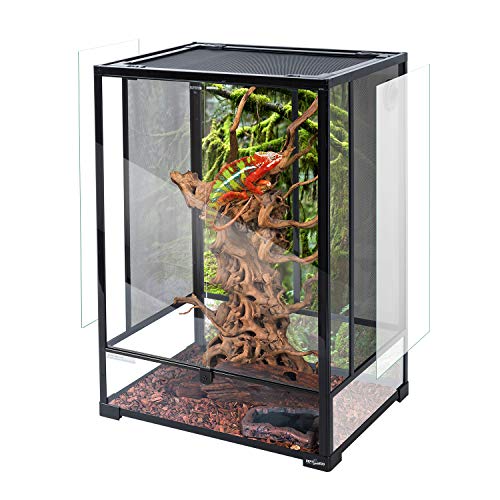
Exo Terra 18x18x36 Tall Glass Terrarium
The correct dimensions for a single emerald tree skink — tall vertical orientation, front-opening doors for arboreal maintenance, raised bottom frame for under-tank heat if needed.

Arcadia Forest 6% T5 HO UVB Lamp
Produces the UVI 1.0-3.0 that emerald tree skinks need as Ferguson Zone 2 animals — correct output without the high intensity of desert UVB bulbs.
Exo Terra Monsoon RS400 Misting System
Automated programmable misting maintains the 60-80% humidity emerald tree skinks require without manual intervention — set for morning and evening 30-second bursts.
Repashy Supercal NoD Calcium Supplement
Calcium without D3 for keepers providing proper UVB — prevents daily D3 oversupplementation risk while ensuring calcium intake at every feeding.
Dubia Roach Colony (medium mixed)
Best staple feeder for emerald tree skinks — soft-bodied, high protein, low fat, digestible chitin. A self-sustaining colony is more economical than buying crickets weekly.
Zoo Med Digital Hygrometer and Thermometer
Monitoring both humidity and temperature is non-negotiable for emerald tree skinks — this combo unit gives real-time readings without multiple devices cluttering the enclosure.
Arcadia EarthPro-A Multivitamin Supplement
Complete multivitamin formulated for insectivorous reptiles — includes carotenoids and vitamin E that support the iridescent coloration emerald tree skinks are known for.
Frequently Asked Questions
Not ideal for absolute beginners, but accessible to intermediate keepers. The key challenges — maintaining 60-80% humidity, providing the correct arboreal vertical setup, and managing communal dynamics — are learnable. Keepers who've successfully maintained a crested gecko or gargoyle gecko have the foundational skills needed.
References & Sources
Related Articles

Monkey-Tailed Skink Care: Complete Owner's Guide
Monkey-tailed skink care explained: enclosure sizing, social grouping, strictly herbivorous diet, and handling tips for the Solomon Islands' most unique lizard. Start here.

Green Tree Python Care: The Complete Guide
This guide contains affiliate links. Complete green tree python care covering locality differences, the juvenile color change, perch design, and advanced feeding techniques.

Blue Tree Monitor Care: The Complete Expert Guide
Blue tree monitor care demands expert-level skill: towering arboreal enclosures, 80% humidity, and extreme rarity. Here's what you must know before buying one.