Best Leopard Gecko Heating Mat: Top Picks & Guide
Find the best leopard gecko heating mat for your setup. Top picks, thermostat pairings, placement tips, and temperature guidelines to keep your gecko healthy.


This article contains affiliate links. If you make a purchase through these links, we may earn a small commission at no extra cost to you. See our affiliate disclosure for details.
We recommend 5 picks here. Our top choice is the Zoo Med ReptiTherm Under Tank Heater — check price and availability below.
How we choose: we compare published specifications against the care requirements in veterinary and species-care literature, and weigh those against what long-time keepers report. We do not test products ourselves and we do not restate Amazon star ratings. The 4 sources behind this article are listed at the bottom.
Quick Comparison
- Price Range
- $$
- Size Options
- 5 sizes
- Heating Element Type
- Carbon fiber
- Waterproof Surface
- Yes
- Adhesive Type
- Included
- Best for Durability
- Excellent
- Price Range
- $$$
- Size Options
- Wide range
- Heating Element Type
- Premium materials
- Waterproof Surface
- Yes
- Adhesive Type
- Strong & removable
- Best for Durability
- Premium/Long-term
- Price Range
- $
- Size Options
- Standard
- Heating Element Type
- Standard PU
- Waterproof Surface
- Yes (PU)
- Adhesive Type
- Standard
- Best for Durability
- Basic
- Price Range
- $$
- Size Options
- Several sizes
- Heating Element Type
- Standard
- Waterproof Surface
- Yes
- Adhesive Type
- Standard
- Best for Durability
- Reliable
- Price Range
- $$
- Size Options
- Standard
- Heating Element Type
- Standard
- Waterproof Surface
- Yes
- Adhesive Type
- Standard
- Best for Durability
- Dependable
Prices are estimates only. Actual prices on Amazon may vary.
Leopard geckos are one of the most beginner-friendly reptiles out there. They're calm, curious, and surprisingly low-maintenance — once you get their heating right.
And that's the part that trips up a lot of new owners.
Unlike many reptiles, leopard geckos are ground-dwelling crepuscular hunters. In the wild, they absorb heat through their belly from warm rocks and sun-baked soil — not from basking under open skies. That means belly heat isn't just helpful. It's essential for their survival.
The best leopard gecko heating mat replicates that ground warmth inside your enclosure. It helps your gecko digest food, stay active, and regulate their internal temperature. Without it, they can't thrive — no matter how good the rest of their setup is.
This guide covers what to look for, our top picks, and how to set everything up safely.
Why Belly Heat Matters for Leopard Geckos
Leopard geckos are ectotherms. They can't generate their own body heat — they rely entirely on their environment to regulate their temperature.
In the wild, they live in the rocky, semi-arid grasslands of South Asia and the Middle East. During the heat of the day, they shelter under warm rocks and in burrows. At dusk, they emerge to hunt, using heat stored in the ground to power their digestion and activity.
According to ReptiFiles, the warm hide floor should sit between 88–92°F (31–33°C). The cool side of the enclosure can drop to 70–75°F (21–24°C). That thermal gradient is what allows your gecko to thermoregulate — moving between warm and cool zones as their body needs.
Without adequate belly heat, your gecko can't properly digest food. That leads to regurgitation, weight loss, and serious long-term health problems. According to PetMD, improper temperatures are one of the most common causes of health issues in captive leopard geckos.
A quality heating mat, paired with a thermostat, solves this.
Under-Tank Mat vs. Ceramic Heat Emitter
Side-by-side comparison
| Feature | Under-Tank Heating Mat (UTH) | Ceramic Heat Emitter (CHE) |
|---|---|---|
| Provides Belly Heat | ★Yes — primary source | No |
| Raises Ambient Temp | No | ★Yes |
| Best Use for Leopard Geckos | ★Essential primary heat source | Supplemental warmth only |
Our Take: UTH is essential for ground-dwelling leopard geckos; CHE can supplement ambient warmth if your room runs cold.
Top 5 Heating Mat Picks
Quick recommendations
Proven staple for decades with carbon fiber heating and five sizes available
USA-made with premium materials and removable adhesive, built to last years without issue
Budget-friendly with waterproof PU surface and quick heat-up for starting setups
Mid-range option with consistent heat output across units and flexible cord design
Widely stocked at pet stores with moderate wattage for easy thermostat control
Heating Mat Buying Checklist
What you need to know
Always pair with proportional (PID) thermostat — heating mat without temperature control is a burn hazard
Size: Cover roughly one-third of enclosure floor (approximately 8" × 12" for 20-gallon long tanks)
Wattage: Lower is better (8–16W) for easier thermostat regulation and fire safety
Build quality: Waterproof surface, flexible heat-resistant cord, flat low-profile design for flush fit
Placement: Must go under tank with air gap below; never place on carpet
Leopard Gecko Heat Requirements
Warm Side Temperature
88–92°F (31–33°C)
Belly heat under warm hide floor
Cool Side Temperature
70–75°F (21–24°C)
Other end of enclosure for thermoregulation
Habitat Type
Ground-dweller
Absorb heat through belly from warm soil, not basking
Thermoregulation
Ectothermic
Cannot generate own body heat; entirely dependent on environment
Detailed Reviews
1. Zoo Med ReptiTherm Under Tank Heater
Best Overall
Zoo Med ReptiTherm Under Tank Heater
Pros
- •Carbon fiber heating element
- •Even heat distribution
- •Available in 5 sizes
- •Flexible thermostat pairing options
- •Proven track record
Cons
- •No built-in thermostat (requires separate purchase)
Bottom Line
A staple in the reptile hobby for decades, using a carbon fiber heating element that distributes warmth evenly. Available in five sizes to match any enclosure.
2. Ultratherm Under Tank Heater
Premium Pick
Ultratherm Under Tank Heater
Pros
- •Made in USA
- •Premium materials
- •Renowned for durability
- •Removable adhesive backing
- •Wide range of sizes
- •Consistent heat output
Cons
- •Higher cost than competitors
Bottom Line
Premium USA-made mat with exceptional durability, renowned in the reptile community for lasting years without issue. Strong but removable adhesive backing.
3. Tikaton Reptile Heat Mat
Budget Pick
Tikaton Reptile Heat Mat
Pros
- •Budget-friendly
- •Heats up quickly
- •Waterproof PU surface
- •Works with standard thermostats
- •Good for multi-enclosure setups
Cons
- •Lower price point indicates reduced durability compared to premium options
Bottom Line
Budget-friendly option that doesn't cut corners on essentials. Features waterproof PU surface and quick heat-up time.
4. iPower Reptile Heat Mat
Runner Up
iPower Reptile Heat Mat
Pros
- •Solid build quality
- •Waterproof surface
- •Flexible cord design
- •Flat profile fits under tanks easily
- •Consistent performance
- •Multiple sizes available
Cons
- •Middle-of-the-pack positioning
Bottom Line
Solid mid-range option with waterproof surface, flexible cord, and flat profile. Available in several sizes with consistent heat output.
5. Zilla Heat Mat
Best Value
Zilla Heat Mat
Pros
- •Widely available at pet stores
- •Even heating
- •Works well in glass terrariums
- •Moderate wattage (easy to control)
- •Dependable performance
Cons
- •Less premium than other options
- •More of a fallback choice
Bottom Line
Widely stocked everyday option that heats evenly and works well in glass terrariums. Moderate wattage for easy thermostat dial-in.
Heating Mat vs. Other Heat Sources
You might be wondering — can't you just use a heat lamp or a ceramic heat emitter?
You can supplement with those. But they don't provide belly heat. Here's how the main options compare:
| Heat Source | Belly Heat | Ambient Heat | Best Use |
|---|---|---|---|
| Under-tank heating mat (UTH) | ✅ Yes | ❌ No | Primary belly heat source |
| Deep heat projector | ⚠️ Partial | ✅ Yes | Supplemental warmth |
| Ceramic heat emitter (CHE) | ❌ No | ✅ Yes | Ambient temp boost |
| Radiant heat panel | ⚠️ Partial | ✅ Yes | Larger enclosures |
| Incandescent basking bulb | ❌ No | ✅ Yes | Daytime ambiance only |
For most leopard gecko setups, an under-tank heating mat is the go-to primary heat source. If your room runs cold in winter, you can add a low-wattage ceramic heat emitter on a separate thermostat to raise ambient temps — but the mat does the core work.
What to Look for in a Leopard Gecko Heating Mat
Not all heating mats are created equal. Here's what actually matters when you're shopping.
Thermostat Compatibility
This is the single most important factor. A heating mat without a thermostat is a fire and burn hazard. Every mat on this list should be paired with a proportional (PID) thermostat.
Look for mats that work with popular controllers like the Inkbird ITC-306A or the Herpstat series. Most standard UTH mats are thermostat-compatible — just don't buy one with a built-in "on/off" controller and call it done.
Size
The mat should cover roughly one-third of your enclosure floor — the warm side only. Going too large eliminates the cool zone your gecko needs. Going too small means the warm hide floor won't reach target temps.
For a standard 20-gallon long (30" x 12"), a mat around 8" x 12" is a good fit.
Wattage
More wattage isn't better here. Lower-wattage mats (8–16 watts) are easier for thermostats to regulate and less prone to overheating. High-wattage mats can spike temps before the thermostat has a chance to respond.
Build Quality
Look for a waterproof surface (for easy cleaning), a flexible and heat-resistant cord, and a flat low-profile design that sits flush under the tank. Avoid mats with exposed heating elements or thin, fragile materials.
Placement Compatibility
Most heating mats go under the tank, not inside. Make sure the mat is thin enough to allow a small air gap between it and your table surface — this prevents heat buildup underneath. Never place a mat on carpet.
Our Top Picks for Leopard Gecko Heating Mats
(Estimates only — actual prices on Amazon may vary.)
1. Zoo Med ReptiTherm Under Tank Heater
The [Zoo Med ReptiTherm](https://www.amazon.com/dp/B07KKHZPMG?tag=krawlo-20 has been a staple in the reptile hobby for decades. It uses a carbon fiber heating element that distributes warmth evenly across the mat surface. It's available in five sizes, so you can match it exactly to your enclosure.
It doesn't have a built-in thermostat — which is intentional. That lets you pair it with a thermostat of your choice for precise, reliable control. This is the mat we recommend to most first-time leopard gecko owners.
Best for: New owners who want a proven, widely available option.
2. Ultratherm Under Tank Heater
The [Ultratherm UTH](https://www.amazon.com/dp/B07WC83SQZ?tag=krawlo-20 is a step up in build quality. It's made in the USA, uses premium materials, and is renowned in the reptile community for lasting years without issue. The adhesive backing is strong but removable if you need to reposition it.
It heats evenly, pairs perfectly with any proportional thermostat, and comes in a wide range of sizes. If you're investing in a long-term setup, this is worth the extra cost.
Best for: Serious keepers who want a high-quality mat that'll last.
3. Tikaton Reptile Heat Mat
The [Tikaton heat mat](https://www.amazon.com/dp/B0D2MJGF49?tag=krawlo-20 is a budget-friendly option that doesn't cut corners where it counts. It heats up quickly, has a waterproof PU surface, and works well with standard plug-in thermostats.
It's a great pick if you're just getting started and don't want to spend a lot upfront — or if you're setting up a second or third enclosure.
Best for: Budget-conscious setups or multi-enclosure households.
4. iPower Reptile Heat Mat
The iPower heat mat sits in the middle of the pack: solid build, waterproof surface, flexible cord, and a flat profile that slides easily under glass tanks. It's available in several sizes and has a good track record for consistent heat output.
Keepers with multiple enclosures often stock up on these because of the consistent performance across units.
Best for: Owners running multiple enclosures who need reliable consistency.
5. Zilla Heat Mat
The [Zilla heat mat](https://www.amazon.com/dp/B002Z5GOU8?tag=krawlo-20 is widely stocked at pet stores and online retailers. It heats evenly, works well in glass terrariums, and is a solid everyday option. It runs at a moderate wattage, which makes it easy to dial in with a thermostat.
If you need a replacement mat in a hurry and want something you can grab locally, Zilla is a dependable fallback.
Best for: Owners who want easy local availability.
You Must Use a Thermostat — No Exceptions
We've mentioned thermostats a few times already. Let's be direct: never run a heating mat without a thermostat.
A heating mat without a thermostat will keep heating. There's nothing to tell it to stop. Surface temperatures can climb well above safe ranges — sometimes high enough to burn your gecko through the substrate, crack glass tanks, or cause a fire.
A proportional thermostat (also called a PID thermostat) measures the temperature at a probe you place inside the warm hide. It then modulates power to the mat to hold that temperature steady. It's the only way to know your gecko's floor temp is actually where it needs to be.
The [Inkbird ITC-306A thermostat](https://www.amazon.com/dp/B0F638W48F?tag=krawlo-20 is our go-to recommendation for most setups. It's accurate, affordable, and straightforward to use. For more advanced control, the Herpstat line is worth exploring.
Place the probe directly on the floor inside the warm hide — not on top of substrate. That gives you the most accurate reading of what your gecko actually experiences.
How to Set Up Your Heating Mat Correctly
Getting the setup right from day one saves you a lot of troubleshooting later. Here's how to do it.
Step 1: Attach the heating mat to the outside bottom of the enclosure, on the warm side. Use the included adhesive or a few dabs of silicone to keep it flat and stable.
Step 2: Place a flat cork tile or slate tile on the enclosure floor directly above the mat. This distributes heat evenly and eliminates hot spots that could burn your gecko.
Step 3: Place your warm hide on top of that tile, centered over the mat.
Step 4: Run the thermostat probe into the warm hide and lay it flat on the floor inside. The probe tip should be touching the tile — this is the temp the thermostat will regulate.
Step 5: Set the thermostat to 90°F (32°C) as a starting point. Plug in the mat.
Step 6: Wait 45–60 minutes, then check the floor temp inside the warm hide with an infrared temperature gun.
Step 7: Adjust the thermostat up or down until your infrared gun consistently reads 88–92°F on the warm hide floor.
Once dialed in, check your temps once a week with the gun. They should be stable.
Temperature Guidelines at a Glance
Here are the target temperatures to aim for, based on guidance from Zen Habitats and ReptiFiles:
| Zone | Target Temperature |
|---|---|
| Warm hide floor | 88–92°F (31–33°C) |
| Warm side ambient | 80–85°F (27–29°C) |
| Cool side ambient | 70–75°F (21–24°C) |
| Nighttime minimum | 65°F (18°C) |
If your ambient room temperature drops significantly at night, you may need a low-wattage ceramic heat emitter on a separate thermostat to keep the cool side from dipping below 65°F.
Common Mistakes to Avoid
Skipping the thermostat. Already covered — but it's the most dangerous mistake in reptile heating. Don't do it.
Covering the whole floor. Your gecko needs a cool retreat. If the entire floor is warm, they can't escape the heat. That's stressful and dangerous. Cover one-third of the floor — no more.
Deep loose substrate directly over the mat. Thick substrate (4+ inches) can insulate the mat and cause it to overheat. If you're building a bioactive setup, check out our guide to choosing the right substrate for leopard geckos — and consider a deep heat projector as an alternative for heavily planted enclosures.
Trusting the thermostat display without cross-checking. Thermostat probes can shift position. Always verify your actual warm hide floor temp with an infrared gun periodically.
Placing the mat on carpet. Carpet insulates heat and is a fire risk. Always use your mat on a hard, non-flammable surface — and leave a small air gap beneath the tank if your setup doesn't have rubber feet.
Choosing the Right Mat for Your Setup
Here's a quick decision guide:
- First-time owner, standard 20-gallon setup: Zoo Med ReptiTherm + Inkbird ITC-306A thermostat
- Long-term investment, quality matters: Ultratherm UTH + Herpstat 1
- Budget build or backup enclosure: Tikaton or iPower + Inkbird thermostat
- Bioactive with deep substrate: Consider a deep heat projector instead of a UTH
The thermostat matters just as much as the mat itself. A great mat with a cheap on/off thermostat will give you swinging temps and a stressed gecko. A decent mat with a quality PID thermostat will give you rock-solid, consistent warmth.
If you're curious about how lighting fits into the bigger picture, leopard geckos don't strictly need UVB — but there's a growing body of evidence suggesting it benefits them. The same principles around quality control and proper hardware apply. And once your enclosure is set up right, you'll find that understanding your gecko's behavior and body language becomes a lot more interesting when you know their environment is dialed in.
Get the belly heat right, and you've solved one of the most important pieces of leopard gecko husbandry. Everything else gets easier from there.
Our Final Verdict
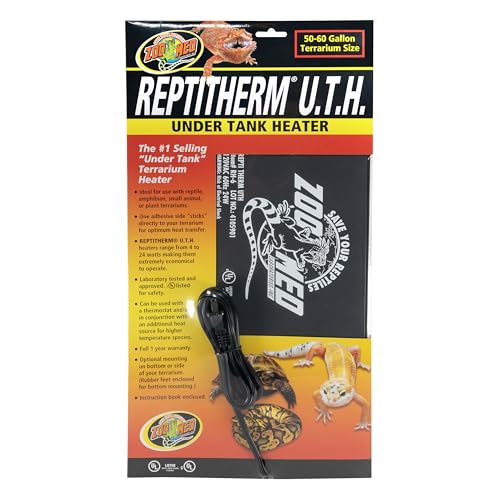
Zoo Med ReptiTherm Under Tank Heater
A staple in the reptile hobby for decades, using a carbon fiber heating element that distributes warmth evenly. Available in five sizes to match any enclosure.

Ultratherm Under Tank Heater
Premium USA-made mat with exceptional durability, renowned in the reptile community for lasting years without issue. Strong but removable adhesive backing.

Tikaton Reptile Heat Mat
Budget-friendly option that doesn't cut corners on essentials. Features waterproof PU surface and quick heat-up time.
Frequently Asked Questions
An under-tank heating mat (UTH) paired with a proportional thermostat is the best primary heat source for leopard geckos. It provides belly heat, which is essential for digestion and thermoregulation. Set the warm hide floor to 88–92°F using the thermostat probe placed directly inside the hide.
References & Sources
- https://reptifiles.com/leopard-gecko-care/leopard-gecko-temperatures-humidity/
- https://www.zenhabitats.com/blogs/reptile-care-sheets-resources/leopard-gecko-complete-lighting-and-heating-guide?srsltid=AfmBOopJVbrUf6p9TTd7ghXABHsmeKQ9d-UyTjFRp2swJYHX-564S0Nv
- https://www.petmd.com/reptile/leopard-gecko-care-sheet
- https://reptifiles.com/leopard-gecko-care/leopard-gecko-substrate/
Related Articles

Best Leopard Gecko Starter Kit: Complete Buyer's Guide
Find the best leopard gecko starter kit for beginners. We break down enclosures, heating, substrate, and accessories so you set up right the first time.

Best Leopard Gecko Accessories: Complete Setup Guide
Discover the best leopard gecko accessories: hides, heat mats, thermostats, UVB lights, décor, and more — everything your leo needs to thrive in 2026.

Best Terrarium for Leopard Gecko: Top Picks & Setup Guide
Find the best terrarium for leopard gecko with our expert guide. Covers minimum size, top tank picks, heating, hides, and full setup tips for a thriving gecko.