
Crested Gecko Humidity Requirements: Levels, Monitoring & Misting Schedule (2026)
Master crested gecko humidity with our complete misting guide. Learn the wet/dry cycle, top auto mister picks, and seasonal tips. Fix bad sheds today.

✓Recommended Gear
In this guide, we cover everything you need to know and recommend 6 essential products. Check prices and availability below.
TL;DR: Crested geckos need a wet-dry humidity cycle — 60-80% after misting, allowed to drop to 40-50% before the next misting — rather than constant high humidity, which causes respiratory infections. Misting once each evening in a well-ventilated 18×18×24 in enclosure with a mesh top typically maintains this cycle without extra equipment.
You set your alarm for 7 AM just to mist the enclosure — again. By week three, the spray bottle feels less like a care tool and more like a punishment. Your humidity readings swing from 55% at 6 PM to 88% after misting, then crash to 42% by midnight. Sound familiar?
The good news: crested gecko humidity is not complicated once you understand one core principle. It is not about hitting a single number — it is about engineering a wet/dry fluctuation cycle that mimics what these geckos evolved with in New Caledonia's subtropical forests. Get the cycle right, and almost everything else falls into place.
This guide covers the exact humidity targets, misting schedules, substrate choices, and equipment (including when to ditch the spray bottle entirely) to keep your crested gecko thriving long-term. Check out our crested gecko species profile for the full care picture.
Why Crested Gecko Humidity Matters
The short answer: wrong humidity causes failed sheds, dehydration, and respiratory infections — three of the most common reasons crested geckos end up at the vet.
Crested geckos are native to New Caledonia, a chain of islands in the southwest Pacific where daily humidity fluctuates dramatically between rain events and dry periods. Their biology is tuned to this rhythm. They drink water droplets off leaves and glass after misting events — they do not drink from standing water bowls the way mammals do.
Constant high humidity (above 80% around the clock) is just as dangerous as constant dryness. It creates the warm, stagnant conditions that bacterial and fungal infections thrive in. The keeper's job is to replicate the natural pattern: spike to high humidity, then let it drop and breathe.
The Wet/Dry Cycle Explained
Think of it like rainfall in a rainforest. There is a downpour, the canopy is dripping wet, geckos drink and absorb moisture through their skin — then the sun comes back out, air circulates, and the environment dries down over several hours before the next rain.
In practice this means:
- Post-misting peak: 80-90% humidity immediately after misting
- Daytime baseline: 45-55% humidity after the enclosure dries out
- Evening re-mist target: return to 75-80% for the overnight period
- Dry-out time: allow 10-12 hours between full misting sessions
Pro Tip: Do not aim for a flat humidity number. If your gauge reads 65% all day without fluctuation, your ventilation is too poor and your enclosure is not cycling properly. Aim for visible swings between 45% and 80%+.
What Happens Without the Cycle
Permanently high humidity creates a bacterial soup. Respiratory infections, scale rot, and fungal growth all increase significantly when humidity never dips below 60%. Permanently low humidity causes dehydration and stuck shed — most visibly on the toe pads and around the eyes, where retained shed can cause permanent damage if left untreated.
Target Humidity Ranges at a Glance
| Time of Day | Target Range | Notes |
|---|---|---|
| Post-misting (any time) | 80-90% | Peak — geckos drink droplets now |
| Daytime baseline | 45-55% | Dry-out phase — ventilation critical |
| Evening pre-mist | 40-50% | Normal before second misting |
| Overnight (after evening mist) | 65-75% | Slow decline through the night |
Monitor with a digital hygrometer, not an analog dial gauge. Dial gauges are notoriously inaccurate and can be off by 15-20%. The **[Govee WiFi Hygrometer](https://www.amazon.com/dp/B0DQ88P15G?tag=krawlo-20 is the best option for most keepers — it logs data to an app so you can see exactly how your enclosure cycles over 24 hours, not just a single snapshot reading.
Pro Tip: Place your hygrometer in the middle of the enclosure, not right next to the screen top or a misting nozzle. Readings next to vent panels will always read low; readings near nozzles will always read high.
Crested Gecko Humidity Targets
It's a wet/dry cycle — not a single flat number
Post-Misting Peak
80–90%
Geckos drink droplets now
Daytime Baseline
45–55%
Dry-out phase — ventilation critical
Dry-Out Time
10–12 hrs
Between full misting sessions
Overnight (post-mist)
65–75%
Slow decline through the night
How to Mist a Crested Gecko Enclosure
The primary rule: mist the walls and plants, not the gecko directly. Geckos drink droplets that form on glass, leaves, and decor — not water sprayed into their face.
Mist until you can see water droplets running down the glass and the substrate surface looks visibly damp (not pooling with water). Then wait. Your humidity should spike and begin declining within 20-30 minutes as air circulates through the screen panels.
Misting Schedule: Two-Per-Day Model
Most crested geckos do well with two misting sessions per day:
- Morning mist (light): A quick pass over the glass and top third of the enclosure. This gives geckos a morning drink opportunity and starts the daytime dry-down from a slightly higher baseline.
- Evening mist (thorough): A full misting session — glass, plants, substrate surface. This is the primary hydration event and coincides with when crested geckos become active. Time it 30-60 minutes after lights go off.
For hand misting, the **[Exo Terra Pressure Sprayer](https://www.amazon.com/dp/B004CJS7XW?tag=krawlo-20 is the best manual option — a pump-up design that creates a fine mist without the hand fatigue of a standard trigger bottle, and the 2-liter tank means fewer refills.
The Tap Water vs. Distilled Water Paradox
Here is a detail almost no guide addresses clearly: the right water choice depends on your misting method.
- Hand misting: Use tap water (dechlorinated by leaving it out overnight, or treated with a conditioner). Tap water contains trace minerals that crested geckos benefit from and that plants in bioactive setups need.
- Automatic misters: Use distilled water or RO (reverse osmosis) water only. Tap water leaves mineral deposits in nozzles and tubing that will clog your system within weeks. Mineral buildup is the number-one reason auto misters fail early.
This is not a minor point — using tap water in an auto mister will eventually destroy the nozzles. Using only distilled water for hand misting long-term can cause minor mineral deficiencies over years. Match the water type to the delivery method.
Hand Misting vs. Automatic Misters: Which Is Right for You?
The honest answer: if you keep more than one gecko or travel regularly, an automatic mister is worth every penny of the upfront cost.
Hand misting twice daily is completely viable — many experienced keepers prefer it because it forces you to observe your enclosure closely every day. But if you miss sessions due to work, travel, or illness, humidity crashes fast in screen-ventilated enclosures.
Cost Comparison
| Method | Upfront Cost | Ongoing Cost | Effort |
|---|---|---|---|
| Spray bottle | ~$5-10 | $0 | High — 2x daily manual |
| Pump sprayer (Exo Terra) | ~$20-30 | $0 | Medium — larger tank, easier pumping |
| Budget auto mister (Monsoon) | ~$60-80 | Distilled water | Low — set schedule |
| Mid-range auto mister (MistKing) | ~$120-180 | Distilled water | Very low — scalable to 10 nozzles |
Pro Tip: Calculate your time cost. If hand misting takes 5 minutes twice a day, that is 60+ hours per year. An auto mister pays for itself in time within a few months — and never misses a session when you are sick or traveling.
Foggers vs. Misters: A Critical Distinction
Do not confuse foggers with misters — they serve completely different functions.
Foggers produce ultrafine water vapor (true fog). This raises ambient humidity readings but does NOT produce water droplets on glass and leaves. Crested geckos cannot drink from fog. Foggers also create stagnant, very high humidity at low levels of the enclosure, which increases respiratory infection risk if used as the primary humidity method.
Misters produce actual water droplets. These coat glass, leaves, and decor — exactly what crested geckos lap up with their tongues. Misters are what you want for hydration.
Foggers can be used as a supplement on particularly dry days or in very dry climates, but should never replace a misting system for a crested gecko.
Hand Misting vs. Automatic Mister
Side-by-side comparison
| Feature | Hand Misting (Pump Sprayer) | Auto Mister (e.g. MistKing) |
|---|---|---|
| Upfront Cost | $20–30 | $60–180 |
| Daily Effort | High — 2x manual/day | Very low — automated |
| Reliability When Traveling | None — manual only | Full — never misses |
| Enclosure Observation | Yes — built-in | No — requires deliberate checks |
Our Take: Hand misting is viable for one gecko, but an auto mister pays for itself in time and reliability.
Top Auto Mister Recommendations
If you are ready to automate, these are the three best options depending on your budget and enclosure count.
Best Overall: MistKing Starter System V4.0
The **[MistKing Starter System V4.0](https://www.amazon.com/dp/B012IAK4SC?tag=krawlo-20 is the industry standard among serious reptile keepers. It uses a peristaltic pump (extremely reliable, low maintenance), a programmable digital timer with second-level precision, and a modular nozzle system that scales up to 10 enclosures from one pump. Use distilled water only. This is the system most professional breeders run.
Why it wins: Second-level timer precision, near-silent operation, expandable without buying a new pump.
Best Budget Pick: Exo Terra Monsoon Solo II
The **[Exo Terra Monsoon Solo II](https://www.amazon.com/dp/B08KJ4G2XL?tag=krawlo-20 has a built-in 1.5L reservoir and a programmable timer with two daily misting sessions. It is self-contained (no external water source needed), which makes it ideal for single-enclosure setups in apartments or bedrooms. Fill it with distilled water, set your morning and evening schedules, and walk away.
Why it wins: No tubing runs, no external reservoir — plug-and-play simplicity for one gecko.
Best High-Volume: REPTI ZOO 10L Mister
The **[REPTI ZOO 10L Automatic Misting System](https://www.amazon.com/dp/B07PRS6YCC?tag=krawlo-20 holds a massive 2.6-gallon reservoir — enough for weeks of daily misting without refills. It supports 360° adjustable nozzles and can expand to 20 nozzles for a larger collection. Strong mid-range option if you have multiple enclosures but do not want MistKing's professional-grade price.
Why it wins: Longest time between refills, best reservoir-to-price ratio for multi-enclosure keepers.

MistKing Starter System V4.0
Industry-standard peristaltic pump mister with second-level timer precision, near-silent operation, and scalable to 10 enclosures — the benchmark choice for serious keepers.
Check Price on Amazon
Exo Terra Monsoon Solo II
Self-contained 1.5L reservoir with programmable dual-session timer — the simplest plug-and-play automation for single-enclosure setups.
Check Price on Amazon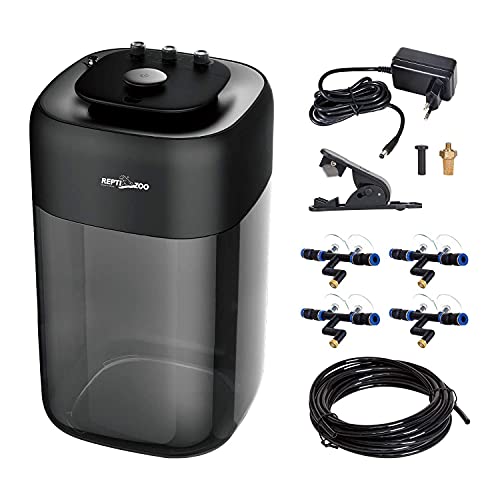
REPTI ZOO 10L Automatic Misting System
2.6-gallon reservoir with 360-degree adjustable nozzles supports up to 20 nozzles — best reservoir-to-price ratio for multi-enclosure keepers.
Check Price on AmazonSubstrate and Its Role in Humidity Retention
Your substrate choice has a bigger impact on humidity stability than most keepers realize.
The substrate acts as a moisture reservoir. A deep, moisture-retentive substrate releases humidity slowly between misting sessions, smoothing out the spikes and crashes. A bare-bottom or low-retention substrate leads to wild swings.
Substrate Moisture Retention Comparison
| Substrate | Moisture Retention | Notes |
|---|---|---|
| Coconut fiber (Eco Earth) | Excellent | Best for maintaining baseline humidity |
| ABG mix (bioactive) | Excellent | Live culture improves moisture cycling |
| Coco coir + sphagnum moss | Very Good | Good DIY option |
| Paper towels | Poor | Dries out within hours after misting |
| Reptile carpet | Poor | Surface dries fast, no moisture buffering |
The **[Zoo Med Eco Earth](https://www.amazon.com/dp/B01CN8ZRYA?tag=krawlo-20 (compressed coconut fiber bricks) is the go-to recommendation for most crested gecko setups. At 3-4 inches deep, it holds enough moisture to keep baseline humidity stable between misting sessions. Expand it in warm water, wring out excess moisture, and layer it in — it should be damp but not dripping.
Pro Tip: Add a layer of dried leaf litter (magnolia or oak leaves, available from reptile suppliers) over the coconut fiber. Leaf litter holds surface moisture longer, gives geckos a natural foraging surface, and is the single cheapest upgrade you can make to a bioactive setup.
Humidity Tips Every Keeper Needs
What you need to know
Never aim for a flat humidity number — visible swings between 45% and 80%+ are the goal.
Use distilled or RO water in auto misters only; tap water (dechlorinated) is fine for hand misting.
Foggers raise humidity readings but produce no drinkable droplets — crested geckos drink from misting.
Coconut fiber at 3–4 inches deep acts as a moisture buffer that smooths humidity spikes and crashes.
In winter, forced-air heating can drop humidity from 80% to 40% in 2–3 hours — add a third misting session.
Seasonal Adjustments: Winter vs. Summer
Most guides skip this entirely — but season matters significantly, especially if you live in a climate with forced-air heating or air conditioning.
Your home's ambient humidity changes dramatically by season, which directly affects how fast your enclosure dries out after misting.
Winter (Forced-Air Heating Season)
Forced-air heating strips humidity from indoor air. Enclosures in heated rooms can drop from 80% to 40% in just 2-3 hours after misting.
Adjustments for winter:
- Add a third light misting session in the afternoon if daytime readings drop below 40%
- Use a room humidifier near (not on) the enclosure to raise ambient air humidity
- Partially cover the screen top with a plastic sheet or foil to slow evaporation — leave at least 30% uncovered for air exchange
- Check your substrate moisture daily; it will dry out faster than you expect
Summer (Air Conditioning Season)
Air conditioned rooms have very dry air, similar to winter heating. However, if you do not air condition, summer brings naturally higher ambient humidity, which means your enclosure may not dry out between sessions.
Adjustments for summer (no AC, humid climate):
- Reduce morning misting to a light pass only, or skip entirely if daytime readings stay above 55%
- Ensure maximum ventilation — add a small USB fan blowing across the screen top if air circulation is poor
- Watch closely for signs of fungal growth on decor or substrate
Troubleshooting Common Humidity Problems
Humidity Drops Too Fast (Under 45% Within 2 Hours)
- Screen top allows too much evaporation — cover 40-50% of the top with a pane of glass or plastic
- Substrate is too shallow — increase to 3-4 inches minimum
- Room air is very dry (winter heating) — add a room humidifier
- Enclosure placed near a heating vent — move it away
Humidity Stays High All Day (Never Drops Below 65%)
- Ventilation is insufficient — remove partial screen covers, add a fan
- Substrate is waterlogged — let the enclosure go 2-3 days without misting, then reduce misting volume
- Enclosure sealed too tightly — crested gecko enclosures need airflow, not just humidity
Gecko Is Having Stuck Sheds Despite Good Humidity Readings
Stuck shed often points to hydration issues rather than just ambient humidity. Crested geckos need to physically drink water droplets — if misting is too light or too brief, droplets may evaporate before the gecko drinks.
- Mist more thoroughly in the evening (full enclosure coverage)
- Add a humid hide filled with moist sphagnum moss — this gives the gecko a microclimate refuge during shed
- Check that the gecko is actually drinking: watch for 5-10 minutes after misting in the evening to see tongue-flicking at water droplets on glass
For a comparison of crested gecko care difficulty versus leopard geckos, see our leopard gecko vs. crested gecko guide.
Recommended Gear
MistKing Starter System V4.0
Industry-standard peristaltic pump mister with second-level timer precision, near-silent operation, and scalable to 10 enclosures — the benchmark choice for serious keepers.
Check Price on AmazonExo Terra Monsoon Solo II
Self-contained 1.5L reservoir with programmable dual-session timer — the simplest plug-and-play automation for single-enclosure setups.
Check Price on AmazonREPTI ZOO 10L Automatic Misting System
2.6-gallon reservoir with 360-degree adjustable nozzles supports up to 20 nozzles — best reservoir-to-price ratio for multi-enclosure keepers.
Check Price on Amazon
Exo Terra Pressure Sprayer
Pump-up design produces a fine, consistent mist without hand fatigue — the best manual misting option for keepers who prefer hands-on daily observation.
Check Price on Amazon
Govee WiFi Hygrometer Thermometer
Logs humidity and temperature data to a smartphone app so you can see your enclosure's full 24-hour cycle, not just a single snapshot reading.
Check Price on Amazon
Zoo Med Eco Earth Coconut Fiber Substrate
Compressed coconut fiber bricks expand to fill deep substrate layers that buffer humidity between misting sessions — the most reliable moisture-retentive substrate for crested geckos.
Check Price on AmazonFrequently Asked Questions
The ideal range is 60-80% as a general guideline, but more precisely: spike to 80-90% immediately after misting, then allow the enclosure to dry down to 45-55% during the day. The wet/dry fluctuation cycle is more important than any single static number.
References & Sources
- https://reptifiles.com/crested-gecko-care/crested-gecko-temperatures-humidity/
- https://www.zenhabitats.com/blogs/reptile-care-sheets-resources/complete-humidity-and-hydration-guide-for-crested-geckos
- https://www.merckvetmanual.com/exotic-and-laboratory-animals/reptiles
- https://www.rvc.ac.uk/exotics/for-pet-owners/reptiles/crested-gecko
Related Articles

Reptile Humidity Control Guide: Keep Levels Right
Master reptile humidity control with this complete guide. Learn ideal levels by species, how to raise or lower humidity, and the best tools for the job.

Veiled Chameleon Humidity and Misting Guide: Schedule, Equipment & Wet-Dry Cycle
Veiled chameleons die from bad misting — it's their only water source. Learn the wet-dry cycle, seasonal schedule, and top equipment to keep yours thriving.

How to Heat a Crested Gecko Tank (Without Overheating)
Cold climates can seriously stress crested geckos out. Pick the right crested gecko heat lamp — CHE or DHP with a thermostat — and browse our top picks.