
Ball Python Heating Guide: CHE vs DHP vs Halogen Compared
CHE, DHP, halogen, or heat mats -- which actually works for ball pythons? This guide breaks down every heat source with real temperature targets and thermostat comparisons.

✓Recommended Gear
In this guide, we cover everything you need to know and recommend 6 essential products. Check prices and availability below.
TL;DR: Ball pythons need a warm side of 88–92°F, cool side of 76–80°F, and a basking surface of 95–104°F — all verified with an infrared thermometer, not a probe thermometer. The Deep Heat Projector (DHP) is the current hobby gold standard as it penetrates tissue like natural infrared; CHEs work well as 24/7 sources; under-tank heaters are inadequate as a primary heat source. Every heat source must run on a proportional (PID) thermostat to prevent dangerous temperature spikes.
Ball pythons are native to sub-Saharan Africa, where they bask in warm, sun-baked burrow entrances and retreat underground when temperatures spike. In captivity, replicating that thermal experience is the single biggest factor separating thriving snakes from chronically stressed ones.
The hobby has shifted dramatically over the past decade. Under-tank heaters and red night bulbs -- once the default -- are now widely considered inadequate. The modern consensus, backed by keeper experience and breeder data, points firmly toward overhead heating. This guide explains why, and helps you choose the right heat source for your setup.
Why Proper Heating Matters for Ball Pythons
Ball pythons are ectotherms -- they regulate body temperature entirely through their environment. Without a proper thermal gradient, they cannot digest food, mount an immune response, or metabolize properly.
A snake sitting in an enclosure that is too cool or too uniform in temperature is not just uncomfortable -- it is immunocompromised. Community data consistently shows that chronic low temperatures are linked to regurgitation, respiratory infections, and long-term refusal to feed.
What Happens Without a Proper Gradient
- Digestion fails -- enzymes only activate at correct body temp (88-92F core)
- Immune system is suppressed -- increased susceptibility to respiratory infection
- Feeding refusal -- the #1 complaint in ball python keeping, often traced to incorrect temps
- Stuck sheds -- inadequate warmth disrupts the shed cycle
According to ReptiFiles ball python care guide, a proper thermal gradient is not optional -- it is the foundation of captive care.
Why Proper Heating Matters
What you need to know
Digestion fails — enzymes only activate at correct body temp (88–92°F core)
Immune system suppressed — increased susceptibility to respiratory infection
Feeding refusal — the #1 complaint in ball python keeping
Stuck sheds — inadequate warmth disrupts the shed cycle
Ball Python Temperature Requirements
Before choosing a heat source, you need to know your targets. Ball pythons need a gradient, not a uniform temperature. The snake must be able to freely move between a warm side, a cooler side, and a defined basking zone.
| Zone | Temperature Target | Notes |
|---|---|---|
| Basking Surface | 95-104F (35-40C) | Measured with IR thermometer on the surface directly under heat source |
| Warm Side Ambient | 88-92F (31-33C) | Air temp at mid-height on warm side |
| Cool Side Ambient | 76-80F (24-27C) | Air temp at mid-height on cool side |
| Night Temperature | 70-78F (21-26C) | Acceptable range -- no heat lamp needed unless room drops below 70F |
A basking surface of 95-104F and a cool side of 76-80F are non-negotiable. Anything below 75F ambient risks serious health consequences.
How to Measure Temperature Accurately
Do not rely on the cheap analog thermometers that come in kit setups. You need two tools:
- Infrared (IR) thermometer -- point-and-shoot surface temp readings. Use this to verify your basking spot. The Etekcity Infrared Thermometer Laser Gun gives instant readings anywhere in the enclosure.
- Digital probe thermometer with dual probes -- place one probe on the warm side, one on the cool side for continuous ambient monitoring. See our Best Reptile Thermometers roundup.
Never measure only the warm side. If you do not know your cool side temperature, you do not actually know your gradient.
Temperature Zone Targets
Basking Surface
95–104°F (35–40°C)
IR thermometer on surface under heat source
Warm Side Ambient
88–92°F (31–33°C)
Air temp at mid-height
Cool Side Ambient
76–80°F (24–27°C)
Air temp at mid-height
Night Temperature
70–78°F (21–26°C)
No heat needed unless room drops below 70°F
Best Heat Sources for Ball Pythons
This is where most keepers get confused. The market offers five main categories of heat sources, each with real tradeoffs. Here is the full comparison before we go deep on each.
| Heat Source | Light Output | Heats Air | Heats Surface | Penetrates Tissue | 24/7 Safe | Best For |
|---|---|---|---|---|---|---|
| Ceramic Heat Emitter (CHE) | None | Yes | Moderate | No | Yes | All setups, day/night |
| Deep Heat Projector (DHP) | None | Yes | Yes | Yes | Yes | Premium setups, naturalistic |
| Halogen Basking Bulb | Yes | Yes | Yes | Moderate | Day only | Bioactive, visual appeal |
| Radiant Heat Panel (RHP) | None | Yes | Moderate | No | Yes | Rack systems, large collections |
| Under-Tank Heater (UTH) | None | No | Belly only | No | Supplemental only | Deprecated as primary source |
Ceramic Heat Emitters (CHE)
Ceramic heat emitters are unglazed porcelain bulbs that screw into a standard lamp base and emit pure infrared heat with zero visible light. They are the most common overhead heat source in ball python keeping for good reason.
How they work: A resistive ceramic element heats up and radiates far-infrared energy (longwave IR-C). This warms the air and surfaces in the enclosure but does not penetrate skin tissue the way the sun's radiation does.
Pros:
- No light output -- safe 24/7 use, does not disrupt day/night cycle
- Long lifespan (12-18 months with a proportional thermostat)
- Very affordable ($10-20 per bulb)
- Works in any deep dome lamp fixture
- Easy to find at any pet store
Cons:
- Only heats air and surface -- does not warm the snake's body from within
- Dries out enclosure more than DHPs (runs hotter)
- Bulbs blow frequently without a proportional thermostat
- No visual light for daytime ambiance
Best wattage: For a 4x2x2 ft enclosure, a 100W CHE is typically adequate on the warm side. For smaller enclosures (36x18x18), 60-75W. Always pair with a thermostat -- you are adjusting via the thermostat, not by swapping bulbs.
The Reptile Systems Ceramic Heat Emitter 100W is a solid, widely used option that handles thermostat cycling without premature failure.
Deep Heat Projectors (DHP)
The Deep Heat Projector -- pioneered by Arcadia -- is the most significant innovation in reptile heating in the last decade. It changed how the community thinks about heating fundamentally.
How they work: DHPs emit a specific spectrum of near-infrared radiation (IR-A and IR-B -- shortwave). These wavelengths penetrate skin and muscle tissue, warming the snake from within the same way sunlight does in the wild. No other heat source replicates this.
Why this matters biologically: When a ball python basks in the wild, it is not just warming its skin surface -- solar radiation penetrates several centimeters into muscle tissue, warming the body core directly. Standard CHEs and heat mats only warm the environment or surface. The snake then absorbs that heat conductively, which is slower and less effective.
Pros:
- Most biologically accurate heat source available for captive reptiles
- Tissue-penetrating IR-A/B radiation -- genuinely novel benefit
- No light output -- 24/7 safe
- Runs cooler than equivalent CHE (less desiccation risk)
- Reportedly improves feeding response and activity levels (community data)
Cons:
- Expensive ($50-80 per unit for Arcadia Deep Heat Projector 50W)
- Requires specific deep-dome fixture (standard domes cause hotspots)
- Less widely available than CHEs
- Newer technology -- long-term lifespan data still emerging
Recommended wattage: 50W DHP for a 4x2x2 enclosure. 80W for larger builds. DHPs are unusually efficient -- they warm tissue at lower ambient output than CHEs, so do not oversize.
According to Zen Habitats complete lighting and heating guide, the DHP is now their primary recommendation for ball pythons due to the tissue-penetrating benefit.
Halogen Basking Bulbs
Halogen flood bulbs produce both visible light and shortwave IR radiation -- making them a dual-purpose solution for keepers who want a daytime basking spotlight with ambient heating.
How they work: Halogen bulbs (typically PAR38 flood format) produce a warm, bright beam with significant near-infrared output. They create a defined basking zone with visible light, simulating the sun's daytime effect.
Pros:
- Produces visible light -- supports a natural photoperiod and bioactive setups
- Near-infrared output (moderate tissue penetration)
- Very cheap ($8-15 for standard hardware-store PAR38 halogen bulbs)
- Creates natural-looking daytime basking behavior
- Wide beam coverage for larger warm zones
Cons:
- Must be on a timer -- cannot run at night (disrupts sleep cycle)
- Requires a separate nighttime heat source (CHE or DHP) if temps drop below 70F
- Shorter lifespan than CHEs (~2,000 hours)
- Produces more visible light than some keepers prefer
Setup note: Standard hardware-store 50W PAR38 halogen flood bulbs (like the Philips 50W PAR38 Halogen Flood Bulb) are functionally identical to reptile basking bulbs that cost 3x more. Reptile-branded bulbs use the same filament technology.
Radiant Heat Panels (RHP)
Radiant heat panels are flat heating elements mounted to the ceiling of the enclosure (inside or on top of screen). They radiate heat downward without producing light.
How they work: RHPs are resistive heating panels that emit far-infrared from a broad, flat surface area. Because heat radiates from above and across a large area, they create even, ambient warmth rather than a defined hot spot.
Pros:
- Very even heat distribution -- no hot spots
- Long lifespan (5-10 years with thermostat)
- Excellent for rack systems and large collections
- Silent, no visible light
Cons:
- Expensive upfront ($60-150 depending on size)
- Less accessible in retail -- typically ordered online
- Not ideal for glass enclosures (designed for screen-top or rack tubs)
- No defined basking spot -- some snakes may not thermoregulate as actively
Best use case: Rack systems with 20-40 enclosures, where individual overhead setups are impractical. Less common in single-enclosure hobby setups.
Under-Tank Heaters (Heat Mats) -- Deprecated as Primary Source
Under-tank heaters (UTHs) were the dominant heating method for ball pythons throughout the 1990s and 2000s. The hobby has moved on -- and for good reason.
Why they are no longer recommended as a primary source:
Ball pythons in the wild thermoregulate by moving into warm air near burrow entrances -- not by pressing their belly against hot ground. Belly heat is a secondary behavioral option, not the primary thermoregulation strategy. UTHs only heat the surface directly above them, creating a single warm tile rather than a warm side ambient gradient.
Critically: UTHs cannot create the warm-side ambient temperature that ball pythons need. A UTH under a 40-gallon tank might bring the warm floor surface to 88F, but the air 6 inches above it may only be 78-80F. The snake's body temperature is regulated by ambient air and basking surface contact together -- not belly heat alone.
The additional risk: UTHs are frequently left unthermostated, and temperatures on the heating element surface can exceed 120F, causing thermal burns to the snake.
If you use a UTH: Only as a supplemental belly-heat source on a proportional thermostat (not an on/off thermostat). The Zoo Med ReptiTherm Under Tank Heater is a reliable option, but it must be controlled. Pair it with a primary overhead heat source.
Arcadia Deep Heat Projector 50W
Best deep heat projector for ball pythons -- penetrates tissue like natural infrared, closest to the sun's warming effect on wild snakes
Check Price on Amazon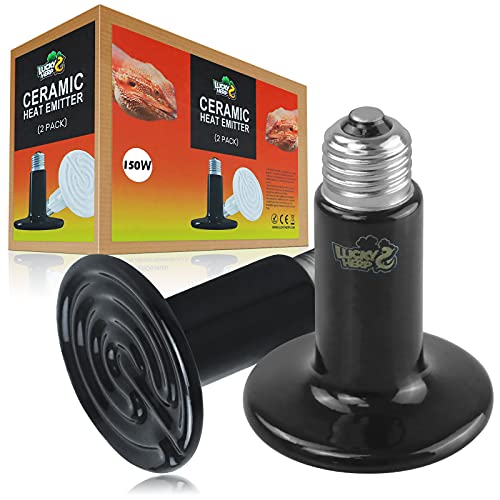
Reptile Systems Ceramic Heat Emitter 100W
Reliable 24/7 heat without light -- ideal for maintaining warm-side temperatures in larger enclosures
Check Price on Amazon
Philips 50W PAR38 Halogen Flood Bulb
Affordable halogen basking option -- produces visible light plus infrared warmth, great for bioactive setups that need a day/night cycle
Check Price on Amazon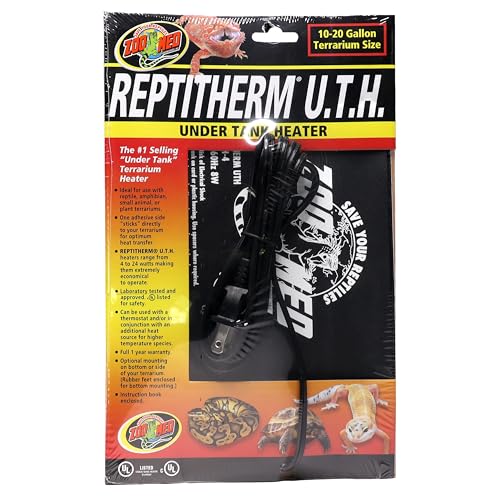
Zoo Med ReptiTherm Under Tank Heater
Only recommended as a supplemental belly-heat source on a proportional thermostat -- not a primary heat source for ball pythons
Check Price on AmazonCHE vs Deep Heat Projector
Side-by-side comparison
| Feature | Ceramic Heat Emitter (CHE) | Deep Heat Projector (DHP) |
|---|---|---|
| Tissue Penetration (Biological Accuracy) | No — surface/air only | ★Yes — IR-A/B wavelengths penetrate muscle |
| Cost per Unit | ★$10–20 | $50–80 |
| Wattage Needed (4×2×2 enclosure) | 100W | ★50W |
| 24/7 Safe | Yes | Yes |
| Light Output | None | None |
| Availability | ★Widely available | Less common, needs special dome |
Our Take: DHP is biologically superior (tissue penetration like natural sunlight); CHE is budget-friendly and accessible. Both require a PID thermostat.
Thermostat Guide
This is the most under-discussed topic in ball python heating. A heat source without a thermostat is a hazard. Every heat source -- CHE, DHP, halogen, UTH -- must be controlled by a thermostat. Without one, ambient temperatures can drift 10-20F above or below target depending on room conditions.
The Three Types of Reptile Thermostats
1. On/Off Thermostats
The simplest and cheapest option. The thermostat monitors temperature via a probe and cuts power to the heat source when the target temp is reached, then restores power when it drops below threshold.
- Cost: $15-30
- How it works: Full power -> off -> full power -> off (binary cycling)
- Problem: Temperature oscillates around the set point. The heat source turns fully on and off repeatedly, creating a sawtooth wave of temperature fluctuation (+/-3-5F). This is hard on bulbs -- thermal shock from rapid cycling is the #1 cause of premature CHE failure.
- Best for: UTHs and heat mats (low wattage, tolerates cycling better)
- Not recommended for: CHEs or DHPs (shortens lifespan significantly)
2. Proportional Thermostats
Proportional thermostats modulate power output continuously rather than switching on/off. As the enclosure approaches target temperature, the thermostat reduces power to a percentage rather than cutting it entirely. Temperature is maintained within +/-1-2F.
- Cost: $40-80
- How it works: Variable power (e.g., 80% -> 50% -> 20% as temp rises)
- Benefits: Stable temperatures, dramatically extended bulb life, no thermal shock
- Best for: CHEs and DHPs -- the recommended pairing
- Example: The Inkbird Proportional Thermostat ITC-306A is a community-recommended mid-range proportional option
3. Pulse Proportional Thermostats
Pulse thermostats deliver power in rapid, short pulses (rather than continuous reduced power), modulating duty cycle to control average output. They are the gold standard for ceramic and radiant heat sources.
- Cost: $60-120
- How it works: Rapid pulses (e.g., on 70% of the time per second) -- effectively the same as proportional but better suited to resistive heating elements
- Best for: CHEs, UTHs, radiant heat panels
- Not suitable for: Halogen bulbs (pulse cycling causes visible flicker)
- Advantage over standard proportional: Even more stable, and better for high-wattage setups
Thermostat Comparison Table
| Type | Price Range | Temp Stability | Bulb Lifespan Impact | Best Paired With |
|---|---|---|---|---|
| On/Off | $15-30 | +/-3-5F | Poor (thermal shock) | Heat mats, UTHs only |
| Proportional | $40-80 | +/-1-2F | Good | CHE, DHP, Halogen |
| Pulse Proportional | $60-120 | +/-0.5-1F | Excellent | CHE, UTH, RHP |
The rule of thumb: Match thermostat type to heat source. Do not pair a $20 on/off thermostat with a $70 DHP -- you will cycle the bulb to death in three months.
Setting Up Your Heat Gradient
A proper ball python heat gradient is not just about the heat source -- it is about placement, enclosure dimensions, and measurement. Here is a step-by-step setup process.
Step-by-Step Setup
-
Choose your enclosure first. A 4x2x2 ft enclosure is the community standard for adult ball pythons. Smaller enclosures cannot maintain an adequate gradient. See our Best Ball Python Enclosures guide for size recommendations.
-
Place your heat source on one side only. Mount your CHE or DHP above the warm side -- not centered. Centering eliminates the gradient and forces the snake to stay in one temperature zone.
-
Position the thermostat probe correctly. Place the probe 6 inches below the heat source at the snake's resting height (not on the basking surface). You are controlling the ambient warm side air temp, not just the surface directly under the lamp.
-
Let the system stabilize for 24 hours before placing the snake. Thermal equilibrium takes time, especially in larger enclosures.
-
Measure both sides with an IR thermometer and digital probes. Record: basking surface temp, warm side ambient, cool side ambient. All three must be within target before the snake goes in.
-
Adjust via thermostat set point, not bulb wattage. If the warm side is reading 95F and you want 90F, lower the thermostat set point -- do not swap to a lower-wattage bulb. The thermostat handles the fine-tuning.
Recommended Equipment Placement (4x2x2 Enclosure)
- Heat source: overhead, positioned over the left 1/3 of enclosure
- Thermostat probe: 6 inches below lamp, secured to side wall
- Hide on warm side: directly under (or adjacent to) heat source
- Hide on cool side: opposite end, shaded
- Water bowl: cool side (reduces evaporation and humidity fluctuation)
- IR thermometer: spot-check basking surface weekly
For humidity tracking, see our Best Reptile Hygrometers guide -- ball pythons need 60-80% humidity, which interacts with your heating choices (CHEs dry air more than DHPs).
Day vs Night Temperature Cycling
Ball pythons in the wild experience a natural temperature drop at night -- from daytime highs of 88-95F to nighttime lows of 70-76F. Replicating this cycle is beneficial but not strictly required in most home environments.
When You Need Nighttime Heat
- Room temperature drops below 70F at night -- you need a nighttime heat source
- Room stays above 70F -- no additional heat needed; simply turn off halogen bulbs and let the enclosure cool naturally
Nighttime Heat Options
| Option | Light Output | Notes |
|---|---|---|
| CHE (left on 24/7) | None | Best option -- thermostat maintains temp without disrupting sleep |
| DHP (left on 24/7) | None | Same as CHE -- excellent for continuous use |
| RHP (ceiling-mounted) | None | Good for consistent ambient warmth overnight |
| Red or blue night bulbs | Low visible | Not recommended -- snakes can detect red and blue light; disrupts circadian rhythm |
| No heat (if room above 70F) | None | Fine -- natural nighttime drop is beneficial |
The biggest mistake community data identifies: using colored night bulbs that claim to be invisible to reptiles. Research shows ball pythons can perceive red and blue wavelengths. These bulbs disrupt their rest cycle.
For more on nighttime heating options, see our Best Night Heat for Reptiles guide.
Common Heating Mistakes
1. Running Heat Sources Without a Thermostat
This is the single most common and dangerous mistake. An uncontrolled 100W CHE in a 40-gallon tank can push warm-side temps above 110F on a warm day. Always use a thermostat -- every heat source, no exceptions.
2. Only Measuring Warm-Side Temperature
If you do not know your cool side temperature, you do not know your gradient. Ball pythons need access to temperatures as low as 76F to thermoregulate down. A 90F warm side with an 86F cool side is still too warm -- the snake cannot cool off.
3. Using Red or Purple Night Bulbs
These are a holdover from older care guides. Ball pythons perceive red and blue light -- these bulbs are not invisible to them. Use a CHE or DHP for nighttime heat instead.
4. Relying on Heat Mats Alone
As covered in the heat source comparison above: UTHs cannot produce a proper warm-side ambient gradient. A snake on a warm tile with 78F ambient air is not properly heated. Community data from breeders consistently shows that snakes on overhead-only systems have better feeding responses and activity levels than those on UTH-only setups.
5. Placing the Thermostat Probe on the Basking Surface
If your probe is on the basking surface directly under the lamp, you are regulating that one spot -- not the warm-side ambient. The basking surface should reach 95-104F as a result of the thermostat holding 88-92F ambient, not as the target the thermostat reads.
6. Mismatching Thermostat Type to Heat Source
Using an on/off thermostat with a CHE or DHP dramatically shortens bulb life. Thermal cycling -- full power on, full power off -- creates thermal shock in the ceramic element. Community data shows CHEs on on/off thermostats fail in 2-4 months versus 12-18 months on proportional thermostats.
7. Not Accounting for Seasonal Room Temperature Changes
A setup that worked perfectly in summer may run cold in winter when your HVAC keeps the room at 65F. Check your cool side temp each season change and adjust thermostat set points or add supplemental heat as needed.
For a comprehensive overview of ball python care beyond heating, visit The BioDude ball python care guide -- one of the most thorough bioactive-focused resources available.
This article is for informational purposes only and is not a substitute for professional veterinary advice. Always consult a qualified reptile veterinarian for health concerns.
For the full care picture, visit our Ball Python Care Guide covering housing, humidity, feeding, and health.
Recommended Gear
Arcadia Deep Heat Projector 50W
Best deep heat projector for ball pythons -- penetrates tissue like natural infrared, closest to the sun's warming effect on wild snakes
Check Price on Amazon
Inkbird Proportional Thermostat ITC-306A
Proportional thermostat with PID control -- prevents temperature swings and extends bulb life significantly
Check Price on AmazonReptile Systems Ceramic Heat Emitter 100W
Reliable 24/7 heat without light -- ideal for maintaining warm-side temperatures in larger enclosures
Check Price on Amazon
Etekcity Infrared Thermometer Laser Gun
Spot-check surface temperatures instantly -- essential for verifying your basking zone is in the 95-104F range
Check Price on AmazonPhilips 50W PAR38 Halogen Flood Bulb
Affordable halogen basking option -- produces visible light plus infrared warmth, great for bioactive setups that need a day/night cycle
Check Price on AmazonZoo Med ReptiTherm Under Tank Heater
Only recommended as a supplemental belly-heat source on a proportional thermostat -- not a primary heat source for ball pythons
Check Price on AmazonFrequently Asked Questions
Only if your room temperature drops below 70F at night. Ball pythons are adapted to natural nighttime temperature drops (to 70-76F) in their native habitat. If your home stays above 70F, simply turn off halogen basking bulbs and let the enclosure cool naturally. If temps drop below 70F, use a CHE or DHP on a thermostat -- never a colored night bulb, as ball pythons can perceive red and blue light.
References & Sources
Related Articles

Expert Ball Python Tank Setup Guide
Learn the essential steps to creating the perfect ball python tank setup, ensuring your pet thrives in a safe and comfortable environment.

Ball Python Care Guide: Habitat, Diet & Health
Complete ball python care guide for beginners. Covers enclosure setup, overhead heating, frozen-thawed feeding, feeding refusal fixes, handling tips, and common health issues.

White-Lipped Python Care: The Complete Guide
White-lipped python care explained: rainbow iridescence, high-humidity tropical setup, feeding nippy juveniles, and everything that makes them unlike any other python. Start here.