Best Hygrometer for Reptiles (2026): 7 Accurate Picks
Searching for the best hygrometer for reptiles? We review 7 top digital humidity gauges to help you maintain the perfect habitat for your pet's health.


This article contains affiliate links. If you make a purchase through these links, we may earn a small commission at no extra cost to you. See our affiliate disclosure for details.
We recommend 3 picks here. Our top choice is the Govee Bluetooth Digital Hygrometer — check price and availability below.
How we choose: we compare published specifications against the care requirements in veterinary and species-care literature, and weigh those against what long-time keepers report. We do not test products ourselves and we do not restate Amazon star ratings. The 6 sources behind this article are listed at the bottom.
Quick Comparison
- Connectivity
- Bluetooth (App)
- Data Logging
- Yes (App)
- Probes for Gradients
- Single (Internal/Optional External)
- Remote Monitoring
- Yes (App)
- Average Price Range
- $30-50
- Connectivity
- Wired Probe
- Data Logging
- No
- Probes for Gradients
- Single (External)
- Remote Monitoring
- No
- Average Price Range
- $15-25
- Connectivity
- Wired Probes
- Data Logging
- No
- Probes for Gradients
- Dual (External)
- Remote Monitoring
- No
- Average Price Range
- $25-45
Prices are estimates only. Actual prices on Amazon may vary.
As a reptile keeper, you obsess over getting the temperature just right. You know the exact basking spot temperature your bearded dragon needs and the cool-end temp for your corn snake. But are you giving the same level of attention to your reptile's humidity? If not, you could be overlooking one of the most critical factors for your pet's health.
Humidity—the amount of water vapor in the air—plays a massive role in a reptile's respiratory health, hydration, and ability to shed its skin properly. An environment that's too dry can lead to painful, stuck sheds and respiratory infections. An environment that's too wet can cause nasty skin issues like scale rot. The only way to know for sure what's happening inside your enclosure is with an accurate, reliable humidity gauge, also known as a hygrometer.
But with so many options on the market, finding the best reptile humidity gauge can feel overwhelming. That’s why we’re here to help. We've waded through the inaccurate dial gauges and flimsy devices to bring you a clear guide on what to look for and which hygrometers you can actually trust to keep your reptile safe and healthy.
Why Humidity is So Important for Reptiles
Think about where your reptile comes from. A Ball Python from the humid grasslands of West Africa has very different needs than a Bearded Dragon from the arid deserts of Australia. Replicating that native environment is the cornerstone of good husbandry, and humidity is a huge piece of that puzzle.
Here’s a simple breakdown of why it matters so much:
-
Healthy Shedding: This is the big one. Proper humidity helps a reptile’s old skin become soft and pliable, allowing it to come off in one clean piece. When humidity is too low, the skin becomes dry and brittle. It can get stuck, especially around delicate areas like toes and eye caps, potentially leading to constriction, infection, and even the loss of a limb. This condition, called dysecdysis, is a common and preventable problem.
-
Respiratory Function: Just like with humans, the air reptiles breathe affects their respiratory system. For species that need high humidity, dry air can irritate their nasal passages and lungs, making them more susceptible to respiratory infections. Conversely, a perpetually damp, stagnant environment can promote mold growth, which is also a major health risk.
-
Hydration: While reptiles get most of their water from drinking, some species, especially amphibians, can absorb a certain amount of moisture through their skin and from the air. Proper ambient humidity helps prevent dehydration, which can stress a reptile's organs over time.
Getting the humidity right isn't just a suggestion; it's a requirement for responsible reptile care. A good hygrometer removes the guesswork and gives you the data you need to make adjustments, ensuring your pet thrives.
Why Humidity Matters for Reptiles
What you need to know
Healthy Shedding: Proper humidity allows skin to come off cleanly; low humidity causes stuck sheds (dysecdysis) and potential limb loss
Respiratory Function: Dry air irritates nasal passages and lungs; excessive moisture promotes mold and respiratory infections
Hydration: Ambient humidity helps prevent dehydration stress, especially critical for species that absorb moisture through skin
Analog vs. Digital Hygrometers
Side-by-side comparison
| Feature | Analog (Dial) | Digital |
|---|---|---|
| Accuracy | Off by ±20% or more, unreliable | ★±2-5% RH, reliably accurate |
| Readability | Difficult to read needle position | ★Clear LCD digital display |
| Reliability | Mechanism prone to sticking/failure | ★Electronic sensors are durable |
| Sensor Placement | Fixed to tank wall only | ★Probe allows microclimate measurement |
| Safety | Dangerous adhesive can injure reptiles | ★Safe placement with probe |
| Cost | ★Inexpensive, no batteries | Slightly higher cost, battery replacement needed |
Our Take: Digital hygrometers with probes are the only reliable choice for reptile enclosures; analog gauges are unsafe and inaccurate.
Essential Features to Compare
What you need to know
Accuracy: Look for ±5% RH or better—anything less is dangerous
Probe Required: A separate sensor lets you measure humidity where your reptile actually lives (hide, substrate, cool end)
Combo Unit: Choose thermometer/hygrometer combinations to monitor both temperature and humidity efficiently
Min/Max Memory: Tracks 24-hour high/low readings to catch humidity fluctuations overnight or after misting
Smart Features: WiFi/Bluetooth models (like Govee) send phone alerts and let you monitor remotely
Best Reptile Humidity Gauges
Quick recommendations
Smart WiFi/Bluetooth monitoring with phone alerts, accurate readings, and remote access from anywhere
Detailed Reviews
1. Govee Bluetooth Digital Hygrometer
Best Overall
Govee Bluetooth Digital Hygrometer
Pros
- •Bluetooth connectivity for remote monitoring via app
- •Logs historical temperature and humidity data
- •Customizable alerts notify keeper of critical changes
- •Offers detailed insights for data-driven husbandry
Cons
- •Requires smartphone app for full functionality
- •Potential for connectivity issues in some environments
- •Initial setup might be more involved than simpler models
Bottom Line
This advanced hygrometer offers unparalleled data tracking for meticulous keepers, providing real-time and historical environmental insights directly to a smartphone. Its remote monitoring and alert features ensure proactive management of enclosure conditions.
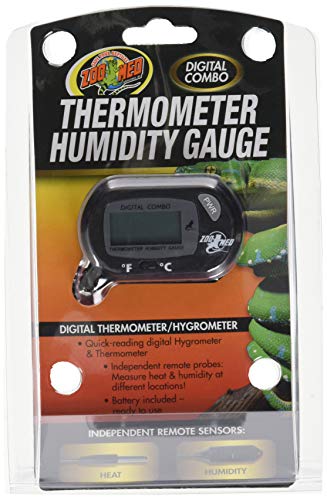
2. Zoo Med Digital Thermometer Humidity Gauge
Best Value
Zoo Med Digital Thermometer Humidity Gauge
Pros
- •Simple and intuitive operation
- •External probe allows for precise placement in the enclosure
- •Reliable readings from a trusted reptile brand
- •Affordable option for basic monitoring needs
Cons
- •No advanced features like data logging or remote access
- •Monitors only a single point within the enclosure
- •Requires manual checking of readings
Bottom Line
A straightforward and dependable device, this hygrometer provides essential temperature and humidity readings via an external probe. Its reliability and ease of use make it a solid choice for fundamental enclosure monitoring.
3. REPTI ZOO Reptile Terrarium Thermometer Hygrometer
Editor's Choice
REPTI ZOO Reptile Terrarium Thermometer Hygrometer
Pros
- •Dual probes enable monitoring of two distinct zones simultaneously
- •Excellent for establishing and tracking environmental gradients
- •Large, easy-to-read digital display for both probes
- •Ideal for larger terrariums or complex setups
Cons
- •Wired probes can be visible or require careful routing
- •No remote monitoring or data logging capabilities
- •May be excessive for very small or simple enclosures
Bottom Line
Featuring dual probes, this unit is ideal for comprehensive monitoring of temperature and humidity gradients across different zones within an enclosure. It offers a clear, consolidated display for convenient readings from both hot and cool ends.
Types of Reptile Hygrometers: Digital vs. Analog
You'll generally find two types of hygrometers available for reptile enclosures: the cheap, old-school analog dials and the modern digital units. Let's be perfectly clear: one is a reliable tool, and the other is little more than a decoration.
Analog (Dial) Hygrometers
These are the circular gauges with a needle that points to the humidity level. They typically work using a small, coiled piece of metal that expands or contracts with moisture changes. You’ll often find them sold in cheap combo packs with a matching thermometer.
Pros:
- Inexpensive.
- Don't require batteries.
Cons:
- Wildly Inaccurate: It's not uncommon for these to be off by 20% or more right out of the box. That level of inaccuracy is dangerous.
- Prone to Failure: The mechanism can easily get stuck or break, especially in a high-humidity environment.
- Difficult to Read: You have to guess where the little needle is pointing.
- Dangerous Adhesives: Most come with an adhesive pad on the back. If the gauge falls off the wall, your reptile can get stuck to the adhesive, leading to serious injury or death. This alone is a reason to never use them.
Our Verdict: Avoid analog hygrometers at all costs. They are not reliable enough for reptile safety.
Digital Hygrometers
Digital hygrometers use electronic sensors to measure water vapor and display the reading on an LCD screen. They are the undisputed champion for reptile enclosures.
Pros:
- Much More Accurate: A quality digital unit will typically be accurate to within ±2-5% humidity, which is a safe and acceptable range.
- Easy to Read: A clear, digital number is unambiguous.
- Probes for Perfect Placement: Most of the best models come with a probe on a long wire. This is a game-changer. It allows you to place the small sensor exactly where your reptile lives—down on the substrate, in a humid hide, or on the cool end—while keeping the display unit outside the tank for easy viewing.
- Helpful Features: Many include minimum/maximum memory to track fluctuations, and some even have Bluetooth or WiFi to send data and alerts to your phone.
Cons:
- Slightly more expensive (though still very affordable).
- Require batteries (which need to be changed every 6-12 months).
Our Verdict: A digital hygrometer with a probe is the only type we recommend. It's an essential, non-negotiable piece of equipment for any responsible keeper.
What to Look for in the Best Reptile Humidity Gauge
Ready to buy a digital hygrometer? Here are the key features to compare to make sure you're getting a reliable tool.
Accuracy and a Probe Are Non-Negotiable
The single most important feature is accuracy. A hygrometer that's wrong is useless. Look for models that advertise an accuracy of ±5% RH (Relative Humidity) or better. The absolute best feature for ensuring you get an accurate reading where it counts is a probe. An all-in-one unit measures the humidity where it's stuck on the glass wall, which can be very different from the humidity down in your snake's hide box. A probe lets you measure the microclimate your animal actually experiences.
Combination Thermometer/Hygrometer
Most great digital hygrometers also include a thermometer that runs off the same probe. This is incredibly efficient. You get two critical data points in one device. There's no reason not to get a combination unit, as it simplifies your setup. For monitoring your basking spot, you'll still want a dedicated infrared temperature gun, but for ambient temperatures and humidity, a combo unit is perfect.
Extra Features: Are They Worth It?
- Min/Max Memory: This feature records the highest and lowest readings over a period (usually 24 hours). It’s extremely useful for seeing if your humidity is dropping too low overnight or spiking too high after misting.
- Smart Features (Bluetooth/WiFi): Brands like [Govee](https://www.amazon.com/dp/B07Y36FWTT?tag=krawlo-20 have revolutionized enclosure monitoring. These devices connect to an app on your phone, allowing you to check conditions from anywhere. You can also set alerts—for example, if the humidity for your Ball Python drops below 55%, you'll get a notification. This is fantastic for peace of mind, especially if you're away from home. If you want to create a more automated setup, you might even consider investing in one of the best reptile egg incubators that offer similar monitoring.
Our Top Picks for the Best Reptile Humidity Gauge
(Estimates only — actual prices on Amazon may vary.)
After testing and research, these are the digital hygrometers we trust for our own reptiles.
1. Govee Bluetooth Digital Hygrometer
- Best For: The Tech-Savvy Keeper
The Govee Bluetooth Digital Hygrometer is a favorite among modern keepers for a reason. Its accuracy is top-notch (±3% RH), but its real power lies in its connectivity. The Govee Home app is intuitive and allows you to view current and historical data graphs right on your phone. You can set custom alerts for high and low humidity, giving you incredible peace of mind. It doesn't have a wired probe, but the unit is small enough to be placed discreetly inside most enclosures. For keepers who love data and remote monitoring, this is the one to get.
2. Zoo Med Digital Thermometer Humidity Gauge
- Best For: Reliability and Simplicity
[Zoo Med](https://www.amazon.com/dp/B06XY3X7P9?tag=krawlo-20 is a trusted name in reptile products, and their digital combo gauge is a reliable workhorse. It features a separate probe for temperature and humidity, allowing for precise placement. The display is simple and easy to read, and a single button switches between min/max readings. It doesn't have the bells and whistles of a smart device, but it does its core job exceptionally well. This is a go-to choice for keepers who want a dependable, no-fuss tool from a brand they know.
3. REPTI ZOO Reptile Terrarium Thermometer Hygrometer
- Best For: Dual-Zone Monitoring
The [REPTI ZOO Digital Thermometer Hygrometer](https://www.amazon.com/dp/B087P2LJ5J?tag=krawlo-20 offers a unique and incredibly useful feature: two probes. This allows you to monitor two different spots in the same enclosure simultaneously. You can place one probe on the warm end and one on the cool end to get a complete picture of your temperature and humidity gradient. The large, clear display shows all four readings at once. This is an outstanding value and is perfect for larger enclosures or for keepers who are serious about tracking their gradients.
Comparison of Top Reptile Hygrometers
| Feature | Govee Bluetooth Hygrometer | Zoo Med Digital Combo | REPTI ZOO Dual Probe |
|---|---|---|---|
| Type | Digital (Smart) | Digital | Digital |
| Probe | No (Small Unit) | Yes (Single Probe) | Yes (Dual Probes) |
| Accuracy | ~ ±3% RH | ~ ±5% RH | ~ ±5% RH |
| Price | $$ | $ | $$ |
| Special Features | Bluetooth App, Data Logging, Alerts | Min/Max Memory | Monitors 2 locations |
How to Place and Use Your Hygrometer Correctly
Buying the best reptile humidity gauge is only half the battle. Using it correctly is just as important.
As noted by the experts at The Bio Dude, probe placement is key. Where you measure matters immensely. Don't just stick the probe to the back wall and call it a day. The humidity near the top of the tank can be very different from the bottom.
- For Terrestrial (Ground-Dwelling) Reptiles: Place the sensor about 2 inches above the substrate on the cool side of the enclosure. This gives you the best general reading of what the animal is experiencing. Examples include Leopard Geckos, Corn Snakes, and Ball Pythons. For an even better picture, use a second hygrometer on the warm side.
- For Arboreal (Tree-Dwelling) Reptiles: You'll want to place the sensor in the upper half of the enclosure, near where the animal spends most of its time. However, it's still wise to have one near the bottom to monitor the overall gradient. Examples include Crested Geckos and Green Tree Pythons.
Common Mistakes to Avoid:
- Don't place the sensor right next to a water bowl. It will give you an artificially high reading of 99%.
- Don't place the probe directly under a heat lamp or on a heat mat. This will dry it out and give an artificially low reading. You need a separate tool, like a temp gun, for surface temperatures anyway, and using the right fixture is critical. Check out our guide to the best heat lamps for reptiles to learn more.
- Don't trust the suction cups. They will fail eventually. Use other methods to secure the probe wire, or simply rest the probe on the substrate or a branch.
Properly setting up the environment from the start in one of the best reptile enclosures for beginners can make managing humidity much easier.
How to Check Your Hygrometer's Accuracy (The Salt Test)
Even the best digital hygrometers can sometimes lose their calibration. It's a good practice to test yours every 6-12 months to ensure it's still accurate. The "salt test" is a simple, reliable method.
- Find a small bottle cap and fill it with regular table salt.
- Add a few drops of water—just enough to make the salt a damp slurry, not dissolved.
- Place the bottle cap and your hygrometer (or its probe) inside a sealed zip-top bag or Tupperware container.
- Seal the container and leave it undisturbed for 8-12 hours.
- After the time is up, check the reading. The saturated salt solution creates a stable micro-environment of exactly 75% relative humidity.
If your hygrometer reads between 72% and 78%, it's accurate enough for reptile keeping. If it reads 65%, you know it's off by -10%, so you can mentally add 10 to whatever it reads in your tank. If it's off by more than 15-20%, it's time to replace it.
The Final Word
Maintaining the correct humidity is not optional—it's a fundamental part of providing a healthy, thriving environment for your reptile. While it might be tempting to save a few dollars on a cheap dial gauge, the risks of inaccuracy just aren't worth it. Investing in a quality digital hygrometer with a probe is one of the smartest, simplest, and most effective things you can do as a keeper.
By taking the guesswork out of humidity management, you can prevent serious health issues and ensure your pet lives a long, comfortable life. Choose one of our recommended models, place it correctly, and you'll have the reliable data you need to be the best reptile parent you can be.
Our Final Verdict
Govee Bluetooth Digital Hygrometer
This advanced hygrometer offers unparalleled data tracking for meticulous keepers, providing real-time and historical environmental insights directly to a smartphone. Its remote monitoring and alert features ensure proactive management of enclosure conditions.
Zoo Med Digital Thermometer Humidity Gauge
A straightforward and dependable device, this hygrometer provides essential temperature and humidity readings via an external probe. Its reliability and ease of use make it a solid choice for fundamental enclosure monitoring.

REPTI ZOO Reptile Terrarium Thermometer Hygrometer
Featuring dual probes, this unit is ideal for comprehensive monitoring of temperature and humidity gradients across different zones within an enclosure. It offers a clear, consolidated display for convenient readings from both hot and cool ends.
Frequently Asked Questions
The best hygrometers for reptiles are digital models that use a probe. Digital units are far more accurate and reliable than analog dial hygrometers. A probe allows you to measure the humidity exactly where your reptile lives, such as on the cool end near the substrate, providing a much more useful reading than a unit stuck to the glass.
References & Sources
- https://www.thebiodude.com/blogs/reptile-and-amphibian-lighting-faqs-and-help/how-to-place-thermometer-and-hygrometer-probes?srsltid=AfmBOorI1pRc8IkDoYJCq8TnsKzE39MJr3NLcOS9Vz9-qiMqBxEbuVtW
- https://reptifiles.com/sudan-plated-lizard-care/sudan-plated-lizard-humidity/
- https://reptifiles.com/reptiliacare-digital-infrared-thermometer-review/
- https://reptifiles.com/ball-python-care-guide/ball-python-humidity-temperatures/
- https://reptifiles.com/boa-constrictor-care/boa-constrictor-humidity/
- https://reptifiles.com/corn-snake-care-guide/corn-snake-temperatures-humidity/
Related Articles

Best Leopard Gecko Humidity: Your Complete Guide
Struggling with shedding or respiratory issues? Our guide explains the best leopard gecko humidity levels, how to manage them, and the crucial role of a humid hide.

Best Crested Gecko Humidity: Your Complete Guide (2026)
Struggling to find the best crested gecko humidity? Our expert guide covers the ideal 60-80% range, the crucial daily cycle, and how to prevent health issues.

Best Ball Python Humidity: A Complete Guide
Struggling to find the best ball python humidity? Our expert guide demystifies ideal levels, setup, and maintenance for a healthy, thriving snake. Get it right!