5 Best UVB Lights for Blue Tongue Skinks (2026): T5 HO Fixtures Tested & Compared
Blue tongue skinks need UVB, but the right strength depends on whether yours is Australian or Indonesian. We tested T5 HO fixtures and ranked the 5 best UVB lights for BTS in 2026.


This article contains affiliate links. If you make a purchase through these links, we may earn a small commission at no extra cost to you. See our affiliate disclosure for details.
We recommend 5 picks here. Our top choice is the Arcadia ProT5 Kit 12% Desert — check price and availability below.
How we choose: we compare published specifications against the care requirements in veterinary and species-care literature, and weigh those against what long-time keepers report. We do not test products ourselves and we do not restate Amazon star ratings. The 1 sources behind this article are listed at the bottom.
Quick Comparison
- UVB Output Strength
- 12%
- Product Type
- Complete Kit
- Ferguson Zone
- Zone 3
- Mesh Screen Penetration
- Excellent
- Bulb Lifespan
- 12 months
- Recommended Mounting Height (with mesh)
- 8-10 inches
- UVB Output Strength
- 10%
- Product Type
- Bulb Only
- Ferguson Zone
- Zone 2-3
- Mesh Screen Penetration
- Good
- Bulb Lifespan
- 6 months
- Recommended Mounting Height (with mesh)
- 8 inches
- UVB Output Strength
- 7%
- Product Type
- Complete Kit
- Ferguson Zone
- Zone 2
- Mesh Screen Penetration
- Moderate
- Bulb Lifespan
- 12 months
- Recommended Mounting Height (with mesh)
- 8-9 inches
- UVB Output Strength
- Bulb-dependent
- Product Type
- Fixture Only
- Ferguson Zone
- Zone 2-3
- Mesh Screen Penetration
- Good
- Bulb Lifespan
- 6 months (bulb-dependent)
- Recommended Mounting Height (with mesh)
- 10-12 inches
- UVB Output Strength
- 6%
- Product Type
- Complete Kit
- Ferguson Zone
- Zone 2
- Mesh Screen Penetration
- Moderate
- Bulb Lifespan
- 12 months
- Recommended Mounting Height (with mesh)
- 6-8 inches
Prices are estimates only. Actual prices on Amazon may vary.
UVB lighting for blue tongue skinks is more nuanced than for most pet reptiles — and the nuance matters. The wrong UVB strength, mounted at the wrong distance, through the wrong screen material, can result in either chronic D3 deficiency or UV photokeratitis. Both are preventable, and both trace directly to misunderstanding two things: which subspecies you own, and how mesh screens interact with UVB output.
This guide covers those two topics in depth, alongside detailed reviews of the five best UVB fixtures for BTS in 2026. For the full picture of your skink's enclosure requirements, visit our Blue Tongue Skink Care Guide and Blue Tongue Skink Lighting Guide.
Quick Comparison Table
| Product | UVB Output | Type | Ferguson Zone | Mesh Penetration | Price |
|---|---|---|---|---|---|
| Arcadia ProT5 Kit 12% Desert | 12% | Kit | Zone 3 | Excellent | $$ |
| Zoo Med ReptiSun T5 HO 10.0 | 10% | Bulb Only | Zone 2-3 | Good | $ |
| Arcadia ShadeDweller ProT5 7% | 7% | Kit | Zone 2 | Moderate | $$ |
| Zoo Med T5 HO Terrarium Hood | Bulb-dependent | Fixture Only | Zone 2-3 | Good | $$ |
| Arcadia ProT5 Kit 6% Forest | 6% | Kit | Zone 2 | Moderate | $$ |
5 Best UVB Lights for Blue Tongue Skinks
Quick recommendations
Unanimous recommendation for Australian subspecies with integrated reflector providing 34% increase in usable UVB at basking distance
Most accessible quality T5 HO bulb available at major pet retailers, covers Zone 2–3 range with 6-month replacement cycle
Engineered for forest-edge habitats of Merauke, Irian Jaya, and Halmahera subspecies with Zone 2 UVI calibration
Polished aluminum reflector with rocker switch, available in 24"/30"/36" sizes for optimal enclosure coverage
Conservative UV spectrum for Indonesian species with overhead decor, 12-month bulb lifespan reduces replacement cost
Detailed Reviews
1. Arcadia ProT5 Kit 12% Desert
Best Overall
Arcadia ProT5 Kit 12% Desert
Pros
- •Integrated reflector increases UVB delivery by 34%
- •12-month bulb lifespan (vs 6-month competitors)
- •Consistent choice among experienced keepers
- •Lower per-year cost over 3-year ownership period
Cons
- •Higher upfront cost than bulb-plus-fixture combinations
Bottom Line
Integrated reflector design delivers 34% more usable UVB than bare tubes. Unanimous recommendation for Australian blue tongue skinks. 12-month bulb lifespan reduces yearly replacement costs.
2. Zoo Med ReptiSun T5 HO 10.0
Best Value
Zoo Med ReptiSun T5 HO 10.0
Pros
- •Available at PetSmart and Petco (broad retail access)
- •Quality performance across Zone 2-3
- •Flexible mounting distances for different subspecies
- •Lower initial cost than kit systems
Cons
- •6-month replacement schedule required
- •UV output declines significantly before visible light stops
Bottom Line
Quality T5 HO bulb available at major retailers. Covers upper Zone 2 and lower Zone 3, suitable for Australian and some Indonesian BTS. Requires 6-month replacement schedule.
3. Arcadia ShadeDweller ProT5 Kit 7%
Best for Indonesian Species
Arcadia ShadeDweller ProT5 Kit 7%
Pros
- •Specifically designed for Indonesian BTS habitat requirements
- •Meaningful UV at controlled Zone 2 levels
- •Pairs well with naturalistic cork bark and plant setups
- •Prevents UV photokeratitis risk from excessive exposure
Cons
- •Insufficient UV for Australian subspecies
- •Requires naturalistic enclosure setup for optimal results
Bottom Line
Purpose-engineered for forest-edge Indonesian species at Ferguson Zone 2. Provides meaningful UV at levels appropriate for Merauke, Irian Jaya, and Halmahera subspecies without photokeratitis risk.
4. Zoo Med T5 HO Terrarium Hood
Best Fixture
Zoo Med T5 HO Terrarium Hood
Pros
- •Polished aluminum reflector maximizes UV delivery
- •Available in three sizes (24", 30", 36")
- •On/off rocker switch for easy timer integration
- •Proper coverage design (60-70% of enclosure length)
Cons
- •Bulb sold separately (not a complete kit)
- •Size selection is critical for proper coverage
Bottom Line
Polished aluminum reflector fixture designed to maximize UV delivery. Available in 24", 30", and 36" lengths. On/off rocker switch integrates easily with outlet timers.
5. Arcadia ProT5 Kit 6% Forest
Budget Pick
Arcadia ProT5 Kit 6% Forest
Pros
- •12-month bulb lifespan (lowest per-year cost)
- •Appropriate for heavily planted naturalistic setups
- •Long-term value for 10-20 year BTS lifespan
Cons
- •Requires very close mounting (6-8 inches with mesh)
- •Only suitable for 24-inch tall or shorter enclosures
- •Lowest UV output of all options reviewed
Bottom Line
Conservative Zone 2 option for Indonesian BTS in heavily decorated enclosures. 12-month bulb lifespan and low per-year running costs, but requires close mounting in shorter enclosures.
Our 5 Top Picks: Detailed Reviews
1. Arcadia ProT5 Kit 12% Desert — Best Overall
The Arcadia ProT5 12% Desert is the unanimous recommendation among serious keepers for Australian blue tongue skinks — Northern, Eastern, and Blotched subspecies that live in open savanna, grassland, and coastal heathland habitats. These environments expose wild BTS to direct sun for significant portions of the active day, and the Ferguson Zone research that Arcadia bases its product line on places them firmly in Zone 3.
The integrated reflector is the engineering feature that separates this kit from most of the competition. Standard fluorescent tube housings allow a large fraction of UVB output to scatter upward and backward — wasted photons that never reach your skink. Arcadia's reflector redirects that scattered output downward, with their own measurements showing up to a 34% increase in usable UVB at basking distance compared to bare-tube installations. That efficiency gain is why experienced keepers consistently choose ProT5 kits over third-party fixture-plus-bulb combinations even when the upfront cost is higher.
At 12%, mount this fixture 12–15 inches above the basking surface without a mesh screen, or 8–10 inches with a standard aluminum mesh top (to compensate for the 30–50% mesh reduction). The 12-month bulb lifespan means you replace once per year versus twice per year for most competing T5 HO bulbs — the per-year cost difference narrows significantly when calculated over a 3-year ownership period.
[Amazon: Arcadia ProT5 Kit 12% Desert](https://www.amazon.com/dp/B0D4WNY9RL?tag=krawlo-20
2. Zoo Med ReptiSun T5 HO 10.0 — Best Value
The Zoo Med ReptiSun T5 HO 10.0 is the most accessible quality T5 HO UVB bulb in the reptile hobby — physically available at PetSmart and Petco rather than online-only — and it performs well enough for most blue tongue skink setups when installed in a reflector-equipped T5 HO hood.
At 10.0 strength (approximately 10% UVB output), the ReptiSun 10.0 covers the upper range of Zone 2 and the lower range of Zone 3. For Northern BTS with a well-designed basking zone and proper mounting distance — 12 inches above the basking surface without mesh, 8 inches with mesh — it delivers adequate D3 synthesis. For Indonesian subspecies at the lower end of Zone 2, mounting the tube 18–20 inches from the basking surface (without mesh) or 14–16 inches with mesh gives a UVI in the 1.0–2.0 range that matches forest-edge habitat exposure.
The significant caveat is the 6-month replacement schedule. Zoo Med and Arcadia both document that T5 HO tubes continue producing visible light long after UV output has declined to levels insufficient for reptile health. Set a calendar reminder and replace on schedule regardless of whether the tube appears to be functioning normally.
[Amazon: Zoo Med ReptiSun T5 HO 10.0](https://www.amazon.com/dp/B0FF9GHCDC?tag=krawlo-20
3. Arcadia ShadeDweller ProT5 Kit 7% — Best for Indonesian Species
The ShadeDweller ProT5 7% is specifically engineered for reptiles that occupy forest-edge, scrubland, and light woodland habitats — exactly the environment Merauke, Irian Jaya, and Halmahera blue tongue skinks come from. Wild Indonesian BTS experience UV through vegetation canopy, at forest margins, and during brief morning basking periods rather than midday open-habitat exposure.
At 7% UVB, this kit produces a UV index of approximately 2.5–3.5 at the recommended mounting distance of 12 inches without mesh, or 8–9 inches with mesh — calibrated to Ferguson Zone 2. Crucially, the ShadeDweller is not a low-UVB fixture in the sense of providing negligible UV. It provides meaningful UV at controlled levels appropriate for subspecies that lack the behavioral adaptations — specifically the ability to seek deep shade quickly in dry, open terrain — that allow Australian species to self-regulate under more intense UV sources.
For a complete Indonesian BTS enclosure setup, the ShadeDweller pairs well with a dense cork bark and artificial plant ceiling structure that creates natural UV gradients. See our Blue Tongue Skink Heating Guide for complementary thermal gradient setup.
Amazon: Arcadia ShadeDweller ProT5 Kit 7%
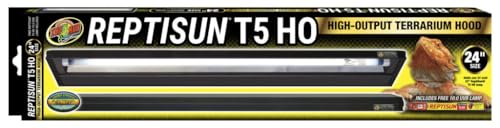
4. Zoo Med T5 HO Terrarium Hood — Best Fixture
If you prefer the Zoo Med ReptiSun bulb ecosystem but want a proper fixture rather than a bare strip light, the T5 HO Terrarium Hood is the right hardware investment. The polished aluminum reflector is the key upgrade — generic hardware-store shop lights use uncoated metal or plastic reflectors that absorb or scatter a meaningful fraction of UVB output, while the Hood's reflector is designed to maximize UV delivery through the enclosure screen.
Size matters for BTS enclosures: the Hood is available in 24", 30", and 36" lengths. The fixture length should span at least 60–70% of the enclosure's length to provide meaningful UV coverage across the transition zone between the basking area and the cooler end, rather than a single concentrated spotlight that forces the skink to choose between thermal comfort and UV access.
The on/off rocker switch is a genuine keeper convenience. When connected to a standard outlet timer, the fixture cycles on your photoperiod schedule without requiring a separate relay or smart plug for the switching function.
[Amazon: Zoo Med T5 HO Terrarium Hood](https://www.amazon.com/dp/B00M9ONY1W?tag=krawlo-20
5. Arcadia ProT5 Kit 6% Forest — Budget Pick for Indonesian BTS
The Arcadia ProT5 6% Forest sits at the conservative end of the UV spectrum for Indonesian blue tongue skinks. Where the ShadeDweller 7% covers the midpoint of Zone 2, the 6% Forest addresses setups where overhead decor further attenuates UV before it reaches the basking surface — a common situation in naturalistic Indonesian enclosures with significant cork bark and leaf litter overhead coverage.
At 6% UVB, this kit requires close mounting — 8–10 inches without mesh, 6–8 inches with mesh — to achieve UV indices at the low end of Ferguson Zone 2. In practice, this means the fixture works best in 24-inch tall or shorter enclosures where these mounting distances are achievable without other hardware modifications.
The 12-month bulb lifespan reduces the per-year running cost compared to Zoo Med's 6-month schedule, which matters over the 10–20 year lifespan of a healthy blue tongue skink.
[Amazon: Arcadia ProT5 Kit 6% Forest](https://www.amazon.com/dp/B0CGY3DZ57?tag=krawlo-20
Ferguson Zones Explained: What UVB Strength Does Your BTS Actually Need?
The Ferguson Zone system is the most important framework for understanding reptile UVB requirements — and it is directly applicable to the subspecies split in blue tongue skinks. Published by Dr. Gary Ferguson in 2010 and adopted by Arcadia as the basis for its product line, the system classifies reptiles into four zones based on their wild UV exposure patterns:
- Zone 1 — Crepuscular or fossorial species: minimal UV exposure, active at dawn/dusk or underground
- Zone 2 — Forest-edge and shrubland species: moderate UV exposure, basking briefly in dappled or partial sun
- Zone 3 — Open-habitat baskers: regular UV exposure, basking in full sun for substantial daily periods
- Zone 4 — Desert high-noon baskers: extreme UV exposure, active in midday open desert sun
Blue tongue skinks span Zones 2–3 depending on subspecies:
| Subspecies | Origin | Habitat | Ferguson Zone | Recommended UVB |
|---|---|---|---|---|
| Northern BTS (T. s. intermedia) | Northern Australia | Open savanna/grassland | Zone 3 | 10–12% |
| Eastern BTS (T. s. scincoides) | Eastern Australia | Open woodland/coastal heathland | Zone 3 | 10–12% |
| Blotched BTS (T. nigrolutea) | Southern Australia | Rocky grassland/shrubland | Zone 2-3 | 10% |
| Merauke BTS (T. gigas evanescens) | Southern New Guinea | Savanna-forest edge | Zone 2-3 | 7–10% |
| Irian Jaya BTS (T. s. chimaerea) | Western New Guinea | Forest edge/shrubland | Zone 2 | 6–7% |
| Halmahera BTS (T. s. chimaerea) | Maluku Islands | Tropical forest edge | Zone 2 | 6–7% |
This table explains why a single UVB strength recommendation cannot apply to all blue tongue skinks. Applying a 12% Desert tube to an Irian Jaya BTS — if the animal cannot access adequate shade — risks UV photokeratitis, a painful eye condition caused by excessive UV-B exposure. Conversely, using a 6% Forest tube for a Northern BTS deprives it of the UV index needed for adequate D3 photosynthesis.
If you are uncertain which subspecies you own, visit our Blue Tongue Skink Care Guide for subspecies identification guidance.
The Mesh Screen Problem: How Screen Tops Cut UVB by 30–50%
Aluminum mesh screen tops — the standard screen found on most commercially available wooden and PVC enclosures — are one of the most misunderstood variables in reptile UVB setup. Keeper data and Arcadia's published testing consistently show that standard aluminum mesh reduces UVB transmission by 30–50%, depending on mesh gauge and wire diameter.
The practical implications:
If your enclosure has a mesh top, you need to:
- Mount your UVB tube 30–50% closer than the recommended distance for open-top installations
- Or choose a higher-output tube to compensate for the mesh transmission loss
- Or replace your mesh top with a glass or acrylic top and mount the tube internally — though this creates heat management challenges
A keeper using the Zoo Med ReptiSun T5 HO 10.0 in a Zoo Med Terrarium Hood, mounted at 18 inches above their basking spot through a standard mesh screen, is likely delivering a UVI of 0.5–1.0 — at the very bottom of Zone 2 and below the adequate threshold for Australian BTS subspecies. Moving the same fixture to 10–12 inches above the mesh immediately doubles the effective UV index at the basking surface.
Material matters more than weave pattern. Aluminum window screen (the fine gray mesh found on most enclosures) transmits 30–40% less UV than the bulkier woven wire mesh found on some higher-end enclosures. Fiberglass screen transmits almost no UV and should never be used above a reptile enclosure if UVB is provided externally.
For keepers using tube-inside-enclosure mounts — where the tube is fitted inside the lid panel with no mesh obstruction — distances can be extended significantly. In this configuration, a 12% T5 HO tube can be mounted 20–24 inches above the basking surface and still deliver Zone 3 UV indices.
For enclosure selection guidance, including which enclosure types allow internal tube mounting, see our Best Blue Tongue Skink Enclosures guide.
Mounting Distance Chart by Enclosure Type
The following distances represent the mounting height above the basking surface (not the enclosure floor) that produces UV indices in the center of each Ferguson Zone range.
| Fixture | Without Mesh | With Aluminum Mesh | Target Zone |
|---|---|---|---|
| Arcadia ProT5 12% Desert | 12–18" | 8–12" | Zone 3 |
| Zoo Med ReptiSun T5 HO 10.0 | 10–14" | 7–10" | Zone 2-3 |
| Arcadia ShadeDweller 7% | 10–14" | 7–9" | Zone 2 |
| Arcadia ProT5 6% Forest | 8–10" | 6–8" | Zone 2 (low) |
Important: These are starting point distances, not precise prescriptions. The only way to know your actual UVI at the basking spot is to measure with a Solarmeter 6.5 (the reptile keeper standard for UV index measurement). Distances vary based on reflector quality, tube age, and enclosure reflectivity. A Solarmeter measurement removes all the guesswork.
Standard enclosure mounting examples:
- 4x2x2 PVC enclosure (Northern BTS): Arcadia ProT5 12% mounted 10–12 inches above the basking platform through mesh = Zone 3 UVI
- 4x2x2 PVC enclosure (Indonesian BTS): Arcadia ShadeDweller 7% mounted 12–14 inches above the basking platform through mesh = Zone 2 UVI
- 36" glass terrarium with screen lid (Northern BTS): Zoo Med ReptiSun 10.0 in T5 HO Hood mounted 8–10 inches above basking platform through mesh = Zone 2-3 UVI
How We Chose These Lights
Our selection criteria for blue tongue skink UVB fixtures focused on three factors that keeper communities and published reptile husbandry research consistently identify as the variables that matter:
T5 HO technology only. T8 fluorescent tubes, compact fluorescent coil UVB bulbs ("screw-in" types), and mercury vapor bulbs were excluded. T5 HO is the current standard of care in the reptile hobby for good reason: higher output per watt, longer effective lifespan, and better UVI penetration at usable distances than any of the alternatives. Mercury vapor bulbs are appropriate for very large or tall enclosures but not for the 4x2x2 enclosure configurations that most BTS keepers use.
Reflector quality. A tube without a quality reflector wastes 30–40% of its output. Every product on this list either includes a high-quality integrated reflector or is recommended specifically as a fixture to pair with a high-quality bulb. Generic strip-light fixtures without reflectors were excluded.
Subspecies appropriateness. A fixture that is excellent for Australian BTS is inappropriate for Indonesian BTS. We evaluated each product against the full range of BTS subspecies and assigned recommendations accordingly.
Tube lifespan and ongoing cost. A $25 bulb on a 6-month replacement schedule costs $50/year. A $55 kit with a 12-month bulb represents a lower annual cost when fixture quality is equivalent. We factored total cost of ownership, not just upfront price.
For a complete overview of blue tongue skink lighting requirements beyond UVB — photoperiod, visible light spectrum, and seasonal variation — see our Blue Tongue Skink Lighting Guide.
Our Final Verdict

Arcadia ProT5 Kit 12% Desert
Integrated reflector design delivers 34% more usable UVB than bare tubes. Unanimous recommendation for Australian blue tongue skinks. 12-month bulb lifespan reduces yearly replacement costs.
Zoo Med ReptiSun T5 HO 10.0
Quality T5 HO bulb available at major retailers. Covers upper Zone 2 and lower Zone 3, suitable for Australian and some Indonesian BTS. Requires 6-month replacement schedule.
Arcadia ShadeDweller ProT5 Kit 7%
Purpose-engineered for forest-edge Indonesian species at Ferguson Zone 2. Provides meaningful UV at levels appropriate for Merauke, Irian Jaya, and Halmahera subspecies without photokeratitis risk.
Frequently Asked Questions
Yes — unambiguously. UV-B driven D3 synthesis is well established in lizard biology, and metabolic bone disease is documented in BTS maintained without UVB and without adequate oral D3 supplementation. Photosynthetic D3 is more bioavailable and self-regulating than oral supplementation. UVB is the superior solution and is now considered a standard of care for blue tongue skinks.
References & Sources
Related Articles

Best Blue Tongue Skink Starter Kit: Ultimate Guide
Discover the best blue tongue skink starter kit with practical advice on enclosure, substrate, heat, lighting, and more!

Best Blue Tongue Skink Lighting: A Complete Guide (2026)
Confused about the best blue tongue skink lighting? Our guide covers everything from UVB percentages (T5 vs T8) to the right heat lamps for a happy, healthy skink.

6 Best Blue Tongue Skink Heating and Lighting Setups (2026)
Blue tongue skinks need a 100-110°F basking surface, meaningful UVB (Ferguson Zone 3), and overhead heat only — no UTH. These 6 picks cover every part of that setup, from deep IR heat projectors to proportional thermostats, with honest notes on what each product does and does not do well.