
Blue Tongue Skink Lighting Guide: UVB, Ferguson Zones & Subspecies Photoperiods
Blue tongue skinks need Zone 3-4 UVB — not optional. Learn T5 HO vs mercury vapor for BTS, Ferguson zones explained, and subspecies photoperiod differences.

✓Recommended Gear
In this guide, we cover everything you need to know and recommend 6 essential products. Check prices and availability below.
TL;DR: Blue tongue skinks require UVB at Ferguson Zone 3, meaning a T5 HO 10% UVB bulb placed 12-18 inches above the basking area for 10-12 hours daily. Skipping UVB or using weak coil bulbs risks metabolic bone disease within months; Indonesian subspecies need slightly less UVB intensity than Northern BTS.
Here's a scenario that plays out constantly in reptile forums: a keeper buys a blue tongue skink, reads that they're "easy lizards," sets them up with a heat mat and a weak UVB coil bulb, and wonders six months later why their skink is lethargic and refusing food. The vet's diagnosis? Early metabolic bone disease — from a reptile that most people assume doesn't need serious lighting.
Blue tongue skinks are not crested geckos. They are not leopard geckos. They are large, diurnal, ground-basking lizards from habitats that receive intense daily sun exposure — and their UVB requirements reflect that. The "skinks are hardy, lighting is secondary" myth has quietly caused preventable illness in thousands of captive animals.
This guide cuts through the confusion. We'll cover exactly which Ferguson Zone BTS occupy, why the T5 HO versus mercury vapor debate matters specifically for this species, and how Indonesian, Northern, and Eastern subspecies have different photoperiod needs that most guides completely ignore. If you own a blue tongue skink, this is the lighting resource you need.
The Ferguson Zone Debate: Why Skinks Need Zone 3-4 UVB
Blue tongue skinks fall into Ferguson Zone 3, with some populations approaching Zone 4 behavior. This places them in the same UV tier as bearded dragons — far above the "ambient UVB is fine" category that applies to crepuscular or forest-floor species.
The Ferguson Zone system was developed by herpetologist Gary Ferguson and colleagues to categorize reptile species by their natural sun exposure habits. The four zones range from Zone 1 (deep shade dwellers, rarely bask) to Zone 4 (open-sun heliotherms, maximum UV exposure). Zone placement determines what UVI range a captive animal needs at its basking spot.
What Zone 3-4 Actually Means in Practice
Zone 3 animals spend significant time in open sun, regularly basking at UV Index readings of 2.6–7.4 during peak hours. Zone 4 animals push even higher. Wild BTS in eastern and northern Australia have been observed basking in full open sun during morning hours with UV indices well above 3.
Here's what that means for your enclosure:
- Target UVI at basking spot: 3.0–5.0 (measured at the skink's dorsal surface height)
- A weak coil UVB bulb that delivers UVI 0.5–1.5 at basking distance is not sufficient
- A T5 HO tube at appropriate mounting distance is the minimum acceptable solution
- No UVB at all — a depressingly common setup — creates a slow vitamin D3 deficit that may take months to manifest visibly
Why BTS Are Different from Leopard Geckos
The debate about whether leopard geckos need UVB is genuine — they are crepuscular Zone 1 species that historically managed without it in captivity, supplementing vitamin D3 orally. That debate does not apply to BTS.
BTS are diurnal, open-habitat baskers. Their physiology is calibrated to synthesize vitamin D3 photosynthetically, and their calcium demands are enormous relative to body size. A large skink eating whole prey and leafy greens every few days has significant calcium turnover — and inadequate D3 means inadequate calcium absorption regardless of how carefully you dust feeders.
Pro Tip: Oral vitamin D3 supplements help but cannot fully replace UVB. The photosynthetic process is self-regulating — your skink cannot overdose on UV-produced D3. Supplemental D3 carries a real toxicity risk at high doses. The safest approach is strong UVB plus moderate D3 dusting.
The Ferguson Zone Classification for Common BTS Subspecies
| Subspecies | Ferguson Zone | Target UVI at Basking Spot | Notes |
|---|---|---|---|
| Northern BTS (T. s. intermedia) | Zone 3–4 | 3.0–5.0 | Most sun-exposed natural habitat |
| Eastern BTS (T. s. scincoides) | Zone 3 | 2.6–4.0 | Open woodland, strong daily basking |
| Indonesian BTS (T. s. gigas, T. s. halmahera) | Zone 2–3 | 2.0–3.5 | More forested, shorter basking windows |
| Merauke (T. s. merauke) | Zone 3 | 2.6–4.0 | Similar to Eastern in UV needs |
According to Frances Baines' UV Guide, proper UV gradient mapping across the enclosure matters as much as the peak UVI figure — your skink should be able to move through a UVI gradient from high-UV basking zone to low-UV retreat.
Mercury Vapor vs T5 HO for Blue Tongue Skinks
The short answer: T5 HO wins for most BTS keepers. Mercury vapor bulbs are not useless, but the control trade-offs matter significantly for a large species with substantial heat requirements.
This debate is more relevant for BTS than for most other commonly kept lizards, for two reasons:
- BTS enclosures are large (minimum 4×2×2 ft for an adult), which changes the physics of UVB distribution
- BTS require a meaningful basking temperature — 95–105°F surface — which creates heat management complexity when heat and UVB are bundled
T5 HO: The Recommended Approach
A T5 HO fluorescent tube gives you independent control over heat and UVB. You dial in UVB output by choosing the tube percentage and mounting distance. You dial in basking temperature separately using a halogen or ceramic heat emitter on a dimmer thermostat.
For BTS, the recommended T5 HO options are:
**[Arcadia T5 HO 12% D3+ UVB](https://www.amazon.com/dp/B0D4WNY9RL?tag=krawlo-20 — The Arcadia 12% D3+ is specifically formulated for Zone 3 species. It delivers the UVI 3–5 range at appropriate mounting distances without overshooting into Zone 4 territory. Arcadia's quality control and spectral data are the industry standard. Pair it with the **[Arcadia ProT5 fixture](https://www.amazon.com/dp/B0CP68YJ1W?tag=krawlo-20 which is engineered for the tube and includes a high-efficiency reflector.
**[Zoo Med ReptiSun T5 HO 10.0](https://www.amazon.com/dp/B0FF9GHCDC?tag=krawlo-20 — Widely available and reliable. At 10% UVB output it's slightly below the Arcadia 12%, but at the correct mounting distance it achieves adequate UVI for Zone 3 BTS. Recommended mounting distance: 8–12 inches above the basking spot with mesh screen.
Pro Tip: Use a **[Solarmeter 6.5 UV Index Meter](https://www.amazon.com/dp/B076GXJFJG?tag=krawlo-20 to verify your actual UVI at the basking spot. Hold it at the height of your skink's back and aim at the tube. Target 3.0–5.0 for Northern/Eastern BTS, 2.0–3.5 for Indonesians. This tool removes all guesswork and is used by professional reptile facilities worldwide.
Mercury Vapor Bulbs: When They Make Sense
Mercury vapor bulbs (MVBs) like the **[Mega-Ray Mercury Vapor Bulb](https://www.amazon.com/dp/B00TQG6DRI?tag=krawlo-20 produce both heat and UVB in one fixture. They are a legitimate option — but with important caveats for BTS.
MVB advantages:
- Single fixture provides both basking heat and UVB
- Strong UVB output over a wide cone
- High visible light output — stimulates natural activity
- Good choice for very large enclosures (6×2×2 ft+) where one heat source may be insufficient
MVB disadvantages for BTS:
- Cannot separate heat and UVB control — if your basking spot is too hot, you cannot reduce wattage without also reducing UVB
- Cannot use with a dimmer thermostat (required for proper temperature regulation)
- Must be mounted at a fixed distance from the basking spot — any repositioning changes both variables simultaneously
- Higher upfront cost; bulbs burn out completely rather than degrading gradually
- Generates intense heat in a small focal point — can cause thermal burns if basking platform is too close
Bottom line: MVBs work in large, tall enclosures where the mounting distance is fixed and the natural heat dissipation at that distance lands in the correct basking temperature range for your specific BTS. For most keepers in standard 4×2×2 ft enclosures, separate T5 HO + halogen is easier to control and dial in correctly.
If you want to explore MVBs further, check our general reptile lighting guide which covers MVB wattage selection in detail.
Side-by-Side Comparison
| Factor | T5 HO + Halogen | Mercury Vapor Bulb |
|---|---|---|
| Heat/UVB independence | Full — adjust each separately | None — coupled |
| Thermostat compatibility | Yes (halogen on dimmer) | No |
| Coverage area | Wide linear zone | Cone from single point |
| Cost to start | ~$80–120 combined | ~$60–90 per bulb |
| Best enclosure size | 4×2×2 ft standard | 6×2×2 ft+ |
| Replacement interval | T5 every 6–12 months | Replace when burnt out |
Arcadia T5 HO 12% D3+ UVB Tube
The Zone 3 standard — specifically formulated for diurnal ground-basking species like blue tongue skinks, with independently verified spectral output data.
Check Price on Amazon
Arcadia ProT5 UVB Fixture
Engineered to match Arcadia T5 HO tubes with a high-efficiency reflector that maximizes UVB delivery into the enclosure.
Check Price on Amazon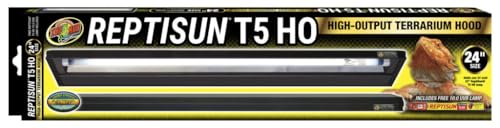
Zoo Med ReptiSun T5 HO 10.0 UVB
Widely available reliable alternative to Arcadia — delivers adequate Zone 3 UVI at correct mounting distances for BTS enclosures.
Check Price on Amazon
Mega-Ray Mercury Vapor Bulb
Best MVB option for large BTS enclosures (6×2×2 ft+) where combined heat and UVB in a single fixture is practical.
Check Price on AmazonT5 HO vs Mercury Vapor for Blue Tongue Skinks
Side-by-side comparison
| Feature | T5 HO (Recommended) | Mercury Vapor |
|---|---|---|
| Heat & UVB control | ★Independent (separate heat source) | Bundled (cannot adjust separately) |
| Thermostat compatible | ★Yes (dimmer thermostat) | No (fixed distance) |
| Basking temperature flexibility | ★Full control | Limited (heat and UVB linked) |
| Visible light output | Good | ★Higher |
| Large enclosures (6×2×2 ft+) | May need additional heat | ★Wide coverage in one fixture |
| Initial cost | ★Lower ($150–250) | Higher ($250–400) |
Our Take: T5 HO wins for most BTS keepers because independent heat control is critical for proper basking temperature regulation in large enclosures.
Setting Up UVB Correctly in a BTS Enclosure
Position the UVB tube over the basking half of the enclosure, spanning at least 50% of total enclosure length. In a standard 4-ft enclosure, a 34-inch tube covers the basking zone appropriately.
Mounting Distance for BTS
BTS are ground dwellers, which means mounting distance is measured from the tube to the enclosure floor — or more precisely, to the height of the skink's back as it basks on the substrate or a low platform. This is typically 4–8 inches lower than the mounting calculation for an arboreal species on a high branch.
For a 4×2×2 ft enclosure with standard metal mesh top:
- Arcadia T5 HO 12%: Mount 10–14 inches above the basking surface
- Zoo Med ReptiSun T5 HO 10.0: Mount 8–12 inches above the basking surface
Metal mesh blocks 30–50% of UVB output. Place the fixture directly on top of the mesh — do not elevate it on a riser or shelf above the screen.
UVB Gradient Across the Enclosure
Your BTS should have access to a full UVB gradient:
- Basking zone (basking end): UVI 3.0–5.0
- Mid-enclosure: UVI 1.0–3.0 (transition zone)
- Cool retreat (far end): UVI < 1.0 (low-UV hide available)
This gradient allows the skink to self-regulate UV exposure. BTS in the wild actively move in and out of sun — they are not passive UV recipients. Giving them a gradient replicates this natural behavior.
Pro Tip: Place a flat piece of slate or a reptile basking tile at the basking spot. It absorbs radiant heat and raises the surface temperature efficiently. Because BTS are ground dwellers, a flat, heat-retaining surface matters more than an elevated branch or platform.
The [Zoo Med Combo Deep Dome](https://www.amazon.com/dp/B01CSABDYQ?tag=krawlo-20 for Heat
For the basking heat lamp, a dual-lamp dome fixture lets you run the halogen basking bulb alongside a secondary ceramic heat emitter in one unit. The Zoo Med Combo Deep Dome is well-suited to BTS setups — its deep reflector concentrates heat efficiently for a ground-dwelling animal, and the two sockets allow you to run a halogen on one socket and a CHE on the other for nighttime heat maintenance.
Pair it with a **[digital reptile thermometer](https://www.amazon.com/dp/B08R65W98H?tag=krawlo-20 with a probe placed directly on the basking surface. For BTS, basking surface temperature should read 95–105°F. Ambient cool side should stay 75–80°F.

Solarmeter 6.5 UV Index Meter
The professional-grade tool for verifying actual UVI at your skink's basking spot — removes all guesswork from lighting setup.
Check Price on Amazon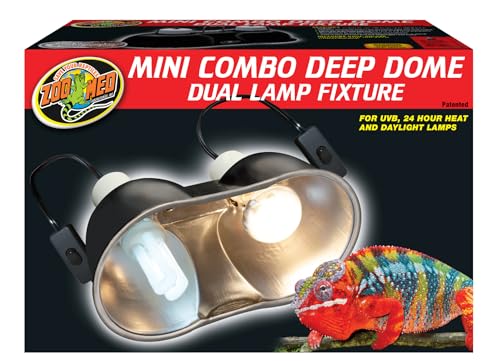
Zoo Med Combo Deep Dome Lamp Fixture
Dual-socket dome allows running a halogen basking bulb and ceramic heat emitter together — ideal for BTS enclosures that need day and night heat management.
Check Price on AmazonLighting by Subspecies: Indonesian vs Northern vs Eastern
Different BTS subspecies come from genuinely different climates — and their photoperiod and UVB needs differ accordingly. This is one of the most overlooked aspects of BTS husbandry, and most generic guides skip it entirely.
Northern Blue Tongue Skink (T. s. intermedia)
Northern BTS come from the tropical savanna of northern Australia — Darwin, Arnhem Land, the Kimberley. This habitat has a distinct wet season (November–April) and dry season (May–October), with day length varying from about 11.5 hours in winter to 13 hours in summer.
Key photoperiod considerations:
- Northern BTS experience the least seasonal day-length variation of the Australian subspecies
- They are accustomed to consistently warm ambient temperatures year-round
- UVB requirements are the highest of the BTS group — they live in open savanna with minimal canopy cover
- Recommended captive photoperiod: 12–13 hours in summer, 11–12 hours in winter
Eastern Blue Tongue Skink (T. s. scincoides)
Eastern BTS come from southeastern Australia — New South Wales, Victoria, South Australia — with a more temperate climate and greater seasonal variation. Day length in Sydney ranges from 9.5 hours in winter to 14.5 hours in summer.
Key photoperiod considerations:
- Eastern BTS experience the greatest seasonal day-length variation
- They naturally undergo a period of reduced activity in winter (not true brumation, but slowed metabolism)
- Mimicking seasonal photoperiod change with Eastern BTS often produces better feeding behavior, breeding response, and overall vitality
- Recommended captive photoperiod: 14 hours in summer, 10–11 hours in winter, with 4–6 week transitional ramps
- Reduced winter photoperiod + cooler ambient temperatures (70–75°F cool side) is appropriate and natural
Indonesian Blue Tongue Skink (T. s. gigas, T. s. halmahera, Irian Jaya)
Indonesian BTS originate near the equator — Sulawesi, Halmahera, New Guinea. Equatorial day length barely varies: roughly 12 hours year-round.
Key photoperiod considerations:
- Indonesian BTS do not experience meaningful seasonal variation in nature — a static photoperiod is physiologically appropriate
- They come from more forested, humid habitats — their UV exposure in the wild is somewhat lower than Australian subspecies
- UVB requirement is still significant (Zone 2–3), but the target UVI at the basking spot can be on the lower end: 2.0–3.5
- Recommended captive photoperiod: 12 hours year-round — consistent, minimal seasonal adjustment
- These subspecies do NOT need or benefit from winter photoperiod reduction; forcing it may cause stress or appetite loss
Photoperiod at a Glance
| Subspecies | Summer Photoperiod | Winter Photoperiod | Seasonal Change? |
|---|---|---|---|
| Northern (intermedia) | 13 hours | 11–12 hours | Mild — 1–2 hours |
| Eastern (scincoides) | 14 hours | 10–11 hours | Significant — 3–4 hours |
| Indonesian (gigas, halmahera) | 12 hours | 12 hours | None |
| Merauke (merauke) | 12–13 hours | 11–12 hours | Mild |
Use a programmable timer to manage photoperiod changes. A reptile light timer with independent on/off scheduling lets you gradually shift photoperiod over several weeks rather than abruptly switching — which more closely mimics natural seasonal change.
Pro Tip: For Eastern BTS, a gradual 4–6 week photoperiod reduction into winter (losing 15–20 minutes per week) is more natural than a sudden shift. Many keepers report improved spring appetite and breeding readiness when they've mimicked this gradual seasonal change.
UVB Tube Replacement and Maintenance
Replace your T5 HO tube every 6–12 months, even if it still produces visible light. The UV-producing phosphors in fluorescent tubes degrade faster than the visible-light phosphors. A one-year-old tube that glows brightly may be delivering as little as 40% of its original UVB output.
Replacement Schedule by Manufacturer
| Tube | Recommended Interval | Notes |
|---|---|---|
| Arcadia T5 HO 12% D3+ | Every 12 months | Arcadia's own data; many keepers replace at 9 months |
| Zoo Med ReptiSun T5 HO 10.0 | Every 6 months | Zoo Med recommends 6-month replacement for T5 HO |
| Any MVB | Replace when burnt out | No gradual degradation — failure is sudden |
Mark the installation date on the tube with a permanent marker. Set a phone calendar reminder. If you acquired your setup used and don't know when the tube was last replaced, replace it now — the cost of a new tube is negligible compared to the cost of treating MBD.
What Blocks UVB (and How to Avoid It)
- Glass: Blocks virtually all UVB. Never mount a UVB tube above a glass lid.
- Acrylic/plastic panels: Block 50–90% of UVB. Do not use plastic covers under your tube.
- Metal mesh: Blocks 30–50%. Mount the tube directly on top of mesh, no gap.
- Fiberglass screen: Blocks significantly more than metal mesh — treat like glass.
For a blue tongue skink enclosure, a PVC or wood enclosure with a metal mesh section directly above the basking zone gives you the best UVB transmission. See our best blue tongue skink enclosures guide for specific enclosure recommendations that pair well with this lighting setup.
Common BTS Lighting Mistakes
These are the errors that show up repeatedly in the BTS keeper community — learn them so you don't repeat them.
Treating BTS like leopard geckos. Leopard geckos are Zone 1 crepuscular species — the UVB debate for them is genuine. For BTS, it is not. BTS need strong UVB, full stop.
Using an Indonesian subspecies photoperiod schedule for an Eastern BTS. Applying a static 12-hour photoperiod to an Eastern BTS denies it the seasonal variation its biology expects. This can suppress breeding behavior and cause year-round ambient activity that wears on the animal.
Mounting the UVB tube over the cool end. BTS spend their basking hours under the heat lamp — if the UVB tube is at the opposite end, they receive almost no UV while basking. The UVB zone and the basking zone must overlap.
Not accounting for ground-dweller geometry. A tube mounted 18 inches from the floor in a 2-ft tall enclosure delivers much weaker UVI at ground level than the same tube would deliver to an arboreal species perched near the top. Calculate mounting distance from the tube to the actual basking surface height, not the enclosure floor.
Using a coil UVB bulb as the primary source. Coil UVB bulbs cannot achieve UVI 3–5 at the 10–14 inch distances appropriate for BTS. They produce a narrow UV hotspot with negligible output at the edges. A T5 HO tube is not optional — it is the minimum for adequate UV coverage in a BTS enclosure.
Running MVB without temperature verification. If you use a mercury vapor bulb, the basking surface temperature must be verified with an IR thermometer or probe thermometer at the basking spot. MVBs run hot — without measurement, thermal burns are a real risk.
Lighting Checklist Before Your Skink Goes In
Before placing your BTS in the enclosure, verify every item:
- T5 HO UVB tube (Arcadia 12% D3+ or Zoo Med ReptiSun 10.0) spanning at least 50% of enclosure length
- T5 HO fixture (Arcadia ProT5 or equivalent) mounted directly on top of metal mesh
- Mounting distance: 10–14 inches above basking surface (measured from tube to skink dorsal height)
- Basking surface temperature verified at 95–105°F with probe thermometer
- Cool-side ambient temperature verified at 75–80°F
- Photoperiod programmed for your subspecies (12 hours for Indonesians, 13–14 hours summer for Australians)
- Tube installation date marked — replacement reminder set
- UVB tube positioned over basking zone (not cool zone)
- Low-UV retreat available at cool end
Ready to buy the right gear? See our curated list at best UVB fixture and best reptile light timer for vetted picks at every price point.
Recommended Gear
Arcadia T5 HO 12% D3+ UVB Tube
The Zone 3 standard — specifically formulated for diurnal ground-basking species like blue tongue skinks, with independently verified spectral output data.
Check Price on AmazonArcadia ProT5 UVB Fixture
Engineered to match Arcadia T5 HO tubes with a high-efficiency reflector that maximizes UVB delivery into the enclosure.
Check Price on AmazonZoo Med ReptiSun T5 HO 10.0 UVB
Widely available reliable alternative to Arcadia — delivers adequate Zone 3 UVI at correct mounting distances for BTS enclosures.
Check Price on AmazonMega-Ray Mercury Vapor Bulb
Best MVB option for large BTS enclosures (6×2×2 ft+) where combined heat and UVB in a single fixture is practical.
Check Price on AmazonSolarmeter 6.5 UV Index Meter
The professional-grade tool for verifying actual UVI at your skink's basking spot — removes all guesswork from lighting setup.
Check Price on AmazonZoo Med Combo Deep Dome Lamp Fixture
Dual-socket dome allows running a halogen basking bulb and ceramic heat emitter together — ideal for BTS enclosures that need day and night heat management.
Check Price on AmazonFrequently Asked Questions
BTS genuinely need UVB — they are Zone 3 diurnal baskers, not crepuscular geckos where the debate is legitimate. Oral D3 supplementation helps but cannot fully replace photosynthetic D3 production, and excessive oral D3 risks toxicity. Strong UVB plus moderate supplemental dusting is the safest and most effective approach.
References & Sources
Related Articles

Blue Tongue Skink Tank Setup: Enclosure Size, Substrate & Heating Guide
Forget the pet store 40-gallon advice—blue tongue skinks need at least 4×2×2 feet. This setup guide covers everything from substrate depth to basking temperatures.

Blue Tongue Skink Heating Guide: Temperatures, Subspecies & Real Setup Advice
Blue tongue skink heating guide: Indonesian vs Northern BTS temperature differences, Deep Heat Projectors vs halogen bulbs, and 4x2x2 setup walkthrough.

Veiled Chameleon Heating and Lighting Guide: The Three-Light Setup Explained
Veiled chameleons need three separate light sources and a nightly drop to 65°F. Learn how to set up the full lighting stack for your screen cage today.