Ceramic Heat Emitter Guide: Setup, Wattage & Safety Tips
This article contains affiliate links. We may earn a small commission at no extra cost to you. Learn more A ceramic heat emitter (CHE) is one of the most…


✓Recommended Gear
A ceramic heat emitter (CHE) is one of the most reliable heating tools for reptile keepers. It produces pure infrared heat with no visible light, making it ideal for 24-hour heating and nocturnal species. But there's a right way and a wrong way to use one — and the wrong way can seriously harm your pet.
This guide covers everything: how a ceramic heat emitter works, which wattage to choose, why a thermostat isn't optional, and the most common mistakes to avoid.
What Is a Ceramic Heat Emitter?
A ceramic heat emitter looks like a standard light bulb but works completely differently. It has no filament and produces no visible light. Instead, the ceramic element converts electricity into pure infrared heat that radiates downward into the enclosure.
CHEs screw into standard E26/E27 sockets and come in wattages from 25W up to 250W. The 60W and 100W sizes are most common for home setups. A 100W ceramic heat emitter handles most medium enclosures (40-75 gallons) well.
One big advantage over basking bulbs: CHEs last a long time. A well-made unit typically runs 3-5 years before needing replacement.
How a Ceramic Heat Emitter Works
CHEs produce infrared radiation — the same kind of warmth you feel from the sun. This heat travels downward, warming both the air and the surfaces below the emitter.
Unlike a basking bulb, a ceramic heat emitter doesn't simulate sunlight. It can't replace UVB lighting or the visible spectrum your reptile needs for daytime basking behavior. Use it only for ambient or nighttime heat, and keep your UVB and basking bulb setups separate.
The surface of a CHE gets extremely hot during use. At 100W, the ceramic tip can exceed 600°F — which is why the fixture you use matters as much as the emitter itself.
Use the Right Fixture
Never screw a ceramic heat emitter into a standard household lamp. You need a deep dome reptile fixture with a ceramic socket rated for at least 150W.
A proper deep dome:
- Fully encloses the CHE to reduce burn risk
- Reflects heat downward into the enclosure
- Uses a ceramic (not plastic) socket that won't melt or warp under sustained heat
Plastic sockets degrade fast and are a fire hazard. Always check the wattage rating on the label before buying a dome fixture.
Why a Thermostat Is Not Optional
This is the most important rule in this guide: never run a ceramic heat emitter without a thermostat.
Without one, the CHE heats without stopping. In a 20-gallon enclosure, temperatures can climb past 120°F within two hours. That's lethal for nearly every reptile species.
A reptile thermostat plugs between the wall outlet and your CHE. It monitors enclosure temperature through a probe and cycles the CHE on and off to hold your target. You set the temperature — the thermostat handles the rest.
There are three main types:
- On/off thermostats: cut power at a set threshold, then restore it when temps drop. Basic, affordable, and works fine for CHEs.
- PWM thermostats: modulate power at high frequency for more precise control.
- Proportional thermostats: gradually adjust output based on how far temps are from the target. Most accurate option.
For most setups, an on/off or PWM thermostat is enough. If you're keeping a temperature-sensitive species like a bearded dragon that needs tight gradients between the basking zone and cool side, a proportional thermostat is worth the extra cost.
Place the thermostat probe on the cool side of the enclosure at mid-level. This gives an accurate ambient reading without the probe being skewed by direct heat from the CHE above.
Check out our reptile thermostat guide to find the right option for your species and enclosure size.
Choosing the Right Wattage
Wattage controls how much heat the CHE can produce. You want enough power to reach your target temperature, but not so much that the thermostat cycles on and off every few seconds.
| Enclosure Size | Suggested Wattage |
|---|---|
| 10-20 gallon | 25W–60W |
| 40 gallon | 60W–75W |
| 75 gallon | 75W–100W |
| 120+ gallon | 100W–150W |
Room temperature matters too. If your room drops below 65°F in winter, go one size higher than the table suggests. The thermostat will fine-tune from there.
If your thermostat shows the CHE running at 100% and still can't hit target temp, go up one wattage. If it's cycling on and off every few seconds, try repositioning the probe or stepping down one size.
How to Set Up Your Ceramic Heat Emitter
Setup takes about 10 minutes. Follow these steps in order:
- Mount the dome fixture to the screen lid, centered over the warm side
- Screw in the CHE — make sure everything is unplugged and cool before handling
- Plug the fixture into the thermostat, then plug the thermostat into the wall
- Place the probe on the cool-side floor or at mid-level (not directly under the CHE)
- Set the target temperature for your species' ambient needs
- Wait 30-45 minutes, then check temps across the enclosure with an infrared thermometer
An infrared temperature gun is essential for this step. It lets you verify surface temps throughout the enclosure — not just at the single probe location. Screen lids and glass tops affect heat distribution differently, so spot-check multiple areas.
CHE Setups for Common Species
Different reptiles need different temperature ranges. Here's how CHE setups vary:
Bearded Dragons: Need ambient warm-side temps around 80-85°F with a separate basking spot at 105-110°F. A CHE handles ambient heat, but you'll still need a bright basking bulb. See our bearded dragon care guide for the full heating setup.
Ball Pythons: Ambient temps around 80°F warm side and 76°F cool side. A 60W CHE with a thermostat handles this well for most standard tubs or 40-gallon enclosures.
Corn Snakes: More temperature-tolerant than many reptiles. A 40-60W CHE maintains ambient temps of 75-80°F without much effort.
Leopard Geckos: Primary heat comes from an under-tank heater for belly warmth. A CHE can supplement ambient temps to around 75°F, but it's a secondary heat source for this species.
Ceramic Heat Emitter vs. Other Heating Options
vs. Basking Bulbs: Basking bulbs produce light and heat together. They're for daytime only. A ceramic heat emitter is strictly for ambient or nighttime heat with no light disruption.
vs. Radiant Heat Panels (RHPs): RHPs mount inside the lid and heat surfaces from above. They're gentler on humidity than CHEs. CHEs are easier to install and more affordable for most setups.
vs. Under-Tank Heaters (UTHs): UTHs heat the floor from below — good for belly-heat species like ball pythons. CHEs heat the ambient air. Many keepers use both together.
vs. Deep Heat Projectors (DHPs): DHPs penetrate deeper into tissue using both near and far infrared. More expensive, but beneficial for larger, heavy-bodied species that benefit from deep tissue warming.
Troubleshooting Common Problems
CHE can't reach target temp: Wattage is probably too low, or the room is cold. Try the next wattage size up.
Temps too high despite thermostat: Check probe placement. If the probe is too close to the CHE, it reads hot and shuts off early while the rest of the enclosure stays cold. Move it to the cool side.
Thermostat cycling on-off very rapidly: CHE wattage may be too high relative to the probe's sensitivity. Reposition the probe or step down one wattage size.
CHE cracked: Never spray water near an active CHE — thermal shock can crack the ceramic element. Replace it immediately. A cracked emitter can arc electricity.
CHE stopped working: Check the socket connection first. If the fixture is fine, the emitter itself needs replacing — ceramic elements can't be repaired.
Safety Tips
A running ceramic heat emitter can burn skin on contact — yours and your reptile's. Keep these in mind:
- Never run the CHE without the dome fixture in place
- Use cage furniture or screen guards to block arboreal reptiles from climbing near the emitter
- Keep at least 6-8 inches between the dome and any wood, fabric, or plastic surface
- Always unplug and let the CHE cool at least 20 minutes before touching or swapping it
- Replace cracked emitters immediately — don't run them
Common Mistakes to Avoid
1. Running a CHE without a thermostat. The most dangerous mistake. Even a few hours of unchecked heat can kill your reptile.
2. Using a plastic-socket fixture. It will melt. Use a ceramic socket only.
3. Placing the thermostat probe directly under the CHE. You'll get false hot readings. The rest of the enclosure will stay cold while the thermostat thinks everything's fine.
4. Wrong wattage. Too low and the thermostat can't compensate. Too high and rapid cycling shortens the CHE's life.
5. Not verifying temps independently. The thermostat controls based on one probe point. Check temps elsewhere in the enclosure with an IR gun at least weekly.
Quick Recap
A ceramic heat emitter is an excellent heating tool when used correctly. The key rules:
- Always pair it with a thermostat — no exceptions
- Use a deep dome ceramic-socket fixture rated 150W+
- Match wattage to enclosure size and adjust for room temperature
- Place the thermostat probe on the cool-mid area, not under the CHE
- Verify temps across the whole enclosure with an infrared thermometer
Get these right and your ceramic heat emitter will run safely for years.
Ready to set up a safe heating system for your reptile? Shop now for ceramic heat emitters, thermostats, and reptile heating gear on Amazon and get the right equipment from the start.
Recommended Gear
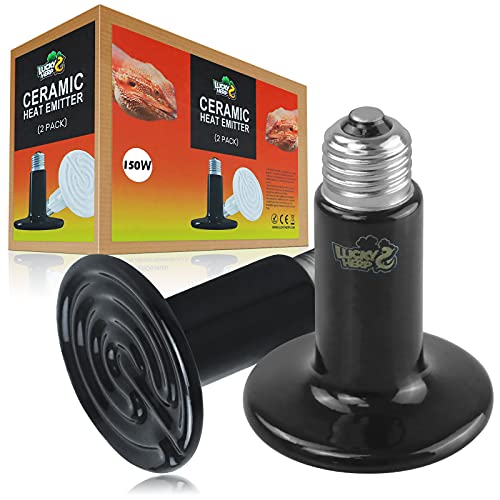
Ceramic Heat Emitter 100W
A 100W CHE is the most versatile option for medium enclosures — enough power for a 40-75 gallon setup while remaining manageable with a thermostat.
Check Price on Amazon
Reptile Thermostat
A thermostat is non-negotiable with any CHE. Without one, the emitter runs unchecked and can overheat your enclosure to lethal levels.
Check Price on AmazonDeep Dome Reptile Lamp Fixture
A ceramic-socket deep dome rated 150W+ is the only safe fixture for a CHE. Standard plastic lamps will melt and become a fire hazard.
Check Price on AmazonInfrared Temperature Gun
An IR thermometer lets you spot-check surface temps across the entire enclosure in seconds — not just at the thermostat probe location.
Check Price on AmazonFrequently Asked Questions
No. Without a thermostat, a CHE runs at full power constantly. In smaller enclosures, temperatures can exceed 120°F within hours — a lethal condition for almost every reptile species.
References & Sources
- https://www.reptifiles.com/wp-content/uploads/2020/01/Why-Infrared-Matters-by-Roman-Muryn.pdf
- https://reptifiles.com/boa-constrictor-care/boa-constrictor-temperatures/
- https://reptifiles.com/corn-snake-care-guide/corn-snake-temperatures-humidity/
- https://reptifiles.com/heterodon-hognose-snake-care/hognose-temperatures-humidity-lighting/
- https://reptifiles.com/ackie-monitor-care/ackie-monitor-temperatures-heating/
- https://reptifiles.com/bearded-dragon-care/bearded-dragon-temperatures-uvb/
Related Articles

Heat Lamp for Reptiles: Complete Setup & Safety Guide
Learn how to choose, install, and safely use heat lamps for reptiles. Complete guide covering bulb types, wattages, temperatures, and species-specific heating needs.

Chuckwalla Care Guide: Size, Heat & Diet for Beginners
Chuckwallas are calm, plant-eating desert lizards, but they need a large enclosure, intense basking heat, strong UVB, and careful daily husbandry.

Yangtze Giant Softshell Turtle: Rarest Turtle Alive in 2026
The Yangtze giant softshell turtle may have only a handful of individuals left worldwide. Here's why it's disappearing and what to keep instead.