Best Reptile Probe Thermometer: Top 5 Picks for 2026
Find the best reptile probe thermometer for accurate temperature monitoring. Compare top picks, learn proper placement, and keep your reptile's habitat safe.


This article contains affiliate links. If you make a purchase through these links, we may earn a small commission at no extra cost to you. See our affiliate disclosure for details.
We recommend 5 picks here. Our top choice is the Inkbird IBS-TH2 Bluetooth Thermometer with Probe — check price and availability below.
How we choose: we compare published specifications against the care requirements in veterinary and species-care literature, and weigh those against what long-time keepers report. We do not test products ourselves and we do not restate Amazon star ratings. The 5 sources behind this article are listed at the bottom.
Quick Comparison
- Data Logging
- Yes
- Remote Access
- Bluetooth (Local)
- Parameters Tracked
- Temperature
- Probe Count
- 1
- Smart Features
- Yes (Bluetooth App)
- Data Logging
- No
- Remote Access
- None
- Parameters Tracked
- Temperature
- Probe Count
- 1
- Smart Features
- No
- Data Logging
- No
- Remote Access
- None
- Parameters Tracked
- Temp + Humidity
- Probe Count
- 2
- Smart Features
- No
- Data Logging
- Yes
- Remote Access
- WiFi (Anywhere)
- Parameters Tracked
- Temp + Humidity
- Probe Count
- 1
- Smart Features
- Yes (WiFi App)
- Data Logging
- No
- Remote Access
- None
- Parameters Tracked
- Surface Temp Only
- Probe Count
- N/A (Infrared)
- Smart Features
- No
Prices are estimates only. Actual prices on Amazon may vary.
Temperature is everything in reptile keeping. Your bearded dragon, ball python, or leopard gecko can't regulate their own body heat — they depend entirely on you to get it right. And you can't get it right without an accurate thermometer.
That's where a probe thermometer comes in. Unlike the cheap stick-on dial thermometers that come with most starter kits, a probe thermometer gives you actual temperature readings at the exact spot that matters: the basking surface, the cool hide, or the substrate your reptile is curled up in.
In this guide, I'll walk you through the best reptile probe thermometers on the market, what makes them worth buying, and exactly how to use them for accurate results.
Why a Probe Thermometer Beats Other Types
Not all thermometers are created equal. There are three main types you'll encounter as a reptile keeper:
| Type | Accuracy | Best For | Drawbacks |
|---|---|---|---|
| Dial/analog | Poor (±5°F or worse) | Nothing — avoid these | Wildly inaccurate, unreliable |
| Infrared/temp gun | Good for spot checks | Verifying basking surface temps | Doesn't track temps over time |
| Digital probe | Excellent (±1°F) | Continuous monitoring | Probe placement matters |
Dial thermometers are notoriously inaccurate. Many reptile keepers have lost animals because a dial thermometer read 85°F when the actual basking temp was over 110°F. The reptile community widely recommends against them — and for good reason.
Infrared thermometers (temp guns) are great for quick surface spot-checks. But they only tell you what a surface reads right now — they can't track temperature over time or alert you to dangerous overnight drops.
A digital probe thermometer gives you continuous, accurate readings from the exact microclimate you're monitoring. It's the gold standard for day-to-day reptile husbandry.
Our Top 5 Picks
Quick recommendations
Bluetooth app connectivity, ±0.5°F accuracy, custom push alerts, tracks multiple units in one dashboard
Simple no-frills design, affordable, reliable, 3-foot cord, min/max memory, Fahrenheit/Celsius display
Dual-probe design monitors temperature and humidity simultaneously, 24-hour min/max records, ideal for ball pythons and tropical species
WiFi-enabled with cloud storage, ±0.54°F accuracy, push alerts from anywhere, historical data for diagnostics
Pairs handheld IR gun for surface temps with digital probe for ambient monitoring—covers all temperature measurement needs
What to Look For Before Buying
What you need to know
Accuracy of ±1°F (0.5°C) or better is essential—cheap units often underperform in real-world conditions
Dual-probe thermometers reveal the full thermal gradient (hot side vs. cool side) at a glance
Backlit displays with min/max memory let you track temperature trends and overnight drops
Alarm features with custom high/low alerts can prevent heating failures and save your reptile's life
Probe cords of 3+ feet work best for larger enclosures and deep bioactive vivariums
Combo units measuring both temperature and humidity are valuable for species with strict humidity needs (ball pythons, crested geckos)
Why Digital Probes Win
What you need to know
Dial thermometers are dangerously inaccurate (±5°F or worse) and the reptile community widely recommends avoiding them entirely
Infrared/temp guns excel at quick surface spot-checks but cannot track temperatures over time or alert you to dangerous drops
Digital probe thermometers provide continuous, accurate (±1°F) readings from the exact microclimate your reptile occupies
Inaccurate thermometers have caused reptile deaths—temperature regulation mistakes are irreversible
Digital probes are the gold standard for day-to-day reptile husbandry and the only type worth investing in
Detailed Reviews
1. Inkbird IBS-TH2 Bluetooth Thermometer with Probe
Editor's Choice
Inkbird IBS-TH2 Bluetooth Thermometer with Probe
Pros
- •Connects to smartphone via Bluetooth for convenient data access
- •Logs continuous temperature data for trend analysis
- •Customizable alerts notify keepers of out-of-range conditions
- •Includes an external probe for precise microclimate monitoring
Cons
- •Bluetooth range is limited to local proximity
- •Does not offer true remote monitoring when away from home
- •Requires app installation and device syncing for full functionality
Bottom Line
This Bluetooth-enabled thermometer provides continuous temperature data logging and custom alerts directly to a smartphone. It offers a smart monitoring solution without requiring a full WiFi network setup.
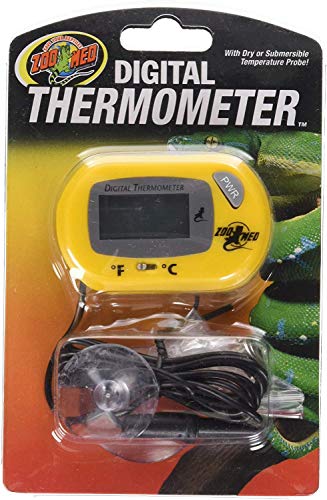
2. Zoo Med Digital Thermometer with Probe
Best Value
Zoo Med Digital Thermometer with Probe
Pros
- •Simple, straightforward setup ideal for beginners
- •Provides accurate temperature readings with a durable probe
- •Includes min/max memory to track temperature fluctuations
- •Offered at an accessible price point from a reputable reptile brand
Cons
- •Lacks smart features like Bluetooth or WiFi connectivity
- •Does not monitor humidity levels
- •Requires manual checking of the display for current readings
Bottom Line
A reliable, no-fuss digital thermometer providing accurate readings from a trusted brand. Its simple setup and min/max memory make it an excellent entry-level option for essential temperature tracking.
3. REPTI ZOO Dual Probe Thermometer Hygrometer
Editor's Choice
REPTI ZOO Dual Probe Thermometer Hygrometer
Pros
- •Monitors both temperature and humidity with dual probes
- •Provides critical data for tropical and arboreal species
- •Offers accurate readings for specific environmental control
- •Versatile probe placement options for different microclimates
Cons
- •Does not include data logging or smart connectivity features
- •Requires manual checks for temperature and humidity data
- •Two probes might be cumbersome in very small enclosures
Bottom Line
This device simultaneously monitors both temperature and humidity using two independent probes. It is essential for maintaining specific microclimates required by tropical or humidity-sensitive species.
4. Govee WiFi Temperature Humidity Monitor with External Probe
Best Overall
Govee WiFi Temperature Humidity Monitor with External Probe
Pros
- •WiFi connectivity enables remote monitoring from any location
- •Provides cloud data logging for historical temperature and humidity trends
- •Customizable push notifications alert users to out-of-range conditions
- •Monitors both temperature and humidity for comprehensive environmental control
Cons
- •Higher price point compared to basic digital thermometers
- •Requires a stable WiFi connection for optimal functionality
- •Setup might be more complex than non-smart devices
Bottom Line
Featuring WiFi connectivity, this monitor allows for remote temperature and humidity tracking from anywhere. It includes cloud data logging and push notifications for proactive environmental management.
5. Etekcity Infrared Thermometer for Reptiles
Budget Pick
Etekcity Infrared Thermometer for Reptiles
Pros
- •Provides instant, accurate surface temperature readings
- •Essential for spot-checking basking areas and substrate hot spots
- •Complements continuous probe thermometers for comprehensive monitoring
- •Easy to use with a simple point-and-shoot operation
Cons
- •Does not provide continuous temperature monitoring over time
- •Cannot measure ambient air temperature accurately
- •Requires manual operation for each reading
Bottom Line
A crucial supplementary tool, this handheld infrared thermometer provides instant, accurate surface temperature readings. It is invaluable for spot-checking basking areas and thermal gradients in real-time.
What to Look for in a Reptile Probe Thermometer
Before you buy, here's what actually matters:
Accuracy
Look for models rated at ±1°F (0.5°C) or better. Most quality digital probe thermometers hit this range. Cheap units often claim accuracy they don't deliver in real-world conditions.
Number of Probes
Single-probe units are fine for basic setups. But if you're monitoring a thermal gradient — which every reptile enclosure should have — a dual-probe thermometer is a game-changer. One probe on the hot side, one on the cool side. You see the full picture at a glance.
Display Clarity
A clear, backlit display makes a huge difference when you're checking temps in a dimly lit reptile room. Look for units that show both current temp and min/max readings stored in memory.
Alarm Features
Some models let you set high/low temperature alerts. This is especially useful if your heating equipment malfunctions overnight. An audible alarm can genuinely save your reptile's life.
Probe Length and Cord
Longer cords give you more flexibility in probe placement. For larger enclosures or deep bioactive vivariums, you'll want at least a 3-foot cord. For setups with thick substrate, a longer probe that reaches several inches deep is a real advantage.
Humidity Combo Units
Many reptile keepers prefer thermometer/hygrometer combos — units that measure both temperature and humidity in one display. This is especially useful for ball pythons, crested geckos, and any tropical species with strict humidity requirements.
Our Top Picks: Best Reptile Probe Thermometers
(Estimates only — actual prices on Amazon may vary.)
1. Inkbird IBS-TH2 Bluetooth Thermometer with Probe
The Inkbird IBS-TH2 is a fan favorite in the reptile community for good reason. It connects to your phone via Bluetooth and logs temperature data continuously over time — so you can spot patterns and trends, not just snapshots.
The probe hits ±0.5°F accuracy, and the companion app lets you set custom high/low alerts. If your enclosure drops below a safe threshold while you're asleep, you'll get a push notification on your phone. For multi-enclosure keepers, you can track several units in a single app dashboard.
It's a standout choice if you want smart monitoring without paying for a full WiFi-connected system.
[Inkbird Bluetooth thermometer with probe](https://www.amazon.com/dp/B0DZF2ZM19?tag=krawlo-20
2. Zoo Med Digital Thermometer with Probe
Zoo Med is a household name in herpetoculture, and their digital probe thermometer is a solid no-frills option. It's simple to use: plug in the probe, clip it in place, and read the display. No app, no WiFi, no fuss.
It reads in Fahrenheit or Celsius and includes a min/max memory function. The probe cord is about 3 feet long, which works well for most standard enclosures.
This is my go-to recommendation for beginners. It's affordable, reliable, and does exactly what it promises. Don't overthink it — this thermometer paired with a good thermostat covers most setups.
[Zoo Med digital thermometer probe reptile](https://www.amazon.com/dp/B00U9ODNRO?tag=krawlo-20
3. REPTI ZOO Dual Probe Thermometer Hygrometer
If you want to monitor both temperature and humidity — and you want to do it in two spots at once — the REPTI ZOO dual-probe combo delivers excellent value.
It ships with two probes: one for temperature and one for humidity. The large display shows all readings clearly, with 24-hour min/max records on screen. Seeing your overnight low and overnight humidity in one glance is genuinely useful.
This is a top pick for species where humidity management is just as critical as temperature. Ball pythons, crested geckos, and jungle carpet pythons all benefit from this level of monitoring. For managing the heating side of your setup, our guide on best digital thermostats for reptiles covers what to pair with it.
[REPTI ZOO dual probe thermometer hygrometer reptile](https://www.amazon.com/dp/B09ZJ9P72L?tag=krawlo-20
4. Govee Temperature Humidity Monitor with External Probe
Govee makes excellent smart home monitoring gear, and their reptile-friendly combo is no exception. It connects to WiFi, so you can check your enclosure temps from anywhere — at work, on vacation, or just across the house.
The alert system is robust. Set custom thresholds and receive push notifications the moment conditions drift out of range. It also stores historical data in the cloud, which makes diagnosing heating or cooling problems much easier.
The external probe is accurate to ±0.54°F — well within the acceptable range for reptile husbandry. If you have a reptile that needs close monitoring (recovering from illness, breeding season, hatchlings), this level of remote oversight is hard to beat.
[Govee WiFi thermometer humidity monitor probe](https://www.amazon.com/dp/B09BVLP9C5?tag=krawlo-20
5. Etekcity Infrared Thermometer Combo
This one takes a different approach. The Etekcity combo pairs a handheld infrared thermometer with a traditional digital probe unit — giving you the best of both worlds.
Use the IR gun for quick basking surface spot checks. Use the probe for continuous ambient monitoring. Together, they cover every temperature measurement a reptile keeper needs.
This is particularly valuable for desert species that need precise surface temps. According to ReptiFiles, ackie monitors need basking surface temps of 120–130°F — a reading you'd want to verify with an IR gun, not just an ambient probe. The same applies to uromastyx, bearded dragons, and other heliotherms.
[Etekcity infrared thermometer reptile probe combo](https://www.amazon.com/dp/B0B71HFH9K?tag=krawlo-20
How to Properly Place Your Probe
Placement makes or breaks the accuracy of any probe thermometer. A poorly placed probe gives you useless data — or worse, a dangerous false sense of security.
According to The BioDude's probe placement guide, here are the key rules:
For ambient air temperature: Position the probe at mid-level in the enclosure, away from direct heat sources and glass walls. This gives you an accurate read of the air your animal actually moves through throughout the day.
For basking spot temperature: Place the probe tip directly on the basking surface — the rock, branch, or substrate under the heat lamp. Your reptile's belly sits here, so this is the most critical measurement in the entire setup.
For cool-side temperature: Place a second probe on the substrate on the cool side of the enclosure. This confirms your thermal gradient is functioning correctly and gives your animal options for thermoregulation.
For burrowing species: For snakes and lizards that spend time underground — like ball pythons or sand boas — position a probe 2–3 inches deep in the substrate. ReptiFiles notes that ball pythons need a warm-side ambient of 80–85°F with a belly-level basking spot around 88–92°F. An ambient reading alone won't tell you what the snake is actually experiencing.
Understanding Thermal Gradients
A proper thermal gradient gives your reptile choices. They move to the warm side to digest and thermoregulate after feeding, and retreat to the cool side to rest or cool down between activity cycles. Without a gradient, a reptile can't regulate its internal temperature effectively — and chronic stress, digestive issues, and immune suppression follow.
Here's what well-maintained temperature gradients look like for some popular species:
| Species | Basking Surface | Warm Side Ambient | Cool Side | Nighttime Low |
|---|---|---|---|---|
| Bearded Dragon | 105–115°F | 90–100°F | 80–85°F | 65–75°F |
| Ball Python | 88–92°F | 80–85°F | 75–80°F | 72–80°F |
| Leopard Gecko | 88–92°F | 80–85°F | 70–75°F | 65–72°F |
| Crested Gecko | N/A (no basking) | 72–78°F | 68–72°F | 65–70°F |
| Blue-Tongued Skink | 100–110°F | 85–90°F | 75–80°F | 65–75°F |
Always verify these ranges against species-specific care guides. Individual animals, locales, and morphs can have slightly different needs.
Common Mistakes to Avoid
Using Stick-On Dial Thermometers as Your Primary Tool
These are the small circular thermometers that stick to the side of the glass. They often come with starter kits and look convenient. Don't trust them. They're frequently off by 10°F or more and measure air temperature at the glass wall — which tells you almost nothing useful. A quality best reptile probe thermometer costs $15–$25 and is dramatically more accurate.
Placing the Probe Too High
If you're monitoring basking temperature but the probe is suspended 6 inches above the basking surface, you're measuring air temperature — not surface temperature. A reptile's belly can be 20°F or more hotter than the air directly above. Always place the probe at the level where your animal's body actually is.
Ignoring Nighttime Temperature Drops
Many keepers set up their thermostat and check temps during the day, then forget about nighttime. Some heating setups drop significantly after the lights go out. Use the min/max memory feature on your thermometer and check the overnight low first thing every morning. It takes five seconds and can catch dangerous drops before they cause harm.
Not Rechecking Accuracy Over Time
Probe thermometers can drift, especially in consistently humid enclosures. If you've had the same unit for 3+ years, it's worth checking it against a second reference thermometer. Most quality units stay accurate for years — but it's good practice to verify annually.
Do You Need a Thermostat Too?
A probe thermometer tells you what the temperature is. A thermostat tells your heating equipment what temperature to maintain.
You need both. A thermometer without a thermostat means manually monitoring temps and hoping your heat lamp doesn't roast your enclosure at 3 AM. A thermostat without an independent probe thermometer means trusting the thermostat's built-in sensor — which may not be positioned where it matters most.
For our full breakdown of heating controllers, check out our guide on best digital thermostats for reptiles. And if you're building a complete heating setup from scratch, our best heat lamps for reptiles guide covers what to pair with your thermometer and thermostat.
Final Thoughts
Getting your temperature monitoring right is one of the highest-impact things you can do for your reptile's long-term health. The price difference between a bad dial thermometer and a quality probe thermometer is $15–$25. That's nothing compared to a vet bill — or the heartbreak of losing an animal to a fully preventable husbandry mistake.
Start with a reliable dual-probe thermometer, place the probes correctly at the basking spot and cool side, and check your min/max readings every morning. It takes 30 seconds. It gives you real confidence that your animal is living in the conditions it needs to thrive — not just conditions you hope are close enough.
Our Final Verdict

Inkbird IBS-TH2 Bluetooth Thermometer with Probe
This Bluetooth-enabled thermometer provides continuous temperature data logging and custom alerts directly to a smartphone. It offers a smart monitoring solution without requiring a full WiFi network setup.
Zoo Med Digital Thermometer with Probe
A reliable, no-fuss digital thermometer providing accurate readings from a trusted brand. Its simple setup and min/max memory make it an excellent entry-level option for essential temperature tracking.

REPTI ZOO Dual Probe Thermometer Hygrometer
This device simultaneously monitors both temperature and humidity using two independent probes. It is essential for maintaining specific microclimates required by tropical or humidity-sensitive species.
Frequently Asked Questions
Analog dial thermometers — the round stick-on type that come in many starter kits — are no longer recommended by experienced reptile keepers. They're frequently inaccurate by 10°F or more and can give dangerous false readings. Digital probe thermometers are the current standard.
References & Sources
- https://www.thebiodude.com/blogs/reptile-and-amphibian-lighting-faqs-and-help/how-to-place-thermometer-and-hygrometer-probes
- https://community.morphmarket.com/t/best-hydrometer/28163
- https://reptifiles.com/ackie-monitor-care/ackie-monitor-temperatures-heating/
- https://reptifiles.com/ball-python-care-guide/ball-python-humidity-temperatures/
- https://reptifiles.com/reptiliacare-digital-infrared-thermometer-review/
Related Articles

Best Reptile Digital Thermometer: 2026 Buyer's Guide
Tired of inaccurate readings? Our guide reveals the best reptile digital thermometers for 2026, comparing temp guns and probes for a healthy, happy pet.

Best Thermometer and Hygrometer for Bearded Dragons (2026)
Wrong temperature readings can silently harm your bearded dragon. We tested 7 thermometers and hygrometers to find the most accurate picks for every enclosure setup — from digital combo units to IR guns and Bluetooth sensors.

Best Digital Reptile Thermometers: IR Guns vs. Probes (2026)
Find the best digital reptile thermometers for accurate basking and ambient readings — 6 picks reviewed, plus why you need both IR gun and probe.