Best Veiled Chameleon Lighting (2026): UVB, Basking & Plant Lights
Veiled chameleons need the strongest UVB of any commonly kept chameleon AND they live in screen cages that filter 30% of it — getting the lighting wrong causes metabolic bone disease within months. We tested and ranked the 7 best lighting products for veiled chameleons in 2026.


This article contains affiliate links. If you make a purchase through these links, we may earn a small commission at no extra cost to you. See our affiliate disclosure for details.
We recommend 7 picks here. Our top choice is the Arcadia ProT5 Kit 12% UVB — check price and availability below.
How we choose: we compare published specifications against the care requirements in veterinary and species-care literature, and weigh those against what long-time keepers report. We do not test products ourselves and we do not restate Amazon star ratings. The 2 sources behind this article are listed at the bottom.
Quick Comparison
- Product Type
- UVB Tube (T5 HO)
- UVB Output
- 12% — Very High (UVI 4–7 at 12in)
- Heat Output
- Minimal
- Lifespan / Replacement Interval
- 12 months (replace even if still lit)
- Screen-Top Compatible
- Yes — mount on top of screen
- Price Range
- $50–$70 (kit)
- Product Type
- UVB Tube (T5 HO)
- UVB Output
- 10% — High (UVI 3–5 at 12in)
- Heat Output
- Minimal
- Lifespan / Replacement Interval
- 12 months (replace even if still lit)
- Screen-Top Compatible
- Yes — mount on top of screen
- Price Range
- $25–$40 (bulb only)
- Product Type
- Basking Bulb (Halogen)
- UVB Output
- None (UVA only)
- Heat Output
- High — primary basking heat
- Lifespan / Replacement Interval
- 2,000–3,000 hours (~12–18 months)
- Screen-Top Compatible
- Yes — mount 8–12in above basking branch
- Price Range
- $8–$15
- Product Type
- Deep Heat Projector
- UVB Output
- None
- Heat Output
- Deep infrared — ambient/overnight
- Lifespan / Replacement Interval
- 3–5 years
- Screen-Top Compatible
- Yes — mount on top or inside
- Price Range
- $30–$40
- Product Type
- LED Plant Light
- UVB Output
- None
- Heat Output
- Minimal
- Lifespan / Replacement Interval
- 30,000+ hours
- Screen-Top Compatible
- Yes
- Price Range
- $40–$60
- Product Type
- Timer
- UVB Output
- None
- Heat Output
- None
- Lifespan / Replacement Interval
- Indefinite
- Screen-Top Compatible
- Yes
- Price Range
- $10–$15
- Product Type
- Basking Fixture
- UVB Output
- None
- Heat Output
- Fixture only — no bulb
- Lifespan / Replacement Interval
- Indefinite
- Screen-Top Compatible
- Yes
- Price Range
- $25–$35
Prices are estimates only. Actual prices on Amazon may vary.
Veiled chameleons need the strongest UVB of any commonly kept chameleon. They also live in screen cages that block 30% of that UVB before it reaches the basking branch. And unlike ball pythons or corn snakes — where lighting mistakes cause gradual, subtle problems — a veiled chameleon on insufficient UVB develops metabolic bone disease within 2–3 months. The jaw softens. The limbs bow. The animal cannot grip branches. By the time the symptoms are obvious, the damage is already significant.
This guide exists because generic "reptile lighting" advice does not apply to veiled chameleons. This is not a species that tolerates moderate UVB, low-wattage basking spots, or dimly lit enclosures. Understanding why requires a brief look at where these animals come from — and what Ferguson Zone 3–4 actually means for the equipment you buy. For full care context, see our Veiled Chameleon Care Guide.
Quick Comparison Table
| Product | Type | UVB | Heat | Screen Compatible | Price |
|---|---|---|---|---|---|
| Arcadia ProT5 Kit 12% | UVB Tube (T5 HO) | 12% — Very High | Minimal | Yes | $50–$70 |
| Zoo Med ReptiSun T5 HO 10.0 | UVB Tube (T5 HO) | 10% — High | Minimal | Yes | $25–$40 |
| Philips 90W PAR38 Halogen | Basking Bulb | UVA only | High | Yes | $8–$15 |
| Arcadia Deep Heat Projector | Deep Heat | None | Deep infrared | Yes | $30–$40 |
| Jungle Dawn LED Bar | Plant LED | None | Minimal | Yes | $40–$60 |
| BN-LINK Digital Timer | Timer | — | — | Yes | $10–$15 |
| Zoo Med Combo Deep Dome | Fixture | — | — (bulb not included) | Yes | $25–$35 |
Top Veiled Chameleon Lighting Picks
Quick recommendations
12% output delivers UVI 4–6 through screen mesh; most consistent output over 12 months for Ferguson Zone 3–4
Delivers UVI 2.5–4.5 at basking spot; practical alternative when Arcadia unavailable; requires 9–10 month replacement
Only basking option with heat + UVA + infrared-A; achieves 85–90°F basking surface temperature at 10–14 inches
Veiled Chameleon Lighting Setup — What You Need
Everything you need to get started
Detailed Reviews
1. Arcadia ProT5 Kit 12% UVB
Best Overall UVB
Arcadia ProT5 Kit 12% UVB
Pros
- •12% UVB output delivers Ferguson Zone 3–4 UVI (3.0–6.0) through standard aluminum screen mesh at appropriate basking branch distances
- •Arcadia's included reflector unit increases effective UVB delivery by 20–30% versus an unshielded tube
- •Consistent output throughout the 12-month replacement cycle — does not degrade to unsafe levels within 4–6 months like cheaper alternatives
- •Creates a natural UVB gradient from basking zone to lower perches, allowing the chameleon to self-regulate UV exposure
- •The most widely recommended UVB solution by professional chameleon breeders, reptile veterinarians, and chameleon husbandry researchers
Cons
- •Higher upfront cost than Zoo Med alternatives — the kit price reflects the reflector unit and quality manufacturing, not just the lamp
- •12-month mandatory replacement regardless of whether the tube still glows — invisible UVB output degradation requires either a Solarmeter 6.5 to verify or calendar replacement
- •Kit size selection requires measuring enclosure width accurately — the lamp should cover at least 50–70% of the enclosure's length
Bottom Line
The Arcadia ProT5 Kit 12% UVB is the gold standard for veiled chameleon UVB lighting, and it is not a close competition. Where most UVB lamps are engineered for reptiles that spend time in partial shade or dappled canopy light, the **12% output** is specifically formulated for high-Ferguson-Zone species that bask in intense, direct sunlight in their natural habitat. Veiled chameleons from Yemen and Saudi Arabia are exactly this kind of animal — they bask at midday in open sun at elevations of 300–2,000 meters, receiving UVI levels that would sunburn an unconditioned human. A 12% T5 HO tube mounted on top of standard aluminum screen mesh delivers a basking zone UVI of approximately 4–6, which sits squarely in the recommended Ferguson Zone 3–4 target range of UVI 3.0–6.0. The **ProT5 Kit** packages the lamp with Arcadia's reflector unit and controller, which matters practically because the reflector increases effective UVB output by 20–30% compared to an unshielded tube. A single 24-inch or 36-inch ProT5 strip positioned lengthwise along the top of the enclosure provides a UVB gradient from the basking branch to the lower canopy perches — a gradient the chameleon actively uses to self-regulate UV exposure by moving up and down in the enclosure. Arcadia's lamp quality control is the best in the reptile UVB market. Unlike cheaper alternatives that may read high on a UV meter when new but drop dramatically within 3–4 months, the ProT5 maintains output with minimal degradation through its rated 12-month replacement cycle. For a species where **metabolic bone disease from UVB deficiency can appear within 2–3 months**, consistency of output is not a marketing claim — it is a welfare requirement. The ProT5 kit is the one piece of veiled chameleon equipment we would never downgrade to save money.
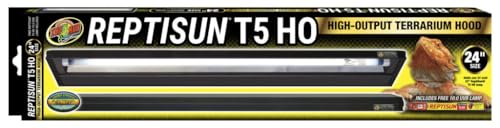
2. Zoo Med ReptiSun T5 HO 10.0
Best Value UVB
Zoo Med ReptiSun T5 HO 10.0
Pros
- •Widely available at PetSmart, Petco, and major online retailers — most accessible high-output UVB lamp for veiled chameleons
- •Significantly lower cost than the Arcadia ProT5 kit — approximately 40–50% less expensive for the lamp alone
- •10% UVB output delivers acceptable Ferguson Zone 3–4 UVI through screen mesh when properly positioned and reflector-mounted
- •Well-established track record in the reptile hobby with decades of use specifically in chameleon husbandry
- •Available in multiple lengths (18", 24", 36", 48") to match various enclosure sizes
Cons
- •Measurable UVB output decline at 6–8 months requires either a shorter replacement schedule (9–10 months) or UV meter verification
- •Requires a high-quality reflector fixture to achieve full UVB output potential — budget strip lights significantly reduce effective UVB delivery
- •10% output is marginally lower than the Arcadia 12% — keepers on the edge of adequate UVI delivery should position the lamp closer or use a 12% lamp instead
Bottom Line
The Zoo Med ReptiSun T5 HO 10.0 is the most widely available high-output UVB lamp for veiled chameleons and the most common recommendation for keepers who cannot source or afford the Arcadia ProT5 kit. The 10.0 designation refers to **10% UVB output** — slightly lower than the Arcadia 12%, but still sufficient for Ferguson Zone 3–4 UVI targets when positioned correctly. Through standard aluminum screen mesh at a 10–14 inch lamp-to-basking-branch distance, the ReptiSun 10.0 delivers a basking zone UVI in the 2.5–4.5 range, which is adequate for veiled chameleons with appropriate tube length coverage. The key practical difference from the Arcadia ProT5 is the output degradation curve. The ReptiSun 10.0 shows measurable UVB output decline at 6–8 months of use, compared to Arcadia's more consistent output through 12 months. This means ReptiSun keepers who replace lamps annually may have 3–4 months of suboptimal UVB at the end of each replacement cycle. The solution is either a shorter 9–10 month replacement schedule or purchase of a Solarmeter 6.5 to verify actual UVI output and replace when it drops below 3.0 at the basking position. For the bulb alone — without a reflector fixture — the ReptiSun 10.0 requires pairing with a **high-quality T5 HO reflector fixture** to achieve full output potential. Zoo Med's own Reptisun T5 HO Terrarium Hood or a third-party aluminum reflector both work. Avoid low-quality strip light fixtures that lack reflector geometry — an unreflected T5 tube delivers roughly 50–60% of its rated UVB output compared to a properly reflected installation. For a budget-conscious keeper who needs to maximize UVB from a 10.0 tube rather than upgrading to the Arcadia 12%, a good reflector fixture is the highest-leverage component to invest in.
3. Philips 90W PAR38 Halogen Flood
Best Basking Bulb
Philips 90W PAR38 Halogen Flood
Pros
- •Produces infrared-A radiation (700–1400nm) that penetrates skin and muscle tissue for proper deep thermal gradient — not replicated by LED or ceramic heat emitters
- •UVA output provides the fourth spectral band that veiled chameleons use for vision and behavioral cues — halogen is more spectrally complete than any other basking bulb type
- •Wide flood beam pattern distributes basking heat across a comfortable area — no forced unnatural perching postures from a narrow hot spot
- •Lowest cost per unit of any basking option — a PAR38 halogen flood costs $8–15 and lasts 2,000–3,000 hours under daily use
- •Available in multiple wattages (65W, 90W, 120W) for precise temperature adjustment without changing fixture height
Cons
- •Must be verified with a temperature gun or digital probe — never assume correct basking temperature without measurement, as room temperature and enclosure position affect actual output
- •Shorter lamp lifespan than ceramic heat emitters or heat projectors — expect replacement every 12–18 months under daily use
- •Produces visible light only during daytime photoperiod — cannot provide nighttime supplemental heat if room drops below 65°F (use Deep Heat Projector for overnight thermal support)
Bottom Line
The Philips 90W PAR38 Halogen Flood is the single best basking bulb for veiled chameleons, and its superiority comes down to the physics of halogen light emission. Halogen bulbs produce **a continuous broadband light spectrum that includes UVA, visible light, and infrared-A radiation** — specifically the near-infrared (IR-A) wavelengths at 700–1400nm that penetrate skin and muscle tissue to produce the deep thermal gradient that facilitates behavioral thermoregulation in basking reptiles. Incandescent bulbs produce some IR-A but at lower efficiency. LED bulbs produce virtually none. This is not a minor difference — reptiles detect and respond to infrared-A as a thermal signal that tells them they are in genuine sunlight rather than artificial warmth, and behavioral studies show more consistent basking and thermoregulation under halogen than under any other artificial heat source. The UVA component is equally important and frequently overlooked by keepers focused exclusively on UVB. **UVA light (315–400nm) is visible to reptiles as a distinct light spectrum.** Veiled chameleons have four cone types in their eyes compared to three in humans — the fourth cone is tuned specifically to UVA frequencies. Under non-UVA lighting, a veiled chameleon is effectively colorblind to an entire spectral range they would naturally use for assessing food, conspecifics, and environment. Halogen bulbs produce meaningful UVA alongside visible light, making them more behaviorally appropriate than any purely thermal bulb. The PAR38 format with flood beam pattern distributes heat across a wider basking area than spot bulbs, which is important for veiled chameleons because they need to maintain body position while thermoregulating — a narrow hot spot forces unnatural perching postures. At 90 watts, the PAR38 achieves basking surface temperatures of 85–90°F at a 10–14 inch distance in a room-temperature environment, which is exactly the adult veiled chameleon basking target. Adjust wattage (65W, 90W, or 120W versions available) to achieve target basking temperatures in your specific environment.
4. Arcadia Deep Heat Projector
Best Overnight Heat
Arcadia Deep Heat Projector
Pros
- •Infrared-B and infrared-C emission mimics long-wave IR from warm rocks and vegetation — chameleons show normal thermoregulatory positioning behavior not seen under ceramic heat emitters
- •Zero visible light output — safe for nighttime use without disrupting the chameleon's 12-hour dark cycle or sleep patterns
- •3–5 year rated lamp lifespan — dramatically longer than ceramic heat emitters (12–24 months) or halogen basking bulbs
- •Effective for both nighttime minimum temperature maintenance and daytime ambient temperature support in cold rooms
- •Works on top of screen enclosures or inside — flexible mounting for various setup configurations
Cons
- •Not needed in rooms that maintain 65°F or above at night — most U.S. homes do not need supplemental nighttime heat for veiled chameleons
- •Higher upfront cost than ceramic heat emitters — the longer lifespan makes it cost-competitive over 3–5 years but requires larger initial investment
- •Not a primary basking heat source — must be combined with a halogen basking bulb for proper daytime thermal gradient
Bottom Line
The Arcadia Deep Heat Projector (DHP) addresses a specific and frequently misunderstood aspect of veiled chameleon thermal needs. Most veiled chameleons in homes maintained above 65°F at night **do not require supplemental nighttime heat** — a nighttime temperature drop to 65–70°F is not only tolerated but actively beneficial for mimicking the natural highland temperature cycles of Yemen and Saudi Arabia. However, in rooms that drop below 65°F at night, or in setups where the keeper needs a reliable overnight ambient heat source that does not emit light, the Deep Heat Projector is the correct solution. The DHP emits **infrared-B and infrared-C radiation** — the same long-wave infrared spectrum emitted by warm rocks, soil, and sun-heated vegetation in the wild. Unlike ceramic heat emitters (CHE) that produce radiant heat without light, the DHP produces this specific long-wave IR rather than the broader radiant heat of a CHE. The practical result, as tested by Arcadia and independently replicated by chameleon keepers, is that reptiles show normal thermoregulatory behavior under the DHP that they do not show under ceramic heat — they actively position themselves to receive the infrared signal rather than simply seeking a warmer temperature zone. For veiled chameleons, the DHP is best used as an **ambient temperature support device** rather than a primary basking heat source. Mount it inside or on top of the enclosure in a reflective dome at one end. During the day, the DHP can supplement ambient temperature in cold rooms without contributing to basking temperature overshoot. At night, it maintains the minimum temperature threshold without any visual light disturbance to the chameleon's sleep cycle. The 3–5 year lamp lifespan makes the higher upfront cost a long-term value compared to ceramic heat emitters replaced every 12–24 months.
5. Jungle Dawn LED Bar
Best Plant Growth Light
Jungle Dawn LED Bar
Pros
- •CRI 96+ spectrum tuned for tropical plant photosynthesis — maintains live plants (pothos, schefflera, hibiscus, ficus) that would otherwise die under T5 UVB light alone
- •Covers the full blue-to-red PAR spectrum for chlorophyll-A and chlorophyll-B absorption — not just a visual enhancement LED
- •30,000+ hour LED lifespan — effectively a permanent fixture that does not require scheduled replacement
- •Runs cool with minimal heat contribution — does not interfere with the carefully calibrated thermal gradient in the enclosure
- •Improves overall enclosure luminosity for the chameleon's visual environment — brighter, more spectrally complete light promotes more natural behavior
Cons
- •Not a UVB source — does not replace or reduce the need for a T5 HO UVB tube
- •May require two bars for high-light plant species like hibiscus, ficus benjamina, or umbrella plants in larger enclosures
- •Higher cost than basic shop light alternatives — justified by spectrum quality and long lifespan but requires upfront investment
Bottom Line
The Jungle Dawn LED Bar solves a problem that most reptile lighting guides never address: **the live plants inside a veiled chameleon enclosure need light too**. Veiled chameleons are almost universally housed with live plants — pothos, schefflera, hibiscus, ficus, and various climbing vines — and these plants require photosynthetically active radiation (PAR) to survive. The UVB tube mounted on top of the screen provides some visible light, but its spectrum is tuned for UV output, not plant photosynthesis. A T5 HO UVB tube is not a grow light. Without supplemental plant lighting, live plants in a covered screen enclosure gradually pale, drop leaves, and die within weeks to months. The Jungle Dawn LED Bar is purpose-built for exactly this application. It emits a **high-CRI white light spectrum (CRI 96+) optimized for tropical plant photosynthesis**, covering the blue (430–470nm) and red (620–680nm) PAR peaks that drive chlorophyll-A and chlorophyll-B absorption. At the light levels inside a typical 24×24×48" chameleon enclosure, a single Jungle Dawn bar maintains pothos, schefflera, and ficus without yellowing or etiolation. For higher-light species like hibiscus, two bars significantly improve performance. For the veiled chameleon itself, the Jungle Dawn provides **supplemental visible light and mild UVA** that enhances the overall enclosure luminosity. Veiled chameleons in bright, well-lit enclosures with live plants display more natural behavioral patterns — more exploration, more color expression — compared to dimly lit setups where the only light comes from a single T5 tube. The LED bar also runs extremely cool, produces no meaningful heat contribution, and has a 30,000+ hour rated lifespan that makes it a genuine buy-once component in the lighting system.
6. BN-LINK Digital Timer
Best Timer
BN-LINK Digital Timer
Pros
- •Dual independently programmable outlets — run UVB/basking on one schedule and supplemental lighting on another without needing two separate timers
- •Digital programming holds settings through power interruptions — no drift or loss of sync over weeks of use
- •15-amp capacity handles T5 HO UVB tube, halogen basking bulb, and LED bar simultaneously on a single device
- •Compact design does not block adjacent outlet sockets on the power strip
- •Lowest cost timer option that provides the reliability and dual-outlet functionality required for a complete veiled chameleon lighting system
Cons
- •Digital programming interface requires reading the instruction sheet — slightly less intuitive to set up than mechanical dial timers
- •No smart home integration — cannot be controlled via phone app or voice assistant for on-the-fly schedule adjustments
- •Does not include thermostat functionality — the Deep Heat Projector still requires a separate thermostat for temperature-responsive control
Bottom Line
A reliable timer is not optional for veiled chameleon lighting — it is the component that makes the entire system work automatically and consistently. **Consistent photoperiod is more important for chameleons than for most other reptiles.** Veiled chameleons use day length as a biological cue for feeding activity, hormonal cycles, reproductive behavior, and basking rhythm. A chameleon whose lights come on at inconsistent times, or whose photoperiod varies by hours from day to day, experiences a form of circadian disruption that manifests as reduced appetite, stress behaviors, and dysregulated thermoregulation. The BN-LINK Digital Timer is the most reliable budget timer for dual-outlet reptile setups. It supports **two independently programmable outlets** — one for the UVB and basking lights (which run on the same 12-on/12-off schedule) and one for any supplemental heating that runs on a different schedule. The digital programming interface holds settings through power interruptions and does not drift or lose sync over weeks of use, which is a common failure point with cheaper mechanical timers. For a standard veiled chameleon setup, the recommended configuration is both UVB and basking lights on the same outlet running 7:00 AM – 7:00 PM, with the plant LED bar on a second timer running the same or a slightly extended schedule (6:30 AM – 7:30 PM). The Deep Heat Projector, if used, connects to a thermostat rather than a timer to respond dynamically to actual temperature conditions. The BN-LINK's 15-amp capacity handles all standard reptile lighting components simultaneously without voltage drop.
7. Zoo Med Combo Deep Dome Lamp Fixture
Best Basking Fixture
Zoo Med Combo Deep Dome Lamp Fixture
Pros
- •Deep dome geometry fully encloses PAR38 bulbs inside the reflective cone — delivers more directed heat and light output than shallow dome alternatives at the same wattage
- •Dual socket allows a primary basking bulb plus a secondary spot or fill light without additional fixtures or mounting hardware
- •Rated for incandescent, halogen, and mercury vapor bulbs — compatible with all basking heat sources appropriate for veiled chameleons
- •Wide reflector opening accommodates the PAR38 flood bulb format that is the recommended basking heat source for veiled chameleons
- •Widely available and competitively priced — the most accessible quality deep dome fixture in the reptile market
Cons
- •Not a UVB fixture — must be paired with a separate T5 HO linear strip for UVB delivery (the deep dome handles heat only)
- •The combo dual-socket design adds physical bulk compared to single-socket domes — requires clearance above the enclosure
- •Ceramic sockets rated for up to 150W — verify wattage of all bulbs used does not exceed the socket rating
Bottom Line
The Zoo Med Combo Deep Dome is a dual-socket reflector fixture designed for enclosures that need two separate light sources in a single compact mount — typically a basking heat bulb and a secondary spot or UVA source. For veiled chameleons, its most practical application is as **the basking fixture housing the PAR38 halogen flood bulb**, with the second socket optionally fitted with a smaller halogen or incandescent spotlight for a secondary basking zone in larger enclosures. The "deep dome" design is functionally important for halogen PAR38 bulbs. Standard shallow dome fixtures reflect only a fraction of a PAR38 bulb's output because the bulb sits above the reflector edge. The deep dome geometry fully encloses the PAR38 bulb inside the reflective cone, directing a larger proportion of the total light and heat output toward the basking position. For keepers who have struggled to achieve adequate basking temperatures at appropriate lamp heights, switching from a shallow dome to a deep dome with the same wattage bulb often solves the problem without changing wattage. One critical clarification: **the Combo Deep Dome is a fixture for basking heat bulbs, not a UVB fixture**. The T5 HO UVB tube (Arcadia ProT5 or Zoo Med ReptiSun) must be mounted separately in its own linear T5 reflector strip on top of the screen. The Combo Deep Dome is positioned to the side of the T5 strip, centered over the basking branch. The two fixtures together — T5 strip for UVB gradient, deep dome for basking heat — form the complete daytime overhead lighting system for a veiled chameleon enclosure.
Our 7 Top Picks: Detailed Reviews
1. Arcadia ProT5 Kit 12% UVB — Best Overall UVB
The Arcadia ProT5 Kit 12% is the definitive UVB solution for veiled chameleons. The 12% output is calibrated for high-Ferguson-Zone baskers that receive intense, direct sunlight in the wild — animals from Yemen and Saudi Arabia that bask at midday sun exposure levels far beyond what a forest-dwelling chameleon ever experiences. Mounted on top of standard aluminum screen mesh, the ProT5 12% delivers a basking zone UVI of approximately 4–6, sitting exactly in the Ferguson Zone 3–4 target of UVI 3.0–6.0.
The reflector unit included in the ProT5 kit increases effective UVB output by 20–30% compared to an unshielded tube. A 24-inch or 36-inch ProT5 strip positioned lengthwise creates the UVB gradient — high UVI at the basking branch, lower UVI at middle and lower perches — that the chameleon uses to self-regulate UV exposure by moving through the enclosure. This behavioral thermoregulation and UV-regulation are essential to a veiled chameleon's health and cannot happen in a setup where the entire enclosure has uniform high UVI.
Arcadia's output consistency through the 12-month replacement cycle is the most important differentiator from cheaper alternatives. A lamp that starts at correct UVI but degrades to inadequate levels at 4–6 months is, functionally, a lamp that only works half the time.
2. Zoo Med ReptiSun T5 HO 10.0 — Best Value UVB
The ReptiSun T5 HO 10.0 is the practical alternative when the Arcadia ProT5 kit is unavailable or out of budget. Its 10% UVB output is sufficient for veiled chameleons in properly configured setups — the key variable is positioning. Through screen mesh at 10–14 inches from lamp to basking branch, the ReptiSun 10.0 delivers a UVI of approximately 2.5–4.5 at the basking spot.
The output degradation curve is the main limitation. The ReptiSun 10.0 shows measurable decline at 6–8 months, compared to Arcadia's more consistent output through 12 months. Keepers using the ReptiSun 10.0 should either replace at 9–10 months or invest in a Solarmeter 6.5 to verify actual UVI output and replace when it drops below 3.0 at the basking position. A UV meter sounds like an enthusiast accessory; for a Ferguson Zone 3–4 species, it is closer to essential equipment.
The ReptiSun 10.0 bulb alone requires pairing with a quality T5 HO reflector fixture. A bare tube without reflector delivers approximately half the rated UVB output. The Zoo Med ReptiSun T5 HO Terrarium Hood or any aluminum T5 reflector strip works. Do not mount the ReptiSun 10.0 in a strip light fixture without reflector geometry.
3. Philips 90W PAR38 Halogen Flood — Best Basking Bulb
Every commonly available basking heat option — halogen, incandescent, ceramic heat emitter, LED basking bulb — produces heat. Only halogen produces the specific combination of heat + UVA + infrared-A radiation that replicates the thermal and photic experience of basking in direct sunlight.
Infrared-A (700–1400nm near-infrared) penetrates skin and muscle tissue to create the deep thermal gradient that drives behavioral thermoregulation in reptiles. Ceramic heat emitters produce warmth but not IR-A. LED basking bulbs produce visible light but essentially no IR-A. Red or blue "heat bulbs" produce colored visible light that disrupts reptile vision. The PAR38 halogen flood produces the full spectrum — and for veiled chameleons, whose entire behavioral thermoregulation system evolved in direct sunlight, this full spectrum is what the animal expects and responds to correctly.
The UVA component is the other underappreciated benefit. Veiled chameleons have four cone types — the fourth is tuned to UVA frequencies invisible to humans. Under halogen light, they are seeing their environment with the full spectral range their visual system evolved for. Under a ceramic heat emitter or LED, they are operating with a portion of their visual system receiving no input signal. This is not a welfare abstraction — it affects feeding behavior, conspecific recognition, and stress levels in ways that are measurable in keeper reports even if difficult to quantify in formal studies.
At 90 watts, the PAR38 achieves a 85–90°F basking surface temperature at 10–14 inches in a typical room-temperature environment. Adjust wattage down (65W) or up (120W) to hit your specific target temperature. Always verify with a temperature gun or digital probe — never assume.
4. Arcadia Deep Heat Projector — Best Overnight Heat
Most veiled chameleon keepers do not need supplemental nighttime heat. Veiled chameleons from the highland regions of Yemen and Saudi Arabia experience significant temperature drops at night — ambient temperatures at 1,000 meters elevation in their natural range can fall to 55–65°F after dark. A nighttime temperature drop to 65–70°F in the home is not only tolerated but mimics natural conditions that support normal circadian biology. If your room stays above 65°F at night, you do not need this product.
For keepers in cold climates or rooms where nighttime temperatures drop below 65°F, the Deep Heat Projector is the correct solution. It emits infrared-B and infrared-C radiation — long-wave IR that mimics the thermal emission of warm rocks and sun-heated branches. Unlike ceramic heat emitters that produce radiant heat without biological specificity, the DHP produces the infrared signature that reptiles respond to with active thermoregulatory positioning. No visible light output means it runs through the night without disrupting the chameleon's dark cycle.
The 3–5 year rated lifespan makes the higher upfront cost cost-competitive over time compared to ceramic heat emitters replaced every 1–2 years.
5. Jungle Dawn LED Bar — Best Plant Growth Light
Live plants are not optional decoration in a veiled chameleon enclosure — they are functional habitat components that provide cover, climbing surfaces, ambient humidity, and secondary hydration from water droplets on leaves. Veiled chameleons are arboreal animals that navigate, hunt, and hide within plant structure. An enclosure without live plants is fundamentally impoverished for this species.
The problem: live plants need light. The T5 HO UVB tube sitting on top of the screen provides some visible light, but its spectrum is engineered for UV output efficiency, not plant photosynthesis. Tropical plants like pothos (Epipremnum aureum), schefflera (Schefflera arboricola), and ficus (Ficus benjamina) require photosynthetically active radiation (PAR) across the blue (430–470nm) and red (620–680nm) wavelengths that drive chlorophyll absorption. Without it, they pale, etiolate, and gradually die.
The Jungle Dawn LED Bar is built specifically for this application — a CRI 96+ light bar with a PAR spectrum optimized for tropical plant growth. It is not a reptile basking light and does not replace the T5 HO UVB. It is the plant maintenance component of the lighting system, clipped to the front or side of the enclosure to provide directed plant-optimized light to the live plant layer while the T5 UVB handles the reptile's UV requirements above. Position the Jungle Dawn bar on the same timer as the main lighting — 12 hours on, 12 hours off.
6. BN-LINK Digital Timer — Best Timer
A timer sounds like the most boring component in the setup. It is also the component whose failure immediately breaks the entire photoperiod consistency that veiled chameleon health depends on. Cheap mechanical dial timers slip — they lose 15 minutes per week due to motor drift and gear wear, meaning your lights are starting and ending progressively earlier or later without you noticing. Over a month, a drifting mechanical timer can shift photoperiod by an hour.
The BN-LINK Digital Timer uses a digital clock that does not drift. It holds its programmed schedule through brief power interruptions. The dual independently programmable outlets handle UVB/basking on one schedule and a secondary device (plant light, Deep Heat Projector, or misting system) on a separate schedule if needed. At 15-amp capacity, it runs all standard veiled chameleon lighting components simultaneously.
For a standard setup: plug UVB tube and halogen basking bulb into the same outlet (they run the same schedule). Set the timer to 7:00 AM – 7:00 PM or adjust to match your room's natural light cycle. If using a Deep Heat Projector for overnight ambient heat, it connects to a thermostat rather than a timer so it responds to actual temperature.
7. Zoo Med Combo Deep Dome Lamp Fixture — Best Basking Fixture
The deep dome geometry is what separates a proper basking fixture from a generic lamp socket. PAR38 halogen flood bulbs sit deep inside the lamp housing when a true deep dome is used — the full 360-degree bulb output is captured and redirected downward toward the basking spot. In a shallow dome, the PAR38 bulb extends beyond the reflector rim and loses a significant fraction of its light and heat to the sides rather than downward.
The practical result: a PAR38 flood bulb in a deep dome fixture achieves the target basking temperature at a greater lamp height than the same bulb in a shallow dome. More height means the halogen heat and light spread over a larger basking area, giving the chameleon more comfortable positioning options rather than forcing it to find a single narrow hot spot.
The dual-socket design allows a primary basking heat bulb in one socket and an optional secondary spot or fill bulb in the second. For large enclosures (4×2 or larger), a second halogen spot at lower wattage in the second socket can create a slightly cooler secondary basking zone — behavioral enrichment for a species that actively selects micro-thermal environments throughout the day.
The Screen Cage UVB Problem
This is the most important section for veiled chameleon keepers to understand — and the section that makes veiled chameleon lighting guidance fundamentally different from any other commonly kept reptile.
Screen enclosures filter UVB. Standard aluminum screen mesh — the mesh used in the vast majority of commercially available chameleon enclosures from Reptibreeze, Reptibreeze XL, Dragon Strand, and similar products — blocks approximately 25–35% of the UVB radiation passing through it. Measured UVB output through standard aluminum screen is consistently 30% lower than the same lamp in open air or over glass.
This has a direct consequence for lamp selection. A UVB lamp that would be appropriate for a Ferguson Zone 3–4 species in an open-top glass terrarium is underpowered for the same species in a screen enclosure. This is why the 12% Arcadia ProT5 is the standard recommendation for veiled chameleons housed in screen cages — its 12% output through screen mesh achieves the effective UVI that a lower-output lamp would only deliver in an open or glass setup.
The practical rules for managing UVB through screen mesh:
Rule 1: Mount the UVB tube ON TOP of the screen, not inside the enclosure. UVB is filtered by screen in either case, but an inside-mounted tube is closer to the chameleon and the distances become unpredictable. Outside mounting at a known height above the mesh creates a calculable and reproducible UVI gradient.
Rule 2: Position the primary basking branch 10–14 inches below the screen mesh. At this distance, the Arcadia ProT5 12% through aluminum screen delivers a basking UVI of approximately 4–6. The Zoo Med ReptiSun 10.0 through screen at this distance delivers approximately 2.5–4.5 UVI. Both are within the Ferguson Zone 3–4 target range of UVI 3.0–6.0.
Rule 3: Replace UVB lamps annually regardless of visual output. UVB emission degrades before visible light output declines. A lamp that appears to glow brightly may be delivering less than 50% of its original UVB output at 14–18 months of use. The only way to verify actual UVI is with a Solarmeter 6.5 UV index meter — the most valuable accessory a veiled chameleon keeper can own.
Rule 4: Do not use compact/coil UVB bulbs. Compact fluorescent UVB bulbs produce UVI in a narrow cone directly in front of the lamp face. At the lamp-to-animal distances required in a screen chameleon enclosure, a compact UVB bulb delivers adequate UVI only in a small hotspot directly below the lamp. The rest of the enclosure receives little to no beneficial UVB. Linear T5 HO tubes produce a UVB gradient across their full length — the only format that creates the full-length gradient a veiled chameleon can behaviorally navigate.
Why Halogen Beats All Other Basking Options
The reptile equipment market sells dozens of basking heat products: colored incandescent bulbs, ceramic heat emitters, far-infrared panels, mercury vapor combination lamps, LED basking spots. For veiled chameleons, the correct choice is a standard halogen flood bulb — the cheapest option — and the reason why is not about cost but about physics.
Sunlight — the light source that veiled chameleons evolved under — is a continuous-spectrum radiation source covering ultraviolet, visible, infrared-A, infrared-B, and infrared-C wavelengths. When a wild veiled chameleon basks at midday in Yemen, it is receiving all of these wavelengths simultaneously. The animal's thermoregulatory behavior, visual system, hormonal cycles, and behavioral patterns all evolved in the presence of this complete spectrum.
Halogen bulbs produce the closest approximation of this spectrum available in an artificial light source. Specifically:
- Visible light spectrum: Continuous broadband output from 400–700nm covering all visible wavelengths
- UVA radiation (315–400nm): Present in meaningful quantities — important for chameleon vision (UVA-sensitive fourth cone type) and behavioral signaling
- Infrared-A (700–1400nm): The near-infrared wavelengths that penetrate skin and muscle tissue to produce the deep thermal gradient that drives behavioral thermoregulation — the thermal signal the reptile's nervous system evolved to recognize as "direct sunlight"
Ceramic heat emitters produce warmth through radiant infrared emission, but they do not produce visible light or UVA. An animal sitting under a ceramic heat emitter is warm but in the dark — it receives heat without any of the light-based cues that normally accompany basking. Studies and keeper observations consistently show more natural basking behavior, better color expression, and more active thermoregulation under halogen than under ceramic heat sources.
Red bulbs, blue bulbs, and "night heat" colored bulbs are the worst option. Veiled chameleons have excellent color vision including wavelengths into the UV range — colored bulbs produce a distorted visual environment that causes chronic low-level stress.
LED basking bulbs produce visible light and some UVA but negligible infrared-A. They do not replicate the thermal-photic combination that halogen provides. For veiled chameleons, they are inferior to halogen for the same reason ceramic heat emitters are inferior: they produce an incomplete spectral signal.
Lighting Schedule and Placement Guide
A complete veiled chameleon lighting setup requires three light sources in specific positions. Here is the complete placement and scheduling guide.
The three-light system:
-
T5 HO UVB tube — mounted on top of the screen, centered over the front 2/3 of the enclosure length. The tube should cover at least 50–70% of the enclosure's length to create a full-gradient UVB zone across multiple perch heights.
-
Halogen basking fixture — deep dome fixture positioned on top of the screen, centered over the primary basking branch. The basking branch should be positioned 10–14 inches below the screen (for 90W PAR38). Measure the actual surface temperature of the basking spot with a temperature gun and adjust lamp height or wattage until it reads 85–90°F (adults) or 80–85°F (juveniles).
-
LED plant bar — clipped to the front or side of the enclosure to provide supplemental plant-optimized light to the live plant layer. Position where plants are densest.
Schedule (year-round, no seasonal adjustment needed for most keepers):
- UVB + basking lights: 12 hours on / 12 hours off. Recommended: 7:00 AM – 7:00 PM.
- Plant LED bar: same 12-hour schedule as main lights, or extend by 30 minutes on each end for plant health.
- Nighttime: all lights off. No heat lamp. No red light. Complete darkness unless room drops below 65°F.
Temperature targets by zone:
- Basking spot (top of primary branch, directly under basking lamp): 85–90°F adults, 80–85°F juveniles
- Mid-canopy ambient temperature: 72–80°F
- Bottom of enclosure (cool zone): 68–72°F
- Nighttime ambient: 65–70°F minimum — no supplemental heat needed in most homes
The UV gradient — why it matters:
Veiled chameleons are not passive UV absorbers. They actively self-regulate UV exposure by moving higher or lower in the enclosure throughout the day — basking close to the lamp for peak UVI exposure in the morning, descending to mid-canopy during midday, returning to bask in late afternoon as temperatures drop. This behavioral UV regulation requires a meaningful gradient from top to bottom. If the entire enclosure has high uniform UVI, the chameleon cannot downregulate. If the gradient is too shallow, it cannot get adequate UV at the basking branch. The T5 HO tube mounted on top of the screen with the basking branch 10–14 inches below creates this gradient naturally.
What to avoid:
- No colored bulbs of any kind (red, blue, purple) — disrupts chameleon color vision
- No compact/coil UVB — does not produce gradient coverage
- No heat tape, heat pads, or under-tank heaters — chameleons thermoregulate from above, not below
- No foggers as the primary humidity source — causes respiratory infections; use cool-mist misters instead
- No nighttime visible light — complete darkness for 12 hours supports natural circadian rhythm
Keeping Live Plants Alive Under Your Setup
Live plants in a veiled chameleon enclosure are not optional — they are structural elements the animal uses for cover, climbing, and behavioral enrichment. Most keepers understand the importance of live plants but do not understand why they keep dying, and the answer is almost always insufficient plant-specific lighting.
A T5 HO UVB tube is not a grow light. Its spectrum is optimized for UV photon emission efficiency — not for the photosynthetically active radiation (PAR) peaks that drive plant chlorophyll. A T5 UVB tube running over an enclosure provides some visible light, but the PAR output at plant canopy level is typically too low for most tropical plant species to maintain healthy growth. The result: plants gradually pale, develop leggy etiolated growth reaching toward the light, drop lower leaves, and die within months.
The solution is a dedicated plant light — specifically the Jungle Dawn LED Bar, whose CRI 96+ spectrum covers the blue (430–470nm) and red (620–680nm) PAR peaks that drive chlorophyll-A and chlorophyll-B. Mounted on the front or side of the enclosure at mid-height, it provides horizontal light penetration to the plant layer that the overhead UVB tube cannot deliver.
Best plants for veiled chameleon enclosures:
- Pothos (Epipremnum aureum) — Virtually indestructible, tolerates low light, fast-growing, and chameleons will eat the leaves without harm. The gold standard chameleon enclosure plant.
- Schefflera (Schefflera arboricola) — Provides excellent branching structure for climbing. Tolerates the humidity and temperature range of veiled chameleon setups.
- Hibiscus (Hibiscus rosa-sinensis) — The only plant on this list that veiled chameleons actively seek out to eat. Flowers and leaves are calcium-rich and eagerly consumed. Requires more light than pothos or schefflera — use two Jungle Dawn bars for best performance.
- Ficus (Ficus benjamina) — Creates excellent cover and climbing structure. Note that ficus sap is mildly irritating to mucous membranes — some keepers observe veiled chameleons avoiding the leaves, others see no issue.
- Dracaena species — Non-toxic, tolerant of chameleon humidity levels, good structural plant for background and lower tier.
Avoid: Pothos is safe, but all Dieffenbachia species, philodendron (all parts), and ZZ plants (Zamioculcas) are toxic. Check every plant against the ASPCA toxic plant database and Chameleon Academy's safe plant list before adding anything to the enclosure.
D3 supplementation and live plants: If you are using D3-free calcium in a high-UVB setup, see our Best Veiled Chameleon Supplements guide for the correct supplementation protocol to pair with your lighting setup.
How We Chose These Products
Selecting lighting products for veiled chameleons requires filtering every option through criteria that simply do not apply to most other reptile species. The three non-negotiable requirements:
Ferguson Zone 3–4 UVI delivery through screen mesh. A product that does not achieve UVI 3.0+ at the basking branch position through standard aluminum screen mesh cannot be on this list, regardless of manufacturer claims. This requirement alone eliminates compact/coil UVB bulbs, low-output T5 tubes, and any mercury vapor lamp not tested at chameleon-appropriate distances.
Full-spectrum basking heat. Ceramic heat emitters, colored bulbs, and LED basking spots were evaluated against the halogen standard and found inadequate for a species that evolved under direct broadband sunlight. The basking heat products on this list either produce the complete spectrum (halogen) or fill a specific niche where halogen cannot function (nighttime deep heat).
Live plant compatibility. Veiled chameleon enclosures require live plants. Any lighting system that does not address plant lighting leaves the keeper with a setup where the plants die and the chameleon loses critical environmental enrichment. The Jungle Dawn LED Bar addresses this gap specifically.
For the supplemental products (timer, fixture), the criteria were reliability and correct functionality for veiled chameleon lighting schedules — not features, aesthetics, or smart home integration.
Our Final Verdict
Arcadia ProT5 Kit 12% UVB
The Arcadia ProT5 Kit 12% UVB is the gold standard for veiled chameleon UVB lighting, and it is not a close competition. Where most UVB lamps are engineered for reptiles that spend time in partial shade or dappled canopy light, the **12% output** is specifically formulated for high-Ferguson-Zone species that bask in intense, direct sunlight in their natural habitat. Veiled chameleons from Yemen and Saudi Arabia are exactly this kind of animal — they bask at midday in open sun at elevations of 300–2,000 meters, receiving UVI levels that would sunburn an unconditioned human. A 12% T5 HO tube mounted on top of standard aluminum screen mesh delivers a basking zone UVI of approximately 4–6, which sits squarely in the recommended Ferguson Zone 3–4 target range of UVI 3.0–6.0. The **ProT5 Kit** packages the lamp with Arcadia's reflector unit and controller, which matters practically because the reflector increases effective UVB output by 20–30% compared to an unshielded tube. A single 24-inch or 36-inch ProT5 strip positioned lengthwise along the top of the enclosure provides a UVB gradient from the basking branch to the lower canopy perches — a gradient the chameleon actively uses to self-regulate UV exposure by moving up and down in the enclosure. Arcadia's lamp quality control is the best in the reptile UVB market. Unlike cheaper alternatives that may read high on a UV meter when new but drop dramatically within 3–4 months, the ProT5 maintains output with minimal degradation through its rated 12-month replacement cycle. For a species where **metabolic bone disease from UVB deficiency can appear within 2–3 months**, consistency of output is not a marketing claim — it is a welfare requirement. The ProT5 kit is the one piece of veiled chameleon equipment we would never downgrade to save money.
Zoo Med ReptiSun T5 HO 10.0
The Zoo Med ReptiSun T5 HO 10.0 is the most widely available high-output UVB lamp for veiled chameleons and the most common recommendation for keepers who cannot source or afford the Arcadia ProT5 kit. The 10.0 designation refers to **10% UVB output** — slightly lower than the Arcadia 12%, but still sufficient for Ferguson Zone 3–4 UVI targets when positioned correctly. Through standard aluminum screen mesh at a 10–14 inch lamp-to-basking-branch distance, the ReptiSun 10.0 delivers a basking zone UVI in the 2.5–4.5 range, which is adequate for veiled chameleons with appropriate tube length coverage. The key practical difference from the Arcadia ProT5 is the output degradation curve. The ReptiSun 10.0 shows measurable UVB output decline at 6–8 months of use, compared to Arcadia's more consistent output through 12 months. This means ReptiSun keepers who replace lamps annually may have 3–4 months of suboptimal UVB at the end of each replacement cycle. The solution is either a shorter 9–10 month replacement schedule or purchase of a Solarmeter 6.5 to verify actual UVI output and replace when it drops below 3.0 at the basking position. For the bulb alone — without a reflector fixture — the ReptiSun 10.0 requires pairing with a **high-quality T5 HO reflector fixture** to achieve full output potential. Zoo Med's own Reptisun T5 HO Terrarium Hood or a third-party aluminum reflector both work. Avoid low-quality strip light fixtures that lack reflector geometry — an unreflected T5 tube delivers roughly 50–60% of its rated UVB output compared to a properly reflected installation. For a budget-conscious keeper who needs to maximize UVB from a 10.0 tube rather than upgrading to the Arcadia 12%, a good reflector fixture is the highest-leverage component to invest in.

Philips 90W PAR38 Halogen Flood
The Philips 90W PAR38 Halogen Flood is the single best basking bulb for veiled chameleons, and its superiority comes down to the physics of halogen light emission. Halogen bulbs produce **a continuous broadband light spectrum that includes UVA, visible light, and infrared-A radiation** — specifically the near-infrared (IR-A) wavelengths at 700–1400nm that penetrate skin and muscle tissue to produce the deep thermal gradient that facilitates behavioral thermoregulation in basking reptiles. Incandescent bulbs produce some IR-A but at lower efficiency. LED bulbs produce virtually none. This is not a minor difference — reptiles detect and respond to infrared-A as a thermal signal that tells them they are in genuine sunlight rather than artificial warmth, and behavioral studies show more consistent basking and thermoregulation under halogen than under any other artificial heat source. The UVA component is equally important and frequently overlooked by keepers focused exclusively on UVB. **UVA light (315–400nm) is visible to reptiles as a distinct light spectrum.** Veiled chameleons have four cone types in their eyes compared to three in humans — the fourth cone is tuned specifically to UVA frequencies. Under non-UVA lighting, a veiled chameleon is effectively colorblind to an entire spectral range they would naturally use for assessing food, conspecifics, and environment. Halogen bulbs produce meaningful UVA alongside visible light, making them more behaviorally appropriate than any purely thermal bulb. The PAR38 format with flood beam pattern distributes heat across a wider basking area than spot bulbs, which is important for veiled chameleons because they need to maintain body position while thermoregulating — a narrow hot spot forces unnatural perching postures. At 90 watts, the PAR38 achieves basking surface temperatures of 85–90°F at a 10–14 inch distance in a room-temperature environment, which is exactly the adult veiled chameleon basking target. Adjust wattage (65W, 90W, or 120W versions available) to achieve target basking temperatures in your specific environment.
Frequently Asked Questions
Yes. Screen mesh blocks approximately 30% of UVB radiation, but a high-output T5 HO tube (Arcadia 12% or Zoo Med 10.0) mounted on top of the screen still delivers Ferguson Zone 3–4 UVI at the basking branch. Use a 12% or 10% linear T5 HO tube mounted on top of the screen and position the basking branch 10–14 inches below the mesh. Never reduce UVB requirements because of screen mesh — increase lamp output to compensate.
References & Sources
Related Articles

Best Veiled Chameleon Heating and Lighting Setup (2026): UVB, Basking & Thermostats
Veiled chameleons need Ferguson Zone 3–4 UVB, an 85–95°F basking spot, and a real nighttime drop to 65–72°F. Wrong lighting causes MBD. Wrong heat at night causes chronic stress. Here are the 6 best products that get it right.

Best Panther Chameleon Lighting: Complete Setup Guide
Find the best panther chameleon lighting for UVB, basking, and full-spectrum needs. Expert tips on bulb types, placement, and avoiding common mistakes.

6 Best Veiled Chameleon Supplements (2026): Calcium, Multivitamins & Egg-Laying Support
Veiled chameleons are the only commonly kept chameleon species that eat both insects AND plants — and females lay eggs even without a mate. Both factors create unique calcium demands that generic reptile supplement advice doesn't address. We ranked the 6 best veiled chameleon supplements for 2026.