Best Mourning Gecko Enclosure: Complete Setup Guide
Find the best mourning gecko enclosure for your setup. We cover sizing, bioactive builds, housing groups, and top product picks for 2026.


This article contains affiliate links. If you make a purchase through these links, we may earn a small commission at no extra cost to you. See our affiliate disclosure for details.
We recommend 5 picks here. Our top choice is the Exo Terra Glass Terrarium 12" × 12" × 18" — check price and availability below.
How we choose: we compare published specifications against the care requirements in veterinary and species-care literature, and weigh those against what long-time keepers report. We do not test products ourselves and we do not restate Amazon star ratings. The 6 sources behind this article are listed at the bottom.
Quick Comparison
- Product Category
- Primary Enclosure
- Enclosure Volume (Approx.)
- ~15 Gallons
- Bioactive Ready
- Yes
- Automated Operation
- No
- Estimated Price Range
- $90-130
- Product Category
- Primary Enclosure (Large)
- Enclosure Volume (Approx.)
- ~33 Gallons
- Bioactive Ready
- Yes
- Automated Operation
- No
- Estimated Price Range
- $180-250
- Product Category
- Climbing & Hiding Decor
- Enclosure Volume (Approx.)
- N/A
- Bioactive Ready
- Yes
- Automated Operation
- N/A
- Estimated Price Range
- $25-45
- Product Category
- Bioactive Substrate
- Enclosure Volume (Approx.)
- N/A
- Bioactive Ready
- Yes (Primary Component)
- Automated Operation
- N/A
- Estimated Price Range
- $20-35
- Product Category
- Humidity Control System
- Enclosure Volume (Approx.)
- N/A
- Bioactive Ready
- Yes (Supports Humidity)
- Automated Operation
- Yes (Programmable)
- Estimated Price Range
- $60-90
Prices are estimates only. Actual prices on Amazon may vary.
Mourning geckos (Lepidodactylus lugubris) are tiny, bold, and endlessly entertaining. They're also one of the best beginner gecko species available — but only if you get their home right. The best mourning gecko enclosure setup makes the difference between geckos that thrive and reproduce versus ones that stress out, hide constantly, and fail to lay viable eggs.
This guide covers everything: sizing for adults and hatchlings, enclosure types, bioactive vs. traditional, group housing, dart frog compatibility, and what to do when one inevitably escapes. By the end, you'll know exactly what to buy and how to set it up.
Why the Right Enclosure Matters
Mourning geckos are arboreal — they live in trees, dense foliage, and vertical surfaces in the wild across the Pacific Islands. They don't roam large ground territories. Instead, they cling to bark, leaves, and glass, hunting tiny insects in humid, plant-dense environments.
This tells you everything you need to know about enclosure design. These geckos need vertical space, plenty of climbing surfaces, and consistent humidity between 60–80%. Get that wrong and you'll deal with chronic stress, dehydration, failed egg development, and geckos you never actually see because they're always hiding.
Get it right? You'll have a thriving, breeding colony that's genuinely one of the most captivating planted vivariums you can build.
Enclosure Size by Group
1–2 geckos
12" × 12" × 18"
3–4 geckos
18" × 18" × 18"
5+ geckos
18" × 18" × 24"
Hatchlings
6" × 6" × 12"
Design rule
Taller is better than wider
Glass vs. Screen Enclosures
Side-by-side comparison
| Feature | Glass Front-Opening | Screen Enclosures |
|---|---|---|
| Humidity retention | ★Excellent (60–80%) | Poor unless 70–80% covered |
| Gecko safety | ★Front-opening prevents escape | Top-opening risk with fast geckos |
| Best for species | Tropical, arboreal geckos | Desert species, chameleons |
| Setup complexity | ★Ready-to-use (Exo Terra, REPTI ZOO) | Requires 70–80% covering + frequent misting |
Our Take: Glass front-opening terrariums are the gold standard for mourning geckos.
Bioactive vs. Traditional Setups
Side-by-side comparison
| Feature | Bioactive | Traditional |
|---|---|---|
| Substrate system | False bottom + aroid mix + springtails + isopods | Coconut fiber or soil blend, spot-cleaned weekly |
| Maintenance frequency | ★Less frequent deep cleaning (self-sustaining) | Full substrate replacement every 2–3 months |
| Humidity consistency | ★Natural regulation through substrate moisture | Manual monitoring and misting required |
| Visual appeal | ★Living miniature ecosystem, stunning | Clean but simpler aesthetic |
| Learning curve | Moderate (requires understanding microorganisms) | ★Simple and straightforward |
Our Take: Bioactive is ideal for mourning geckos but requires more planning; traditional works fine if maintained consistently.
Enclosure Furnishings Essentials
Everything you need to get started
Detailed Reviews
1. Exo Terra Glass Terrarium 12" × 12" × 18"
Best Overall
Exo Terra Glass Terrarium 12" × 12" × 18"
Pros
- •Front-opening dual doors allow for easy access and maintenance.
- •Deep waterproof base is ideal for creating bioactive habitats.
- •Closeable cable ports ensure safe and tidy equipment installation.
- •Optimal size for small groups of 2–4 mourning geckos.
Cons
- •May not be sufficient for larger colonies of 5 or more geckos.
- •Limited space for extremely elaborate, multi-level planted vivariums.
Bottom Line
This popular terrarium is an excellent choice for small groups of mourning geckos, providing optimal vertical space and essential features. Its design supports both traditional and bioactive setups with practical access and secure cable management.
2. REPTI ZOO 18" × 18" × 24" Reptile Terrarium
Premium Pick
REPTI ZOO 18" × 18" × 24" Reptile Terrarium
Pros
- •Generous 18"x18"x24" dimensions accommodate larger colonies of 5+ geckos.
- •Deep, drainage-ready base is purpose-built for comprehensive bioactive setups.
- •Features tempered glass construction for enhanced durability and safety.
- •Equipped with secure front latches to prevent escapes.
Cons
- •Higher price point reflects its larger size and premium features.
- •The substantial footprint requires more dedicated space than smaller enclosures.
Bottom Line
This spacious terrarium is engineered for larger mourning gecko colonies and advanced bioactive vivarium designs. Constructed with tempered glass and secure features, it provides ample room and stability for complex, planted ecosystems.
3. Exo Terra Cork Bark Flat and Round
Editor's Choice
Exo Terra Cork Bark Flat and Round
Pros
- •Provides essential naturalistic climbing surfaces and vertical enrichment.
- •Offers secure hiding spots, crucial for reducing gecko stress.
- •Creates ideal sites for geckos to lay their eggs.
- •Available in both flat slabs and rounded forms for varied applications.
Cons
- •Natural product, so pieces vary in size and shape, requiring careful selection.
- •Requires purchasing a significant quantity to adequately fill an enclosure.
Bottom Line
Cork bark is an indispensable element for mourning gecko enclosures, fulfilling their inherent need for climbing and secure hiding. It offers naturalistic textures and shapes vital for both daily activity and successful egg-laying.
4. Josh's Frogs BioBedding Tropical Bioactive Substrate
Best Value
Josh's Frogs BioBedding Tropical Bioactive Substrate
Pros
- •Pre-mixed aroid-style formula simplifies bioactive setup, especially for beginners.
- •Ensures excellent drainage, preventing waterlogging and anaerobic conditions.
- •Effectively retains humidity, which is vital for mourning gecko health and shedding.
- •Supports the establishment of live plants and a beneficial cleanup crew.
Cons
- •Primarily designed for bioactive enclosures and unnecessary for traditional setups.
- •Can be a higher initial cost compared to assembling basic substrate components independently.
- •May require occasional turning or replenishment to maintain long-term effectiveness.
Bottom Line
This pre-mixed substrate offers a streamlined solution for establishing a thriving bioactive terrarium, removing the complexity of formulating custom blends. It effectively supports plant growth and a cleanup crew while maintaining optimal humidity and drainage.
5. REPTI ZOO Reptile Misting System
Budget Pick
REPTI ZOO Reptile Misting System
Pros
- •Automates daily misting, saving time and ensuring consistent hydration.
- •Maintains stable humidity levels (60-80%), critical for shedding and egg development.
- •Provides a natural water source as geckos drink from droplets on surfaces.
- •Programmable for customized misting schedules to suit specific enclosure needs.
Cons
- •Requires initial setup and regular refilling of the water reservoir.
- •Higher upfront investment compared to manual spray bottles.
- •Improper programming can lead to over-saturation or insufficient misting.
Bottom Line
An automated misting system significantly enhances mourning gecko care by consistently maintaining optimal humidity and providing a vital water source. Its programmability eliminates manual misting, contributing to stable environmental conditions crucial for gecko health and reproduction.
Best Mourning Gecko Enclosure Size
Housing Adults
For a single mourning gecko or a small group of 2–3, a 10-gallon tall tank is the absolute minimum. Most experienced keepers recommend going bigger from the start.
A 12" × 12" × 18" front-opening terrarium is the sweet spot for a small group of up to 4 geckos. It provides enough vertical height for climbing, room for live plants, and enough floor space for cork bark and leaf litter at the bottom. These enclosures are widely available and easy to find in bioactive-ready configurations.
If you're planning a larger colony of 5 or more geckos, step up to an 18" × 18" × 24" vivarium. The extra height and width gives each gecko defined territory and reduces the stress-driven aggression that sometimes appears in crowded setups.
| Group Size | Minimum Size | Recommended Size |
|---|---|---|
| 1–2 geckos | 10 gal tall | 12" × 12" × 18" |
| 3–4 geckos | 12" × 12" × 18" | 18" × 18" × 18" |
| 5+ geckos | 18" × 18" × 18" | 18" × 18" × 24" |
The rule of thumb: taller is better than wider. Mourning geckos are climbers, not ground-dwellers. Horizontal floor space matters far less than vertical height.
Housing Hatchlings
Baby mourning geckos are genuinely tiny — a newborn is roughly the size of your thumbnail. Putting hatchlings into a large enclosure right away is a mistake. They'll struggle to find food and water in all that open space, and large empty areas stress them out badly.
Start hatchlings in a 6" × 6" × 12" or similar small, tall enclosure. Keep it simple: paper towel or coconut fiber substrate, a couple of fake plants for cover, a small cork piece for hiding, and a very shallow water dish they can't drown in. Baby gecko care doesn't need to be complicated — clean and accessible is the priority.
Move them to adult-sized setups once they're reliably eating and showing healthy, consistent weight gain. That usually happens around 2–3 months old, depending on how fast they grow.
Enclosure Types: What Actually Works
Glass Terrariums with Front-Opening Doors
Front-opening glass vivariums are the gold standard for mourning geckos, and it's not really close. Brands like Exo Terra and REPTI ZOO make excellent options that are specifically designed for arboreal species.
Why front-opening? Because mourning geckos are fast — impressively fast. If you open from the top, you risk a gecko launching itself off the glass the moment your hand appears. Front doors let you work inside the enclosure more safely, keep the gecko contained, and give you much better access to lower areas of the tank.
Glass holds humidity extremely well, which is essential for these tropical geckos. Look for enclosures with a waterproof bottom tray (critical for bioactive substrate depth) and a screen top with closeable outlets for cables and tubing.
Screen Enclosures (Skip These)
Pure screen enclosures — the kind used for chameleons — are too drying for mourning geckos. Unless you cover 70–80% of the screen with glass panels or foam and mist multiple times daily, humidity will drop far too low. Save screen enclosures for desert species and chameleons. Mourning geckos need enclosed, humid spaces.
Custom PVC or Plywood Builds
If you enjoy building your own furniture and don't mind a weekend project, custom PVC or plywood enclosures are excellent. They hold humidity even better than glass, you can build to any dimensions you want, and costs can be lower at large sizes. The downside is time and skill investment. For most keepers, a quality glass terrarium is the smarter starting point.
Bioactive vs. Traditional Setups
The Case for Bioactive
Mourning geckos are one of the ideal gecko species for bioactive vivarium builds. Their waste output is minimal, they don't dig or uproot plants, and they naturally coexist with the isopods and springtails that form a bioactive cleanup crew.
A bioactive setup uses a false bottom drainage layer, a rich aroid mix substrate above it, live plants, and a colony of springtails and isopods. The microorganism and invertebrate community breaks down waste, controls mold, and keeps the enclosure self-sustaining. Humidity stays consistent naturally because the substrate holds moisture.
The result is a living, miniature ecosystem — visually stunning and requiring less frequent deep cleaning than traditional setups. If bioactive sounds appealing, pair this enclosure guide with our Mourning Gecko Care: The Complete Beginner's Guide for full habitat context.
Traditional Substrate Setups
If bioactive feels like too much to tackle right now, a traditional substrate works fine. Coconut fiber, a reptile soil blend, or a mix of coconut fiber and organic topsoil holds moisture well and is easy to manage.
With a traditional setup, spot-clean weekly and do a full substrate replacement every 2–3 months. Avoid substrates that dry out quickly, compact heavily, or have sharp particles — mourning geckos lay sticky eggs in or near the substrate, and consistent moisture is essential for successful hatching.
Essential Enclosure Furnishings
Cork Bark
Cork bark is the single most important décor item for a mourning gecko enclosure. It provides vertical climbing surfaces, secure hiding spots, and egg-laying sites. Stack flat cork planks vertically against the back glass to create a naturalistic climbing wall. Add cork rounds horizontally for additional hides at different heights.
Mourning geckos will spend most of their active time on cork bark — it's where they hunt, sleep, and lay eggs. More cork bark is almost always better.
Live Plants
Live plants do double duty: they look incredible and they actively maintain humidity through transpiration. Great options for mourning gecko enclosures include:
- Pothos — nearly indestructible, fast-growing, and geckos love climbing the vines
- Ficus pumila (creeping fig) — covers surfaces quickly and creates excellent texture for gripping
- Peperomia — low-maintenance, comes in varied leaf textures, stays compact
- Bromeliads — cup-shaped bromeliads collect water and provide built-in drinking spots
- Tillandsia (air plants) — mount easily on cork bark, add variety without needing substrate
Leaf Litter
Dry magnolia or oak leaves spread across the bottom of the enclosure add a natural touch and provide real behavioral enrichment. Mourning geckos forage through leaf litter instinctively. Leaf litter also supports isopod and springtail populations in bioactive setups by giving them food and shelter.
Egg-Laying Sites
If you're housing females (which is basically always, since mourning geckos are an all-female parthenogenetic species), expect eggs. Provide dedicated laying sites: cork bark tubes pushed into the substrate, bamboo sections, or dense clumps of damp sphagnum moss tucked into corners. You'll often find eggs cemented to the underside of cork bark pieces — leave them in place if possible.
Temperature and Lighting
Mourning geckos are comfortable at 72–80°F (22–27°C) — which is basically normal household room temperature. Many keepers don't need supplemental heating at all if their home stays above 70°F year-round.
If your home drops below 68°F at night or in winter, add a low-wattage radiant heat panel mounted to the side of the enclosure (not the top — top heat dries out the enclosure too fast). A thermostat is strongly recommended to prevent overheating.
For lighting, a low-output LED or T5 HO fluorescent on a 12-hour timer works well. Mourning geckos are crepuscular, meaning they're most active at dawn and dusk, so they don't need intense UV exposure. That said, low-output UVB can still support natural vitamin D3 synthesis and overall health — similar reasoning applies here as in our Best UVB Light for Crested Gecko guide, since many small arboreal geckos benefit from low-level UV even when they don't strictly require it. The main function of the light cycle is to grow your plants and establish a natural rhythm.
Can Mourning Geckos Be Housed Together?
Yes — and they often do better in small groups than alone. Mourning geckos are one of the few gecko species where communal housing genuinely works without constant aggression. Because the entire species is female and reproduces parthenogenetically, you don't have territorial male conflict to manage.
A group of 3–5 females in a well-planted 18" × 18" × 24" enclosure is a fantastic setup. You'll see natural social behaviors, and the activity level makes the vivarium far more dynamic to observe. Multiple geckos together also tend to be bolder and less skittish than singletons.
One important caveat: don't house geckos that are mismatched in size. Larger, established adults may outcompete smaller or younger geckos at feeding time. If you want to add hatchlings to an adult colony, grow them out to a similar size first in a separate enclosure — then introduce them.
Can Mourning Geckos Be Housed With Dart Frogs?
This is one of the most common questions new mourning gecko keepers ask, and the short answer is yes — with important conditions.
Mourning geckos and dart frogs occupy different vertical niches. Geckos stay up high on glass and cork bark; dart frogs forage on the ground level. In a large, heavily planted vivarium, they coexist well and many keepers have maintained mixed setups successfully for years.
The risks to watch for:
- Disease transmission — Always quarantine new animals separately for 30–60 days before any mixed housing
- Enclosure size — In enclosures smaller than 18" × 18" × 24", stress from proximity becomes a real issue
- Egg predation — Dart frogs will eat mourning gecko eggs. If you want your gecko eggs to hatch, pull them and incubate separately
If you want to try a mixed vivarium, go bigger than you think you need, plant it heavily, and monitor both species for behavioral changes in the first few weeks.
A Mourning Gecko Escaped — What Do You Do?
It happens to almost every mourning gecko keeper eventually. These geckos are extraordinarily fast, and a lid left slightly ajar or a gap around a cable port is all it takes.
First: don't panic. Mourning geckos naturally stay close to their enclosure. They're not going to cross the house in search of adventure — they're going to find the nearest dark, humid hiding spot.
Check these spots first:
- Directly behind and underneath the enclosure
- Inside any houseplants sitting near the tank
- Dark corners near the floor, especially under shelving or furniture
- Inside shoes, fabric bags, or folded clothing left on the floor nearby
Set up a simple trap: place the enclosure lid flat on the floor near the tank with a small amount of food underneath it — fruit-flavored baby food like mango or banana works great. Many escaped geckos find their way back to familiar scents within 24–48 hours on their own.
If your home is cold (below 65°F), warm the room. Mourning geckos won't survive long exposure to temperatures below 65°F. Heat is your friend in a search situation.
After recovery, inspect every gap around your enclosure and seal them. Cable ports, lid edges, and access points for drainage tubes are the usual escape routes.
Our Top Mourning Gecko Enclosure Picks
(Estimates only — actual prices on Amazon may vary.)
The Exo Terra Glass Terrarium 12" × 12" × 18" is the most widely recommended best mourning gecko enclosure among experienced keepers. It features dual front-opening doors for safe access, a waterproof base deep enough for bioactive substrates, and a mesh top with closeable cable outlets. It holds humidity well and the front-door design dramatically reduces escape risk during maintenance. For a small group of 2–4 geckos, this is the ideal starting enclosure.
For larger colonies or ambitious bioactive builds, the REPTI ZOO 18" × 18" × 24" Reptile Terrarium steps up the game. Tempered glass panels, a deeper drainage-ready base, and more secure front door latches make it the go-to for keepers who are serious about long-term planted vivariums. Worth the extra investment for 5+ gecko groups.
Cork bark is where most keepers underinvest. Buy more than you think you need. Flat slabs for back walls, tubes for horizontal hides — a well-cork'd enclosure makes geckos immediately more active and visible.
For substrate in a bioactive build, an ABG (Atlanta Botanical Garden) mix or similar aroid blend gives you the drainage, moisture retention, and plant-root support you need. Pre-mixed options are available online if you'd rather not source and mix components yourself.
Rounding out your setup, a reptile misting system on a timer takes the guesswork out of humidity management. Set it to mist once in the evening and once in the morning — mourning geckos drink droplets directly from glass and leaves, so consistent misting also covers their water needs.
Our Final Verdict

Exo Terra Glass Terrarium 12" × 12" × 18"
This popular terrarium is an excellent choice for small groups of mourning geckos, providing optimal vertical space and essential features. Its design supports both traditional and bioactive setups with practical access and secure cable management.
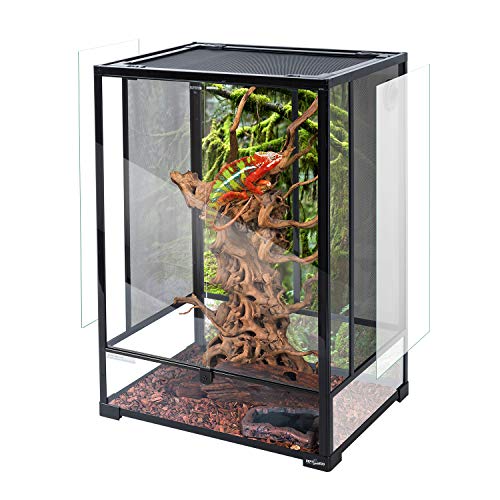
REPTI ZOO 18" × 18" × 24" Reptile Terrarium
This spacious terrarium is engineered for larger mourning gecko colonies and advanced bioactive vivarium designs. Constructed with tempered glass and secure features, it provides ample room and stability for complex, planted ecosystems.

Exo Terra Cork Bark Flat and Round
Cork bark is an indispensable element for mourning gecko enclosures, fulfilling their inherent need for climbing and secure hiding. It offers naturalistic textures and shapes vital for both daily activity and successful egg-laying.
Frequently Asked Questions
A single mourning gecko needs a minimum 10-gallon tall enclosure, but a 12" × 12" × 18" front-opening terrarium is the recommended starting point. For groups of 3–5 geckos, upgrade to an 18" × 18" × 24" vivarium. Always prioritize height over floor space — mourning geckos are arboreal climbers.
References & Sources
- https://reptifiles.com/mourning-gecko-care/
- https://reptifiles.com/mourning-gecko-care/mourning-gecko-vivarium-size/
- https://reptifiles.com/mourning-gecko-care/decorating-mourning-gecko-vivarium/
- https://reptifiles.com/mourning-gecko-care/mourning-gecko-substrate/
- https://www.thebiodude.com/blogs/gecko-caresheets/mourning-gecko-bioactive-care-and-maintenance?srsltid=AfmBOopWHgCAKuw5ooligPBkog8NdFQHi0t7xYIhKxkfT9f3R17FjPQs
- https://dubiaroaches.com/blogs/gecko-care/how-to-care-for-your-mourning-gecko?srsltid=AfmBOooblrd3yUrwG4slXu7N_DmU25w5LuWCJjR1aylR65mizX_Rg2c3
Related Articles

Best 4x2x2 Reptile Enclosure: Top Picks & Reviews 2026
Find the best 4x2x2 reptile enclosure for your pet. We compare PVC, wood, and hybrid options from Zen Habitats, Kages, and more — with honest pros and cons.

Best Plants for Your Chameleon Enclosure: A Krawlo Guide
Discover the best plants for your chameleon enclosure, from safe live options to essential faux choices. Create a thriving, natural habitat with our expert guide.

Finding the Best Chameleon Enclosure: A 2026 Guide
Choosing the best chameleon enclosure is key to a healthy pet. This guide covers the top picks for size, material (screen vs. glass), and setup for 2026.