Best Gargoyle Gecko Lighting: Complete Setup Guide
Find the best gargoyle gecko lighting for a healthy, thriving gecko. Covers UVB needs, heat sources, schedules, and top product picks for every setup.


This article contains affiliate links. If you make a purchase through these links, we may earn a small commission at no extra cost to you. See our affiliate disclosure for details.
We recommend 3 picks here. Our top choice is the Arcadia T5 HO 6% Forest UVB — check price and availability below.
How we choose: we compare published specifications against the care requirements in veterinary and species-care literature, and weigh those against what long-time keepers report. We do not test products ourselves and we do not restate Amazon star ratings. The 4 sources behind this article are listed at the bottom.
Quick Comparison
- UVB Output %
- 6%
- Bulb Type
- T5 HO Fluorescent
- Recommended Distance to Gecko
- 10-15 inches
- Coverage Area
- Large/Full
- Replacement Frequency
- Every 12 months
- Best For Enclosure Size
- 18x18x24 and larger
Zoo Med ReptiSun 5.0 T5 HO
- UVB Output %
- 5.0%
- Bulb Type
- T5 HO Fluorescent
- Recommended Distance to Gecko
- 8-12 inches
- Coverage Area
- Large/Full
- Replacement Frequency
- Every 12 months
- Best For Enclosure Size
- 18x18x24 and larger
- UVB Output %
- 5.0%
- Bulb Type
- Compact Fluorescent
- Recommended Distance to Gecko
- 6-8 inches
- Coverage Area
- Limited
- Replacement Frequency
- Every 6 months
- Best For Enclosure Size
- Smaller or minimalist setups
Prices are estimates only. Actual prices on Amazon may vary.
Gargoyle geckos are incredible animals. Their bumpy skin, wide eyes, and easygoing personalities make them one of the most rewarding geckos you can keep. But when it comes to lighting, a lot of owners hit a wall.
Do gargoyle geckos even need a special light? What kind? How bright? These are totally fair questions — and the answers might surprise you.
Here's the short version: gargoyle geckos are crepuscular (most active at dusk and dawn) and come from cool, shaded forest floors in New Caledonia. They don't bask under a blazing sun like a bearded dragon. But they still benefit from low-level UVB and a consistent day/night light cycle.
Get lighting right, and your gecko thrives. Get it wrong, and you'll see sluggish behavior, poor calcium absorption, and a stressed-out animal. Let's walk through everything you need to know.
Do Gargoyle Geckos Need UVB Light?
The short answer: yes — but not much.
For years, keepers raised gargoyle geckos without any UVB at all. Many survived just fine on D3 supplements. But "surviving" and "thriving" aren't the same thing.
Our understanding of reptile UV needs has improved a lot in recent years. We now know that even crepuscular and nocturnal species absorb UV light in the wild — through canopy gaps, during early morning activity, and on bright overcast days. Gargoyle geckos in New Caledonia aren't living in total darkness.
UVB light helps your gecko in several important ways:
- Produces vitamin D3 naturally through the skin
- Improves calcium absorption and bone density
- Supports immune function and natural behavior
- Reduces reliance on powdered supplements
Gargoyle geckos fall into Ferguson Zone 1–2, which means they need low-level UVB exposure. You don't need the scorching desert bulbs you'd use for a uromastyx. A low-percentage T5 HO bulb — like an [Arcadia 6% Forest UVB](https://www.amazon.com/dp/B0CP689GP3?tag=krawlo-20 or a [Zoo Med ReptiSun 5.0](https://www.amazon.com/dp/B00M9ONY1W?tag=krawlo-20 — placed at the right distance is everything they need.
If you keep crested geckos too, our guide on Best UVB Light for Crested Gecko: Ultimate Care Guide covers the same lighting principles — the two species have nearly identical UV requirements.
Best UVB Bulbs for Gargoyle Geckos
Quick recommendations
Excellent UV output, good build quality, widely available
Slightly lower UV output but very consistent performance
Works for smaller enclosures or travel setups, though coverage area is limited
T5 HO vs T8: Which Is Right for Your Setup?
Side-by-side comparison
| Feature | T5 HO | T8 |
|---|---|---|
| UV Output | ★Stronger with deeper penetration | Dimmer with shorter range |
| Best For | Larger enclosures (18×18×24+) with plants & hides | Smaller enclosures or minimalist setups |
| Light Blocking | ★Penetrates through vegetation and hides | Limited penetration through obstacles |
Our Take: T5 HO is the smarter choice for standard and complex setups.
UVB Bulb Distance Reference
T5 HO 6% (Arcadia)
10–15 inches
T5 HO 5.0 (Zoo Med)
8–12 inches
T8 5.0
6–8 inches
Measure from gecko's actual resting spot, not enclosure floor
Light Schedule by Season
Spring/Summer
13 hours light, 11 hours dark
Fall/Winter
11 hours light, 13 hours dark
Year-Round Alternative
12 hours light, 12 hours dark
Steady 12/12 cycle works fine year-round
Detailed Reviews
1. Arcadia T5 HO 6% Forest UVB
Best Overall
Arcadia T5 HO 6% Forest UVB
Pros
- •Excellent UV output
- •Good build quality
- •Widely available
- •Proven effectiveness for vitamin D3 synthesis
Bottom Line
Top pick for most gargoyle gecko keepers. Delivers excellent UV output and build quality for natural vitamin D3 production and proper calcium absorption.
2. Zoo Med ReptiSun 5.0 T5 HO
Zoo Med ReptiSun 5.0 T5 HO
Pros
- •Very consistent performance
- •Solid quality
- •Lower cost than Arcadia
Cons
- •Slightly lower UV output than Arcadia 6%
Bottom Line
Solid alternative with very consistent performance. Slightly lower UV output than Arcadia but reliable vitamin D3 production at a lower price point.
3. Exo Terra Repti-Glo 5.0 Compact
Best for Smaller Setups
Exo Terra Repti-Glo 5.0 Compact
Pros
- •Compact and portable
- •Works for smaller enclosures
- •Budget-friendly
Cons
- •Limited coverage area
- •Not suitable for standard 18x18x24 enclosures
- •Less powerful than T5 HO options
Bottom Line
Compact fluorescent option suitable for smaller enclosures or travel setups. Limited coverage area makes it impractical for standard-sized enclosures.
Natural History: Why Lighting Matters for This Species
Gargoyle geckos (Rhacodactylus auriculatus) are native to the southern end of New Caledonia, a group of islands in the South Pacific. They live in humid subtropical forest, spending their days hidden in leaf litter, tree crevices, and dense vegetation.
At dusk and dawn, they emerge to hunt insects and lap up fruit. During this window, they do encounter ambient UV light — filtered through the forest canopy, but still present.
This background matters because it tells us exactly what to replicate. You're not building a sun-drenched savanna. You're recreating a cool, humid forest with soft, dappled lighting and clear day/night rhythms. Keep that image in mind as you set up your enclosure.
Understanding the Three Types of Light
Before buying anything, it helps to understand what each type of light actually does.
| Light Type | Purpose | Required? |
|---|---|---|
| UVB Fluorescent (T5 HO or T8) | Vitamin D3 production | Strongly recommended |
| Full-spectrum LED / Daylight Bulb | Ambient light, day/night cue | Optional but useful |
| Incandescent or Halogen Basking Bulb | Focused heat point | Not needed |
Gargoyle geckos don't need an intense basking spot. Their preferred daytime temperature range is 72–78°F (22–26°C), and nights can drop into the mid-60s without any issue. That's close to typical room temperature for most homes.
You're not heating a desert. You're maintaining a cool forest — and that changes everything about how you build your lighting rig.
Best UVB Lights for Gargoyle Geckos
T5 HO vs T8: Which Is Right for Your Setup?
T5 HO (High Output) bulbs are the stronger option. They push UV deeper into the enclosure, which matters once you add plants, hides, and cork branches that block light.
T8 bulbs are dimmer and work fine in smaller enclosures or very minimalist setups. If your enclosure is a standard 18×18×24 or larger, T5 HO is the smarter choice.
Recommended UVB Percentages
For gargoyle geckos, stick with 5.0 or 6% UVB bulbs. These are sometimes labeled as "forest" or "tropical" UVB in contrast to higher-output "desert" bulbs (10–12%).
- Arcadia T5 HO 6% Forest: The top pick for many serious keepers. Excellent UV output, good build quality, widely available.
- Zoo Med ReptiSun 5.0 T5 HO: A solid alternative, slightly lower UV output but very consistent performance.
- Exo Terra Repti-Glo 5.0 Compact: Works for smaller enclosures or travel setups, though coverage area is limited.
Positioning and Distance
This is where most people make mistakes. Distance from the bulb to your gecko's highest resting spot matters enormously.
| Bulb Type | Distance from Gecko |
|---|---|
| T5 HO 6% (Arcadia) | 10–15 inches |
| T5 HO 5.0 (Zoo Med) | 8–12 inches |
| T8 5.0 | 6–8 inches |
Always measure to where your gecko actually rests — not the enclosure floor. If your gecko hangs out on a branch 8 inches below the lid, that's your measurement point.
Coverage Area: Leave Room for Shade
This is critical. Don't let UVB cover the entire enclosure. Your gecko needs a UV gradient — bright zones and shaded zones — so it can self-regulate its UV exposure.
Aim for the UVB fixture to cover one-third to one-half of the enclosure. Leave the other half unlit. Provide hides and foliage in the dark zone so your gecko can retreat comfortably.
Bulb Replacement: The Invisible Failure
UVB bulbs stop producing UV long before they stop glowing. This is one of the most common — and most dangerous — mistakes in reptile keeping.
- T5 HO bulbs: Replace every 12 months
- T8 bulbs: Replace every 6 months
- Write the installation date on the bulb with a marker. Don't guess.
A 14-month-old T5 HO might look perfectly bright and white, but it could be delivering almost zero UV radiation. If your gecko has been under a dead bulb, you'll want to revisit your supplement schedule while you wait for D3 levels to recover.
Heat and Lighting: What You Actually Need
Here's an honest take: most gargoyle gecko keepers don't need a dedicated heat lamp at all.
If your home stays between 68–76°F (20–24°C), your gecko is already in its comfort zone. Adding a heat bulb can actually push temperatures too high — remember, these animals start showing heat stress above 80°F.
If your room drops below 65°F at night, you'll want a supplemental heat source. But reach for a ceramic heat emitter (CHE) or deep heat projector (DHP) — not a glowing bulb. These produce infrared heat without light, so they don't disrupt your gecko's sleep or perception of night.
(Estimates only — actual prices on Amazon may vary.) A reliable ceramic heat emitter typically runs $10–$25 and can run on a simple thermostat to keep overnight temps stable without overheating.
Always pair any heat source with a thermostat. Even low-wattage ceramic emitters can overheat a small enclosure if left uncontrolled.
Light Schedule: Your Gecko's Day/Night Cycle
Gargoyle geckos need a consistent photoperiod — a regular on/off rhythm that signals "daytime" and "nighttime." This affects feeding behavior, activity levels, and long-term health.
Recommended schedules:
| Season | Light Hours | Dark Hours |
|---|---|---|
| Spring/Summer | 13 hours | 11 hours |
| Fall/Winter | 11 hours | 13 hours |
You don't have to follow seasonal variation — a steady 12/12 cycle works fine year-round. But mimicking natural seasonal shifts can improve feeding consistency and, if you're breeding, can help trigger natural reproductive cycles.
Use a digital outlet timer to automate your lights. Manual switching is inconsistent, and reptiles respond poorly to unpredictable schedules. A basic timer costs under $15 and removes all the guesswork.
Setting Up Lighting Step by Step
Here's a simple setup guide for a standard 18×18×24 front-opening terrarium:
- Mount a T5 HO UVB strip fixture on top of the mesh screen lid, or inside the enclosure near the top
- Position it over one-half of the enclosure to create a UV gradient
- Confirm the distance from the bulb to your gecko's main perching zone (target 10–12 inches for T5 HO 6%)
- Leave the other half darker — add a hide or dense plant coverage in that zone
- Add a ceramic heat emitter on the warm side only if your ambient temps drop below 65°F
- Connect everything to a timer set for your chosen photoperiod
That's the whole setup. Gargoyle gecko lighting doesn't need to be expensive or complicated.
Common Lighting Mistakes to Avoid
Using a colored heat bulb as the only light source. Red, blue, or "moonlight" bulbs don't produce meaningful UVB and often spike enclosure temps. They're not a substitute for a proper UVB fixture.
Covering the entire enclosure with UVB. Your gecko needs shade. Without a gradient, it can't regulate its UV exposure and may avoid the enclosure's upper half entirely.
Never replacing the UVB bulb. This is the most common silent failure. Mark your bulbs and replace on schedule, not when they burn out.
Running lights 24/7. Geckos need darkness to sleep, regulate hormones, and behave naturally. Always give them 10–13 hours of darkness per day.
Placing a UVB bulb outside a glass enclosure. Standard glass blocks virtually all UVB rays. If the bulb is outside a glass wall or lid, your gecko gets zero benefit. Use a mesh-top terrarium or mount the bulb inside.
Lighting for Juveniles vs Adults
Juvenile gargoyle geckos don't need a different lighting setup — just make sure there's plenty of shade available. Young geckos are more cautious and will hide frequently, so a generous dark zone matters even more than with adults.
Adult females used for breeding benefit especially from consistent UVB exposure. Calcium metabolism is under heavy demand during egg production, and natural D3 synthesis helps offset the need for constant dusting. Our guide on Crested Gecko Care: The Complete Beginner's Guide has more detail on calcium cycling for egg-laying females — the biology overlaps directly with gargoyle geckos.
Quick Reference: Gargoyle Gecko Lighting at a Glance
| Parameter | Recommendation |
|---|---|
| UVB bulb type | T5 HO 6% or 5.0 fluorescent |
| UVB coverage | 1/3 to 1/2 of enclosure |
| Distance from bulb | 10–12 inches to gecko |
| Photoperiod | 11–13 hrs light / rest dark |
| Daytime temperature | 72–78°F (22–26°C) |
| Nighttime temperature | 65–72°F (18–22°C) |
| Bulb replacement | T5 HO: 12 months / T8: 6 months |
| Heat source (if needed) | Ceramic emitter or deep heat projector |
The right lighting setup is one of the highest-leverage investments you can make for your gargoyle gecko's long-term health. Pair it with proper humidity (60–80%), a naturalistic enclosure, and a varied diet, and you've got the foundation for an animal that can live 15–20 years in your care.
Our Final Verdict
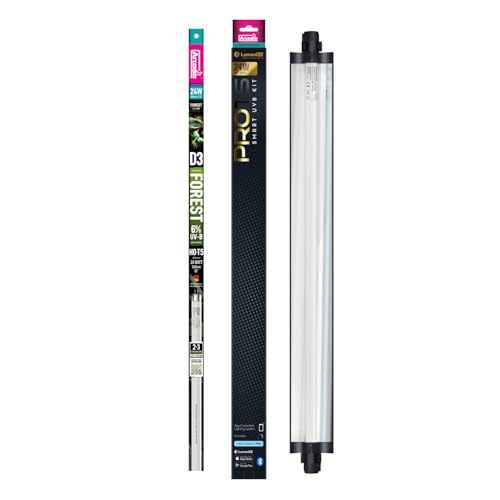
Arcadia T5 HO 6% Forest UVB
Top pick for most gargoyle gecko keepers. Delivers excellent UV output and build quality for natural vitamin D3 production and proper calcium absorption.
Zoo Med ReptiSun 5.0 T5 HO
Solid alternative with very consistent performance. Slightly lower UV output than Arcadia but reliable vitamin D3 production at a lower price point.
Exo Terra Repti-Glo 5.0 Compact
Compact fluorescent option suitable for smaller enclosures or travel setups. Limited coverage area makes it impractical for standard-sized enclosures.
Frequently Asked Questions
Gargoyle geckos don't need high-wattage heat lamps. If your room temperature stays between 68–76°F, no heat lamp is needed at all. For UVB, a standard T5 HO fixture (24W is typical for an 18-inch bulb) is plenty. If supplemental heat is required, a 40–60W ceramic heat emitter is usually sufficient for a 20-gallon enclosure.
References & Sources
- https://www.thebiodude.com/blogs/gecko-caresheets/gargoyle-gecko-care-sheet-and-maintenance?srsltid=AfmBOoqys4D8GTczy4q5_60SYZEjXTJc6WCxOrpiiRdYPvT14UTx8GdC
- https://reptifiles.com/gargoyle-gecko-care-guide/gargoyle-gecko-humidity-temperatures/
- https://dubiaroaches.com/blogs/gecko-care/gargoyle-gecko-care-sheet?srsltid=AfmBOor32c8OpdQJy1ckJKmOFhCVwuFdsQlucWNEt-dIiAzftJprodgP
- https://reptifiles.com/gargoyle-gecko-care-guide/shopping-list/
Related Articles

Best Blue Tongue Skink Lighting: A Complete Guide (2026)
Confused about the best blue tongue skink lighting? Our guide covers everything from UVB percentages (T5 vs T8) to the right heat lamps for a happy, healthy skink.

Best Red Footed Tortoise Lighting: A Complete Guide
Struggling to find the best red footed tortoise lighting? Our expert guide covers UVB, basking heat, and night cycles to prevent MBD and ensure a healthy pet.

Best Pac Man Frog Lighting: A Simple Guide for Keepers
Confused about the best pac man frog lighting? Our guide demystifies UVB, heating, and day/night cycles to ensure your amphibian thrives. Find top picks here!