Best Bearded Dragon Terrarium: A 2026 Keeper's Guide
Searching for the best bearded dragon terrarium? Our expert guide covers the right size, material, and setup to keep your beardie happy and healthy for years.


This article contains affiliate links. If you make a purchase through these links, we may earn a small commission at no extra cost to you. See our affiliate disclosure for details.
We recommend 3 picks here. Our top choice is the Carolina Custom Cages Terrarium (48"x24"x24") — check price and availability below.
How we choose: we compare published specifications against the care requirements in veterinary and species-care literature, and weigh those against what long-time keepers report. We do not test products ourselves and we do not restate Amazon star ratings. The 6 sources behind this article are listed at the bottom.
Quick Comparison
- Product Type
- Glass Enclosure
- Dimensions
- 48" × 24" × 24"
- Heat Retention
- Poor - struggles in cool rooms
- Door Configuration
- Front-opening doors
- Weight & Portability
- Very heavy, difficult to move
- Best For
- Warm climate keepers
- Product Type
- PVC Enclosure
- Dimensions
- 48" × 24" × 24" (4'x2'x2')
- Heat Retention
- Excellent - superior insulation
- Door Configuration
- Front-opening doors
- Weight & Portability
- Lightweight, easy to relocate
- Best For
- All climate/keeper types
- Product Type
- UVB Lighting System
- Dimensions
- Linear T5 HO tube
- Heat Retention
- N/A - supplemental only
- Door Configuration
- Mounted fixture inside tank
- Weight & Portability
- Lightweight, requires fixture
- Best For
- All bearded dragon setups
Prices are estimates only. Actual prices on Amazon may vary.
Welcome to the most important decision you'll make for your bearded dragon. It's not the food they eat or the name you pick—it's their home. Choosing the best bearded dragon terrarium is the foundation for a healthy, happy, and long-lived pet. A proper enclosure isn't just a box; it's a controlled micro-environment that replicates their native Australian habitat.
Think of it this way: your dragon will spend nearly its entire life inside this space. It needs to be large enough for exercise, provide a proper temperature gradient to regulate body temperature, and offer security to prevent stress. Cutting corners on the enclosure is one of the most common and damaging mistakes new keepers make.
In this guide, we'll walk you through everything you need to know. We'll cover why size is non-negotiable, compare the most common materials like glass and PVC, and explain the essential components you need to turn an empty tank into a thriving dragon palace. Let's build the perfect home for your scaly friend.
Why Terrarium Size Matters More Than You Think
If there's one thing to take away from this guide, it's this: go big or go home. While that tiny baby dragon might look lost in a huge tank, it will grow incredibly fast. A small tank is not only a wasted investment but is actively detrimental to your dragon's health.
A large terrarium is essential for three key reasons:
-
Thermoregulation: Bearded dragons are cold-blooded (poikilothermic), meaning they rely on external sources to regulate their body temperature. A large enclosure allows you to establish a proper temperature gradient, with a hot basking spot on one end (around 100-105°F) and a cool zone on the other (75-80°F). In a small tank, it's nearly impossible to create this gradient. The entire enclosure becomes too hot, offering no escape and leading to chronic dehydration and heat stress.
-
Exercise and Enrichment: Bearded dragons are surprisingly active lizards. They need space to run, climb, and explore. A cramped environment leads to obesity, lethargy, and stress. Providing ample space is a form of enrichment that encourages natural behaviors and keeps your dragon physically fit.
-
Mental Well-being: Constant confinement in a small space is stressful. This chronic stress can weaken the immune system, making your dragon more susceptible to illness. A properly sized home provides a sense of security and allows them to move freely, which is crucial for their mental health.
Minimum Enclosure Sizes by Age
To keep things simple, here are the modern, science-backed minimums. While you can start a baby in a smaller tank, we strongly recommend starting with the adult-sized enclosure from day one to save money and provide the best possible environment from the start.
| Dragon Age/Size | Minimum Tank Size | Recommended Dimensions | Notes |
|---|---|---|---|
| Baby/Juvenile (<10 inches) | 40 Gallon Breeder | 36" x 18" x 16" | Will be outgrown in 6-8 months. |
| Adult (>10 inches) | 120 Gallons | 48" x 24" x 24" (4'x2'x2') | The widely accepted minimum for a single adult. |
As noted by the experts at ReptiFiles, a 4'x2'x2' enclosure is the accepted standard of care for an adult. It provides the necessary space for a proper heat gradient and adequate room for your dragon to move around.
Tank Size Requirements by Dragon Age
Side-by-side comparison
| Feature | Baby/Juvenile Dragons | Adult Dragons |
|---|---|---|
| Age/Size | <10 inches | >10 inches |
| Minimum Tank Size | 40 Gallon Breeder | ★120 Gallons (Standard) |
| Recommended Dimensions | 36" × 18" × 16" | ★48" × 24" × 24" (4'×2'×2') |
| Timeline | Outgrown in 6-8 months | ★Lifelong enclosure |
Our Take: Start with the adult-sized 4'×2'×2' enclosure from day one to save money and avoid repeated tank upgrades.
Material Comparison: Glass vs. PVC
Side-by-side comparison
| Feature | Glass Terrariums | PVC Enclosures |
|---|---|---|
| Heat Insulation | Poor—struggles in cool rooms | ★Excellent—saves on electricity |
| Weight & Portability | Very heavy, difficult to move | ★Lightweight and portable |
| Stress Levels | Can trigger reflection stress | ★Opaque sides provide security |
| Visibility | ★Excellent from all sides | Limited but reduces stress |
| Upfront Cost | ★Lower | Higher, assembly required |
| Best For | Warm climates only | ★Most keepers |
Our Take: PVC enclosures are superior for heat retention and reducing stress—the ideal choice for nearly all bearded dragon keepers.
Top Terrarium Recommendations
Quick recommendations
Meets size requirements with crucial front-opening doors—ideal for warm climates
Superior heat retention and proven security—highly-regarded option that sets your dragon up for life
Detailed Reviews
1. Carolina Custom Cages Terrarium (48"x24"x24")
Best for Warm Climates
Carolina Custom Cages Terrarium (48"x24"x24")
Pros
- •Excellent visibility from all sides
- •Easy to clean and sterilize
- •Front-opening doors for stress-free access
- •Meets minimum adult size requirement
Cons
- •Very heavy and difficult to move
- •Poor heat insulation - struggles to stay warm in cool rooms
- •Reflective surfaces can cause stress from self-reflection
Bottom Line
Glass enclosure with front-opening doors meeting the critical 4'x2'x2' adult size requirement. Excellent visibility and easy to clean, but poor heat insulation makes it best suited for keepers in warm climates.
2. Dubia.com 4'x2'x2' PVC Reptile Enclosure
Best Overall
Dubia.com 4'x2'x2' PVC Reptile Enclosure
Pros
- •Fantastic heat retention saves electricity costs
- •Lightweight and easy to move
- •Opaque sides and back help dragon feel secure and reduce stress
- •Quickly becoming the top choice for serious keepers
Cons
- •More expensive upfront than glass
- •Usually requires assembly
- •Primarily sold through specialty online retailers
Bottom Line
Premium PVC enclosure that sets the standard for serious keepers. Superior heat retention, lightweight design, and stress-reducing opaque sides make it the ideal all-around choice for bearded dragon keeping.
3. Zoo Med ReptiSun 10.0 UVB T5 HO Lamp
Essential
Zoo Med ReptiSun 10.0 UVB T5 HO Lamp
Pros
- •High-output UVB radiation (10.0 rating)
- •Linear T5 HO tube design
- •Spans approximately 2/3 of enclosure length for optimal coverage
- •Widely recommended as arguably the most important piece of equipment
Cons
- •Requires replacement every 6-12 months as UVB output degrades
- •Requires proper fixture mounting inside terrarium
- •Requires dimming thermostat for control
Bottom Line
High-output UVB fluorescent lamp essential for all bearded dragons. Provides critical UV radiation for vitamin D3 synthesis and calcium absorption - absolutely mandatory to prevent Metabolic Bone Disease.
How to Choose the Best Bearded Dragon Tank?
Now that you understand the importance of size, let's look at the different types of terrariums available. The main factors to consider are the material, the door orientation, and ventilation.
Material: Glass vs. PVC vs. Wood
There's no single "perfect" material, as each has its pros and cons. Your choice will depend on your budget, your home environment, and your personal preference.
Glass Terrariums
Glass tanks are what most people picture when they think of a reptile enclosure. They are widely available at pet stores and online.
- Pros: Excellent visibility from all sides, holds humidity well (though beardies need a dry environment), easy to clean and sterilize.
- Cons: Very heavy and difficult to move, poor heat insulation (can struggle to stay warm in a cool room), and the reflective surfaces can sometimes cause stress if a dragon sees its own reflection.
- Best For: Keepers in warmer climates where heat loss is less of a concern. A great choice is the [Carolina Custom Cages Terrarium (48"x24"x24")](https://www.amazon.com/dp/B0738L5GNR?tag=krawlo-20 which meets the size requirement and has crucial front-opening doors.
PVC Enclosures
These enclosures are made from a durable, lightweight plastic. They are quickly becoming the top choice for serious keepers.
- Pros: Fantastic heat retention, saving you money on electricity. Lightweight and easy to move. The opaque sides and back help the dragon feel more secure and reduce stress.
- Cons: Can be more expensive upfront, usually require assembly, and are primarily sold by specialty online retailers.
- Best For: Almost everyone. Their superior heat management and security make them an ideal choice. The [Dubia.com 4'x2'x2' PVC Reptile Enclosure](https://www.amazon.com/dp/B0F7X4MTXX?tag=krawlo-20 is a popular and highly-regarded option that sets your dragon up for life.
Wood / Melamine Enclosures
Wood enclosures are often a path for the DIY-savvy keeper, but they can also be purchased pre-made.
- Pros: Excellent insulation, often customizable, and can be built to very large specifications.
- Cons: MUST be thoroughly sealed with a non-toxic, waterproof sealant. If not sealed, the wood will absorb moisture and waste, leading to bacteria growth and rot. They are also extremely heavy.
- Best For: Experienced keepers or those with strong DIY skills who can ensure the enclosure is built and sealed to a high standard.
Front-Opening vs. Top-Opening Doors
This is a simple choice: always get a terrarium with front-opening doors.
In the wild, predators like birds attack bearded dragons from above. When your giant hand reaches in from the top of a tank, it triggers their instinctual fear response. This can make handling and taming a stressful experience. Front-opening doors allow you to approach your dragon from the side, on their level. This is far less threatening and builds trust.
Furthermore, from a practical standpoint, accessing the enclosure for feeding, spot cleaning, and maintenance is significantly easier with front doors. You won't have to move fragile lighting and heating fixtures every time you need to get inside.
Ventilation
Proper airflow is critical to prevent stagnant air and respiratory infections. A good terrarium will have vents that allow for cross-ventilation, typically with vents on the front and back, or on the sides. Glass tanks often have a screen top, which provides ample ventilation but can also let too much heat and humidity escape. PVC enclosures usually have strategically placed vents that offer a good balance of airflow and insulation.
Setting Up Your New Terrarium: The Essentials
An empty tank is just the beginning. You need to equip it with the right gear to create a healthy habitat. This includes substrate, lighting, heating, and decor.
Substrate: The Foundation of Your Enclosure
Substrate is the material that lines the bottom of the tank. This is a hotly debated topic, but safety should always be the priority. For young dragons, it's best to use a solid, non-particle substrate like paper towels, butcher block paper, or textured tile to eliminate any risk of ingestion (impaction).
For adults, you have more options. While there are many choices, selecting the right one is vital for your dragon's health and the enclosure's cleanliness. For a complete analysis of safe and unsafe options, check out our comprehensive guide on the best bedding for bearded dragons. Many keepers are now creating bioactive setups with a soil/sand/clay mix, which allows for a more naturalistic environment, as championed by experts like The Bio Dude.
Lighting and Heating: Creating the Perfect Basking Spot
This is the most technical part of your setup, but it's non-negotiable. Your dragon needs two specific types of light to thrive:
- A Basking Heat Lamp: This provides a concentrated spot of heat for your dragon to bask and digest its food. You'll need a dimming thermostat to ensure the basking surface temperature stays consistent.
- A High-Output UVB Light: This is arguably the most important piece of equipment. Bearded dragons need UVB radiation to synthesize vitamin D3, which allows them to absorb calcium. Without it, they will develop Metabolic Bone Disease (MBD), a painful and crippling condition. The bulb must be a linear (tube) fluorescent light, like the [Zoo Med ReptiSun 10.0 UVB T5 HO Lamp](https://www.amazon.com/dp/B07PNK42W8?tag=krawlo-20 that spans about 2/3 of the enclosure's length. It should be mounted inside the terrarium for maximum effectiveness.
Getting the temperature and lighting perfect is an art, and the right equipment makes all the difference. We dive deep into this topic in our guide to the best heat lamp for a bearded dragon.
Furnishing and Enrichment: Make it a Home
Decor isn't just for looks; it's for enrichment. Your terrarium should be a stimulating environment.
- Basking Platform: A flat, stable surface like a large rock or a piece of slate placed directly under the basking lamp.
- Hides: You need at least two—one on the warm side and one on the cool side—so your dragon can hide and feel secure without having to sacrifice thermoregulation.
- Climbing Structures: Sturdy branches, logs, and even hammocks provide excellent opportunities for climbing and exercise. Ensure anything you use is secure and won't fall and injure your pet.
- Food and Water Bowls: Provide a shallow water dish and a separate bowl for greens and insects.
A bored dragon is an unhappy dragon, so don't forget to add some fun! You can find great ideas in our article on the best toys for bearded dragons, which explores safe and stimulating options for your pet.
Our Final Verdict
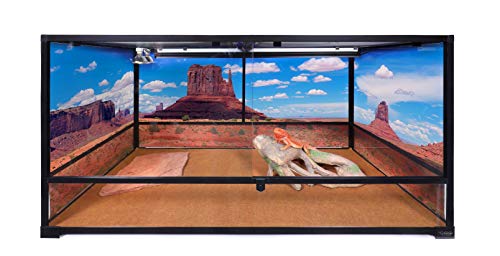
Carolina Custom Cages Terrarium (48"x24"x24")
Glass enclosure with front-opening doors meeting the critical 4'x2'x2' adult size requirement. Excellent visibility and easy to clean, but poor heat insulation makes it best suited for keepers in warm climates.

Dubia.com 4'x2'x2' PVC Reptile Enclosure
Premium PVC enclosure that sets the standard for serious keepers. Superior heat retention, lightweight design, and stress-reducing opaque sides make it the ideal all-around choice for bearded dragon keeping.

Zoo Med ReptiSun 10.0 UVB T5 HO Lamp
High-output UVB fluorescent lamp essential for all bearded dragons. Provides critical UV radiation for vitamin D3 synthesis and calcium absorption - absolutely mandatory to prevent Metabolic Bone Disease.
Frequently Asked Questions
The best terrarium for an adult bearded dragon is a front-opening PVC or glass enclosure that is at a minimum 120 gallons, which typically measures 4 feet long, 2 feet wide, and 2 feet tall (4'x2'x2'). This size is essential for providing a proper temperature gradient and adequate space for exercise.
References & Sources
- https://www.thebiodude.com/blogs/lizard-caresheets/bearded-dragon-bioactive-care-and-maintenance?srsltid=AfmBOorYlvr8gZq8yu5r6-AKuttYv1vJVX2vRQPXYf_dlipqasrghWj2
- https://www.petmd.com/reptile/bearded-dragon-care-sheet
- https://reptifiles.com/bearded-dragon-care/bearded-dragon-terrarium-size/
- https://www.thesprucepets.com/best-bearded-dragon-supplies-4155661
- https://reptifiles.com/bearded-dragon-care/bearded-dragon-substrate-housing/
- https://reptifiles.com/bearded-dragon-care/bearded-dragon-decorations-ideas/
Related Articles

Best Bearded Dragon Accessories: Complete Setup Guide
Discover the best bearded dragon accessories for a thriving enclosure — basking platforms, hides, hammocks, climbing décor, and expert design tips for every budget.

Best Bearded Dragon Starter Kit (2026): What You Really Need
Find the best bearded dragon starter kit in 2026. We break down what's worth buying, what to skip, and exactly what your beardie needs to thrive.

Best UVB Light for Bearded Dragon (2026 Keeper's Guide)
Find the best UVB light for your bearded dragon in 2026. T5 vs T8, wattage, placement, and top picks reviewed by reptile care specialists.